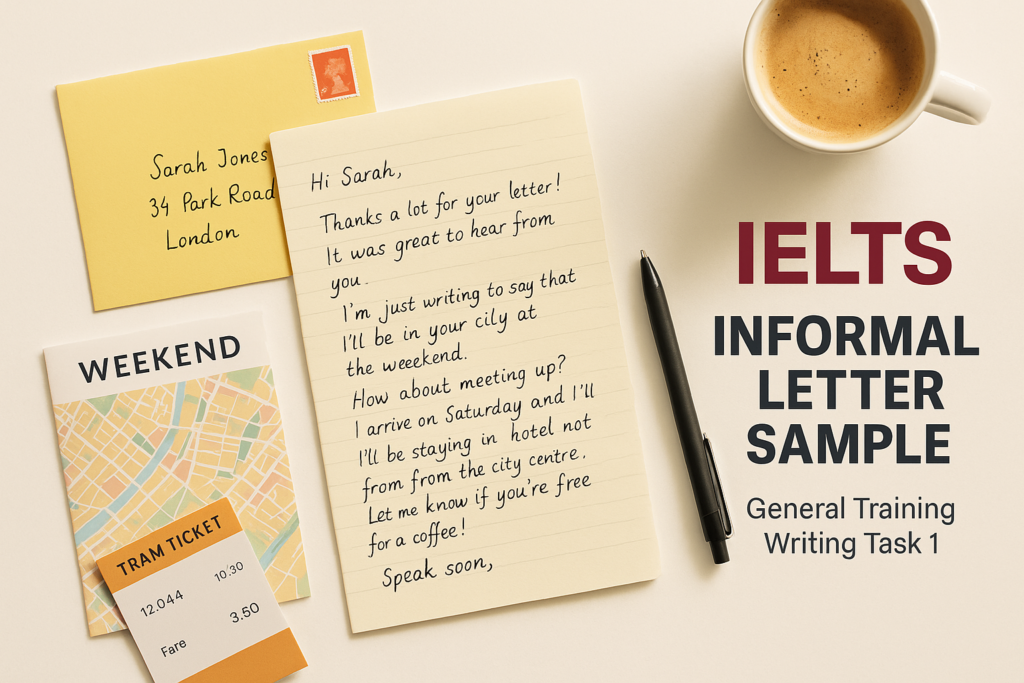
An IELTS General Training Writing Task 1 informal letter sample is most useful when you can see why the answer works, not just copy its phrases. In this guide, you will work through a realistic question, a clear plan and a complete model response. You will also learn how to sound friendly without becoming careless. If you are unsure of your current level, the IELTS Express Pre-Test can give you a personalised band prediction before you begin a longer study plan.
Informal letters are usually written to someone you know well, such as a friend, relative or close colleague. The language should sound warm and natural, but the response still needs accurate grammar, logical paragraphs and full coverage of every bullet point. That combination is where many candidates lose marks.
What Makes A Letter Informal In IELTS?
The relationship in the prompt decides the tone. If you are writing to a close friend, you can use contractions such as “I’m”, “you’ll” and “we’ve”. You can also use direct questions, friendly expressions and personal details. A natural opening might be “It was great to hear from you” or “Thanks for offering to help”.
Informal does not mean slang-filled or disorganised. Avoid text-message abbreviations such as “u”, “thx” or “BTW”. You are still completing an English test. Aim for the kind of language you would use in a thoughtful email to a friend: relaxed, clear and easy to follow.
- Use the person’s first name.
- Use contractions where they sound natural.
- Include personal reactions and friendly questions.
- Organise the letter into clear paragraphs.
- End with an informal sign-off and your first name.
The Informal Letter Question
Here is the practice task used for the model answer:
You are going to spend a weekend in a city where your friend lives. Write a letter to your friend. In your letter, explain why you are visiting the city, say what you would like to do during the weekend, and ask if you can stay at your friend’s home.
You should write at least 150 words. You do not need to write any addresses. Begin your letter with “Dear …”.
This is clearly informal because the recipient is a friend. The three bullet points create three content jobs. Your answer must explain the reason for the visit, describe your preferred activities and make the accommodation request. Missing or barely developing one of these points can reduce Task Achievement.
A Simple Four-Minute Plan
Before writing, turn each bullet point into two or three notes. For the reason, you might choose a Saturday professional workshop. For the activities, you could suggest dinner, a harbour walk and a Sunday market. For the request, decide which nights you need, acknowledge that your friend may be busy and offer an easy alternative.
Then put the notes into a logical sequence. Paragraph one gives the purpose of the letter. Paragraph two explains the visit. Paragraph three suggests weekend plans. Paragraph four asks about staying and closes warmly. This takes only a few minutes and prevents you from remembering the final bullet point when time is nearly gone.
If you want to compare this tone with a less familiar relationship, study the recent IELTS semi-formal letter sample. The basic organisation is similar, but the greeting, requests and sign-off are more measured.
Band 7-Style Informal Letter Sample
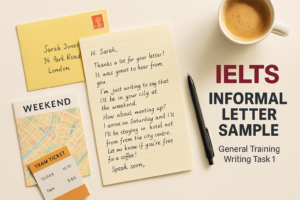
Dear Maya,
How are things? I’ve got some good news: I’ll be in Melbourne on the weekend of 17 October, and I’d love to catch up with you while I’m there.
The main reason for my visit is a one-day training workshop on Saturday. My company is sending me to learn about a new project-management system, so I’ll be tied up from about nine until four. It should be useful, although spending a Saturday in a conference room is not exactly my idea of fun!
Once the workshop finishes, perhaps we could have dinner somewhere near the river. You mentioned a small Thai place last time we spoke, and I’m still keen to try it. On Sunday, I’d love to visit the Queen Victoria Market and take a walk through the gardens if the weather is decent. Of course, I’m happy to go along with any better ideas you have.
I was also wondering whether I could stay at your place on Friday and Saturday night. Please don’t feel under any pressure if the timing is inconvenient; I can easily book a hotel nearby. If it is all right, I’ll bring my sleeping bag and make breakfast on Sunday to say thanks.
Let me know what you think. I’m really looking forward to seeing you.
All the best,
Daniel
Why This Sample Works
The opening immediately establishes a friendly relationship and explains the purpose. It does not waste words on a memorised introduction. The reason for travelling is then developed with specific details: the type of workshop, the day, the approximate hours and a light personal comment.
The activities paragraph does more than list two places. It connects a restaurant to an earlier conversation, proposes a time and leaves space for the friend’s ideas. The accommodation request is polite but not formal. “I was also wondering whether I could stay” softens the request, while the offer to book a hotel removes pressure.
The answer also uses a useful range of grammar naturally. It includes future forms, conditionals, relative clauses and complex sentences, yet it remains easy to read. Strong IELTS writing is controlled rather than complicated for its own sake. To practise this balance under realistic timing, access unlimited IELTS mock tests and review whether your tone stays consistent when the clock is running.
How To Cover Every Bullet Point Fully
A common weak approach is to write one sentence for each bullet point. That technically mentions the task, but it rarely explains enough. A stronger method is “answer, detail, effect”. First answer the bullet directly. Then add a concrete detail. Finally, show why the detail matters or invite a response.
For example, “I’m visiting for a workshop” answers the first bullet. Adding that the employer arranged it and that it runs from nine until four develops the idea. The comment about being stuck in a conference room adds personality. Each detail has a purpose; none feels like padding.
After writing, underline the sentence that answers each bullet. If you cannot identify one quickly, the examiner may also struggle to see that you have completed the task. This quick check is more valuable than replacing simple words with unusual vocabulary.
Useful Informal Phrases That Sound Natural
Learn functions rather than memorising an entire letter. For an opening, try “How have you been?”, “Thanks for your message” or “I’ve been meaning to write”. To introduce news, use “I’ve got some good news” or “You’ll never guess what happened”. To suggest a plan, use “How about…?”, “Perhaps we could…” or “Would you be up for…?”.
For a request, “I was wondering if…” is friendly and tactful. For reassurance, use “No worries if that doesn’t work” or “Please don’t feel under any pressure”. Natural closing lines include “Let me know what you think”, “Can’t wait to see you” and “Write back when you get a chance”.
Do not force several idioms into every paragraph. Expressions such as “over the moon” can work in the right situation, but too many memorised phrases make the letter sound unnatural. Clear, personal language is usually more convincing.
Common Mistakes In Informal Letters
The first mistake is choosing a formal tone for a close friend. Phrases such as “I am writing to enquire” and “I would be grateful if you could” create unnecessary distance. The opposite mistake is becoming so casual that sentences are incomplete or punctuation disappears.
Another problem is copying the task wording. Paraphrase it through personal detail instead. Do not simply write, “I am writing to explain why I am visiting the city.” Tell the friend the actual reason. Candidates also lose control when they use one enormous paragraph. A new paragraph for each content purpose makes the response easier to follow.
Finally, watch the sign-off. “Yours faithfully” belongs in a formal letter to an unnamed recipient. “Best wishes”, “Take care”, “All the best” or “See you soon” are safer choices for a friend. For a direct contrast, review the latest IELTS formal letter sample and notice how the social distance changes the language.
Vocabulary And Grammar For A Higher Band
Vocabulary should be accurate and appropriate to the relationship. In the model, phrases such as “tied up”, “catch up”, “keen to try” and “go along with” sound natural in a friendly letter. They are not obscure. Their value comes from fitting the situation precisely.
Grammar range matters, but accuracy matters too. Mix short direct sentences with longer ones. A conditional such as “If it is all right, I’ll bring my sleeping bag” is useful because it communicates a real condition. A relative clause can add detail without beginning another sentence. Use these structures to express meaning, not to display a checklist.
Leave three minutes to check verb tense, articles, subject–verb agreement and sentence boundaries. Also check names and dates. A polished letter with slightly simpler grammar is stronger than an ambitious response filled with avoidable errors.
Timing And Word Count Strategy
Task 1 should take about 20 minutes because Task 2 carries more weight. Spend roughly four minutes planning, thirteen minutes writing and three minutes checking. Aim for about 170 to 200 words. There is no official maximum, but writing far beyond 200 words uses time you need for the essay and creates more opportunities for mistakes.
Do not count every word during the test. Learn the average number of words you write per line or paragraph during practice. Four well-developed paragraphs plus a greeting and sign-off will usually put you safely above 150 words.
For structured guidance across all parts of the exam, Career Wise English offers practical preparation built around real test demands. The key for this task is to practise several relationship types, not just repeat one favourite letter.
Your Final Informal Letter Checklist
Before moving to Task 2, confirm that the reader is someone you know well and that your tone matches that relationship. Check that every bullet point has been answered and developed. Make sure the purpose appears early, the paragraphs follow a logical order and the request is clear.
- At least 150 words
- A suitable informal greeting and sign-off
- All three bullet points fully developed
- Friendly language without text-message abbreviations
- A mix of accurate sentence structures
- Two or three minutes used for proofreading
Most importantly, read the letter once as the friend receiving it. Does it sound like a genuine message with useful details, or like a memorised template? The best informal answers feel personal while remaining controlled.
Ready to find out your IELTS band score?
Take the IELTS Express Pre-Test for just $4.99 and get your personalised band prediction with a 14-day improvement plan.
FAQ: IELTS General Training Informal Letters
How should I start an informal IELTS letter?
Use “Dear” followed by the person’s first name. Begin with a natural friendly line, then state why you are writing. Avoid a formal phrase such as “I am writing to enquire” when the recipient is a close friend.
Can I use contractions in IELTS General Training Task 1?
Yes. Contractions such as “I’m”, “we’ll” and “don’t” are appropriate in an informal letter and help create a natural tone. They are usually less suitable in a formal complaint or official request.
How many paragraphs should an informal letter have?
Four or five short paragraphs usually work well: an opening and purpose, one paragraph for each main content area, and a brief closing. The exact number matters less than clear organisation.
Do I need to write an address?
No. IELTS instructions tell you that addresses are not required. Begin with the greeting and use your time to develop the three bullet points.
What happens if my letter is under 150 words?
An answer under 150 words may not develop the task sufficiently and can be penalised. Practise writing roughly 170 to 200 words so you have a comfortable margin without using too much Task 2 time.