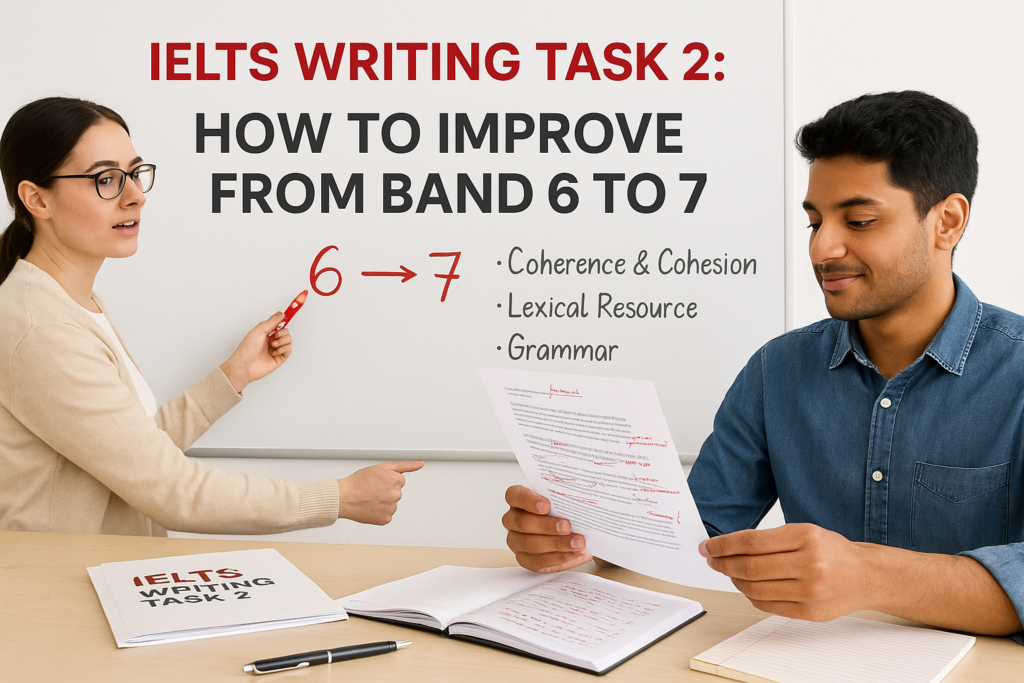
If you want to know how to improve IELTS Writing Task 2 from band 6 to 7, the answer is usually not to learn harder vocabulary or write longer essays. Most Band 6 candidates already understand the basic essay format. The real problem is that the answer is sometimes too general, the ideas are not developed enough, grammar errors keep interrupting meaning, or the position changes slightly from paragraph to paragraph. Before you build a new study plan, take the IELTS Express Pre-Test to check your current writing band and find out which part of your essay is keeping you at Band 6.
Band 7 is not perfect writing. You can still make small grammar mistakes. You can still use some simple vocabulary. What changes is control. A Band 7 essay answers the question directly, develops ideas with clear explanation, uses paragraphs logically, and shows enough range without becoming confusing. Your goal is not to impress the examiner. Your goal is to make the examiner feel that your argument is easy to follow and mature enough for the score you want.
Why Many Task 2 Essays Stay At Band 6
A Band 6 essay often has a clear overall idea, but it does not fully satisfy the task. The candidate may answer part of the question and ignore another part. For example, if the question asks for causes and solutions, the essay may spend too much time describing causes and only add one weak solution at the end. If the question asks to what extent you agree or disagree, the position may look clear in the introduction but become less clear in the body paragraphs.
Another common Band 6 pattern is thin development. The candidate writes a relevant topic sentence, but then repeats the same idea in different words. Band 7 needs explanation, support, and a logical reason why the idea matters. You do not need a dramatic example. You need a complete thought.
- The essay answers the topic but not the exact task.
- Main ideas are relevant but underdeveloped.
- Paragraphs contain several small points instead of one clear argument.
- Grammar errors sometimes make meaning less precise.
- Vocabulary is either too simple in key places or too forced.
Understand What Band 7 Really Means
Band 7 means the examiner can see a clear answer to the question, a logical progression of ideas, and enough language control to communicate with flexibility. It does not mean every sentence must be complex. In fact, many candidates stay at Band 6 because they try to write complicated sentences before they can control simple ones.
For Writing Task 2, you need to think across four areas: Task Response, Coherence and Cohesion, Lexical Resource, and Grammatical Range and Accuracy. A weak score in one area can hold down the final writing band. That is why studying only vocabulary lists rarely works. If your position is unclear, better vocabulary will not fix the essay. If your paragraphs are not developed, memorised linking words will not fix the essay either.
For a deeper breakdown of how writing is judged, compare your essays against the IELTS Writing Task 2 band score guide. It will help you see whether your main problem is ideas, organisation, grammar, or vocabulary.
Upgrade Task Response First
Task Response is often the fastest place to gain marks because it depends on thinking before writing. Spend the first five minutes analysing the question. Identify the topic, the instruction, the number of parts, and the position you will take. If the task says discuss both views and give your own opinion, you must discuss both views and make your opinion clear. If it says advantages and disadvantages, do not write only about benefits.
A Band 7 answer has a position that stays stable. You can be balanced, but balanced does not mean vague. For example, you can write that online learning is useful for flexibility, but traditional classrooms are still better for younger students who need supervision. That position is balanced and clear. A weak answer says online learning is good in some ways and bad in other ways, then never decides what the writer actually believes.
- Underline the instruction words before planning.
- Decide your position before writing the introduction.
- Make every body paragraph support that position.
- Answer all parts of the task, not only the easiest part.
- Use the conclusion to confirm your answer, not introduce a new idea.
Build Paragraphs That Actually Develop Ideas
To move from Band 6 to Band 7, your body paragraphs need more depth. A useful structure is: topic sentence, explanation, example or support, result, and link back to the question. The topic sentence tells the examiner the point. The explanation shows why it is true. The example makes it concrete. The result explains why it matters.
Here is a weak Band 6-style idea: Technology is useful because students can study online and it is convenient. The idea is relevant, but it is thin. A stronger Band 7-style development would explain that online platforms allow students in rural areas or full-time work to access lessons without travelling, which can make education more flexible and affordable. The idea is not more difficult. It is simply more complete.
If you need to practise this under realistic timing, use unlimited IELTS mock tests and write several essays with strict 40-minute limits. Timed practice shows whether your paragraph development survives exam pressure.
Use A Safer Four-Paragraph Essay Structure
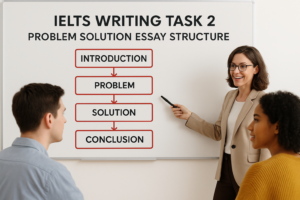
For most candidates, a four-paragraph structure is the safest route to Band 7: introduction, body paragraph one, body paragraph two, and conclusion. This gives you enough space to develop two main ideas properly. Five paragraphs can work, but many Band 6 candidates use three body paragraphs and then underdevelop all of them.
Your introduction should paraphrase the question and give your position. Body paragraph one should present one main argument. Body paragraph two should present a second main argument, a contrasting view, or a solution, depending on the question type. The conclusion should summarise your final answer in a direct way.
- Introduction: answer the question and state your position.
- Body 1: develop the first main idea fully.
- Body 2: develop the second main idea fully.
- Conclusion: confirm your answer without adding new evidence.
Improve Grammar By Reducing Risk
Many Band 6 candidates believe they need more complex grammar, but the first step is often reducing avoidable errors. If your sentences are too long, punctuation errors and agreement mistakes become more likely. If your clauses are not controlled, the meaning becomes unclear. Band 7 grammar is about range and accuracy together.
Use a mix of sentence types. Write some short sentences for clarity. Use complex sentences when the relationship between ideas is clear, such as cause, contrast, condition, or result. For example: Although online learning is flexible, it may not suit young students who need close supervision. That sentence is useful because the grammar supports the argument.
After each practice essay, check for repeated errors. Do you forget articles such as a, an, and the? Do you make subject-verb agreement mistakes? Do you overuse commas? Fixing three repeated errors can improve your score faster than memorising ten new structures.
Upgrade Vocabulary Without Sounding Forced
Band 7 vocabulary is accurate and flexible. It is not a list of rare words. Examiners do not reward a word just because it is long. They reward vocabulary that fits the topic and the sentence. If you write children can acquire beneficial knowledge through educational institutions when you mean children can learn useful skills at school, the sentence may sound unnatural.
Build topic vocabulary in groups. For education, learn phrases such as academic pressure, practical skills, equal access, and independent learning. For technology, learn phrases such as digital access, online privacy, automation, and screen time. For health, learn phrases such as public health, balanced diet, preventive care, and sedentary lifestyle.
The best vocabulary improvement comes from rewriting your own sentences. Take a basic sentence and make it more precise, not more dramatic. This habit also helps with grammar because you learn how words naturally fit together.
Plan Each Essay In Five Minutes
A good plan prevents a weak essay. In the exam, use the first five minutes to decide your answer, choose two main ideas, and select one example or explanation for each body paragraph. Do not write a long outline. You only need enough structure to stop yourself drifting halfway through the essay.
For example, if the question asks whether governments should spend more money on public transport, your plan might be: agree because public transport reduces traffic and pollution; however, spending must focus on reliable services rather than expensive projects with little daily benefit. That plan gives you a clear position and two body paragraphs.
- Minute one: identify the question type.
- Minute two: choose your position.
- Minute three: choose body paragraph one.
- Minute four: choose body paragraph two.
- Minute five: prepare one example or result for each paragraph.
Practise With A Band 6 To Band 7 Rewrite Method
One of the most effective ways to improve is to rewrite your own Band 6 essays. Do not simply write a new essay every day and hope the score changes. Take one old essay and improve it in stages. First, rewrite the introduction so the position is clearer. Second, strengthen each topic sentence. Third, add one extra layer of explanation to each body paragraph. Fourth, correct repeated grammar errors. Fifth, replace vague vocabulary with more precise wording.
This method works because it trains the exact skills that Band 7 requires. You learn to see the difference between a relevant idea and a developed argument. You also become more aware of your personal error patterns. If you want guided support and a plan matched to your target score, see our IELTS preparation plans.
Common Mistakes That Stop Band 7
The first mistake is memorising whole essays. Memorised writing often fails because the real question is slightly different. The examiner can also notice unnatural phrases that do not fit the task. It is better to memorise flexible argument patterns and topic vocabulary.
The second mistake is writing too many ideas. A Band 7 essay usually has two main ideas that are well developed. Four weak ideas are not better than two strong ones. If every paragraph feels rushed, reduce the number of points and explain the best ones properly.
The third mistake is ignoring feedback. Many candidates keep practising the same way even after receiving the same correction many times. If your teacher repeatedly says your examples are too general, make examples your focus for the next week. If your grammar errors are mostly sentence endings, make sentence control your focus.
A 14-Day Band 6 To Band 7 Writing Plan
Use a short, focused plan rather than random practice. In the first two days, diagnose your writing by checking two essays against the criteria. From days three to five, practise introductions and positions. From days six to eight, rewrite body paragraphs for stronger development. From days nine to eleven, focus on grammar control and sentence variety. From days twelve to fourteen, write full essays under timed conditions and review them carefully.
During this plan, do not measure progress only by how many essays you write. Measure progress by whether your next essay has a clearer position, stronger paragraph development, fewer repeated grammar errors, and more natural vocabulary. Quality practice beats volume.
For extra model answers and topic practice, use the IELTS Writing Task 2 sample answers page and compare how strong essays introduce a position, develop ideas, and close the argument.
Final Tips Before Your Next Practice Essay
Before your next Task 2 essay, choose one improvement target. Do not try to fix everything at once. If your ideas are weak, focus on paragraph development. If your position is unclear, focus on planning. If grammar mistakes are frequent, write shorter sentences and edit more carefully. Band 7 comes from controlled improvement, not panic study.
Most candidates can improve faster when they stop chasing impressive language and start building examiner-safe essays. Answer the task directly, develop two main ideas, use natural vocabulary, control grammar, and review your mistakes. That is the practical path from Band 6 to Band 7.
Ready to find out your IELTS band score?
Take the IELTS Express Pre-Test for just $4.99 and get your personalised band prediction with a 14-day improvement plan.
FAQ: How To Improve IELTS Writing Task 2 From Band 6 To 7
How long does it take to improve IELTS Writing Task 2 from Band 6 to Band 7?
Many students need two to six weeks of focused practice, depending on their grammar control, feedback quality, and study time. The fastest improvement usually comes from fixing task response and paragraph development first.
Do I need advanced vocabulary to get Band 7 in Writing Task 2?
No. You need accurate and flexible vocabulary. Natural topic phrases used correctly are better than rare words that sound forced or do not fit the sentence.
Can I get Band 7 with some grammar mistakes?
Yes. Band 7 does not require perfect grammar, but errors should not frequently reduce clarity. You need a mix of sentence types and enough accuracy to communicate ideas clearly.
Should I write four or five paragraphs for Task 2?
Four paragraphs is usually safer: introduction, two developed body paragraphs, and conclusion. Five paragraphs can work, but only if each body paragraph is properly developed.
What is the biggest difference between Band 6 and Band 7 essays?
The biggest difference is control. A Band 7 essay answers the exact task, keeps a clear position, develops ideas logically, and uses language accurately enough for the argument to feel smooth.