If you are preparing an IELTS Writing Task 1 Line Graph sample answer, the main skill is not describing every number. It is choosing the biggest changes, grouping similar trends, and writing a clear overview. Before you practise full reports, take the IELTS Express Pre-Test to check your current writing band and see whether Task 1 is holding your overall score down.
Line graphs are common in IELTS Academic Writing Task 1 because they test your ability to describe change over time. You may see one line, two lines, or several lines. The topic might be population, sales, energy use, transport, internet access, tourism, prices, or school enrolments. The topic changes, but the examiner is still looking for the same things: a clear summary, accurate comparisons, logical organisation, and controlled grammar.
What A Line Graph Answer Must Include
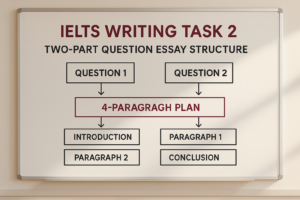
A strong Task 1 line graph answer has four parts. First, paraphrase the question in one sentence. Second, write an overview that summarises the main trends without numbers. Third, describe the most important details in body paragraph one. Fourth, describe the remaining important details in body paragraph two.
The overview is the most important paragraph. If you do not include a clear overview, your Task Achievement score is limited. For a line graph, the overview should usually mention which figures rose, which fell, which stayed stable, and which category finished highest or lowest.
- Do not list every figure from the graph.
- Group lines that follow similar patterns.
- Use approximate language when exact numbers are not necessary.
- Compare starting and ending points where useful.
- Keep the report factual and avoid personal opinion.
IELTS Writing Task 1 Line Graph Sample Question
Here is a realistic Academic Task 1 question:
The line graph shows the percentage of households with internet access in three countries between 2000 and 2020.
Imagine the graph shows Australia rising from 40% to 92%, Canada rising from 50% to 95%, and New Zealand rising from 35% to 90%. All three countries increase steadily, Canada remains slightly ahead for most of the period, and the gap between the countries becomes smaller by 2020.
If you want to practise this under exam pressure, use unlimited IELTS mock tests and write several Task 1 reports with strict timing. Line graphs feel easy until you only have 20 minutes and need to choose details quickly.
Band 7 Sample Answer: Line Graph
The line graph compares the proportion of households with internet access in Australia, Canada, and New Zealand from 2000 to 2020.
Overall, internet access increased significantly in all three countries over the period. Canada had the highest percentage for most years, while New Zealand started with the lowest figure. However, by 2020 the difference between the three countries had become much smaller.
In 2000, about half of Canadian households had internet access, compared with approximately 40% in Australia and 35% in New Zealand. Over the next five years, all three countries recorded steady growth. Canada rose to around 65%, while Australia reached roughly 55%. New Zealand also increased, although it remained slightly behind the other two countries at about 50%.
Between 2005 and 2015, the upward trend continued. Canada climbed from about 65% to nearly 88%, maintaining a small lead over Australia, which rose to approximately 82%. New Zealand experienced a similar increase, reaching around 78% by 2015. In the final five years, growth slowed as all three countries approached very high levels of internet access. By 2020, Canada had reached about 95%, Australia stood at around 92%, and New Zealand was close behind at 90%.
Why This Sample Answer Reaches Band 7
This sample answer reaches a Band 7 style because it has a clear overview, logical paragraphing, and accurate comparisons. It does not describe every single point on the graph. Instead, it groups the data by time period and explains the main pattern: all three countries increased, Canada stayed ahead, and the gap narrowed by the end.
The language is also controlled. The answer uses phrases such as approximately, roughly, around, stood at, rose to, and remained slightly behind. These phrases are useful because Task 1 often requires approximate reporting rather than exact mathematical language.
Best Structure For A Line Graph Report
Use a four-paragraph structure unless the graph is extremely simple. Paragraph one should paraphrase the task. Paragraph two should give the overview. Paragraph three should describe the first major group of data, often the early years or the highest line. Paragraph four should describe the remaining data, often the later years or the lower lines.
For most students, this structure is safer than writing one long body paragraph. It helps the examiner see your organisation clearly. It also stops you from jumping randomly between years and categories.
- Introduction: say what the graph shows.
- Overview: summarise the biggest trends.
- Body 1: describe the first main period or group.
- Body 2: describe the second main period or group.
Useful Vocabulary For Line Graphs
Line graphs need vocabulary for movement and comparison. You do not need rare words. You need accurate verbs and adverbs that match the size and speed of change.
- rose / increased / climbed: use these for upward movement.
- fell / declined / dropped: use these for downward movement.
- remained stable: use this when there is little or no change.
- fluctuated: use this when the figure moves up and down several times.
- reached a peak: use this for the highest point.
- hit a low point: use this for the lowest point.
For more practice with Task 1 language and structure, compare this report with our IELTS Writing Task 1 sample answers. Notice how each answer uses different vocabulary depending on whether the data rises, falls, fluctuates, or stays stable.
Common Mistakes In Line Graph Answers
The first mistake is missing the overview. Some candidates write an introduction and then move straight into numbers. That can make the report look detailed, but it is still weak because the examiner cannot see the main message of the graph.
The second mistake is describing figures in the order they appear without grouping. A graph with three lines and five years can quickly become confusing if you write one sentence for every point. Grouping is a Band 7 habit because it shows that you understand the data, not just copy it.
The third mistake is using dramatic language. Do not write that a percentage rocketed if it only increased slowly. Do not write plummeted if the fall is small. IELTS rewards accuracy. If your Task 1 reports often feel disorganised, review the IELTS Writing Task 1 band score guide and check whether your overview and comparisons are strong enough.
How To Plan A Line Graph In Two Minutes
Spend the first two minutes studying the graph before you write. Find the starting points, ending points, highest line, lowest line, biggest change, and any unusual movement. Then decide how to split the body paragraphs. Usually, you can split by time period or by category.
For example, if all lines rise steadily, body paragraph one can describe the first half of the period and body paragraph two can describe the second half. If one line rises while another falls, body paragraph one can describe the rising line and body paragraph two can describe the falling line.
- Step one: identify the overall trend.
- Step two: find the highest and lowest figures.
- Step three: group similar lines together.
- Step four: choose four to six important numbers.
- Step five: write the overview before detailed body paragraphs.
Line Graph Grammar That Sounds Natural
Line graph answers often use past simple because most graphs show a completed time period. For example, write the figure rose from 40% to 92%. If the graph includes a future projection, use future forms carefully, such as the figure is expected to reach 95%.
Prepositions matter too. Use from for the starting point and to for the ending point. Use by for the amount of change. For example, internet access rose from 40% to 92%, an increase of 52 percentage points. If you need guided correction and a realistic study plan, see our IELTS preparation plans.
Final Tips Before You Write Your Own Report
Before writing your own line graph answer, ask one question: what would a busy reader need to know first? Usually, the answer is the overall direction of change and the main comparison between categories. Put that in the overview. Then select details that support it.
Do not try to sound clever. A clear, accurate report is stronger than a complicated one full of forced vocabulary. Use simple comparisons, accurate numbers, and a logical structure. That is what makes a Task 1 line graph answer feel examiner-safe.
Ready to find out your IELTS band score?
Take the IELTS Express Pre-Test for just $4.99 and get your personalised band prediction with a 14-day improvement plan.
FAQ: IELTS Writing Task 1 Line Graph Sample Answer
How many words should a line graph answer have?
Aim for about 170 to 200 words. You must write at least 150 words, but very long answers often waste time and increase the chance of grammar mistakes.
Do I need an overview for every line graph?
Yes. The overview is essential in Academic Task 1. It should summarise the main trends without listing too many numbers.
Should I describe every number on the graph?
No. Choose the most important figures. Focus on starting points, ending points, peaks, low points, major changes, and useful comparisons.
Can I use bullet points in IELTS Writing Task 1?
No. Write in full paragraphs. Bullet points are useful for planning, but your final answer should be a formal report.
What tense should I use for a line graph?
Use past simple for completed periods, present simple for current facts, and future forms for projections. The dates on the graph should guide your tense choice.