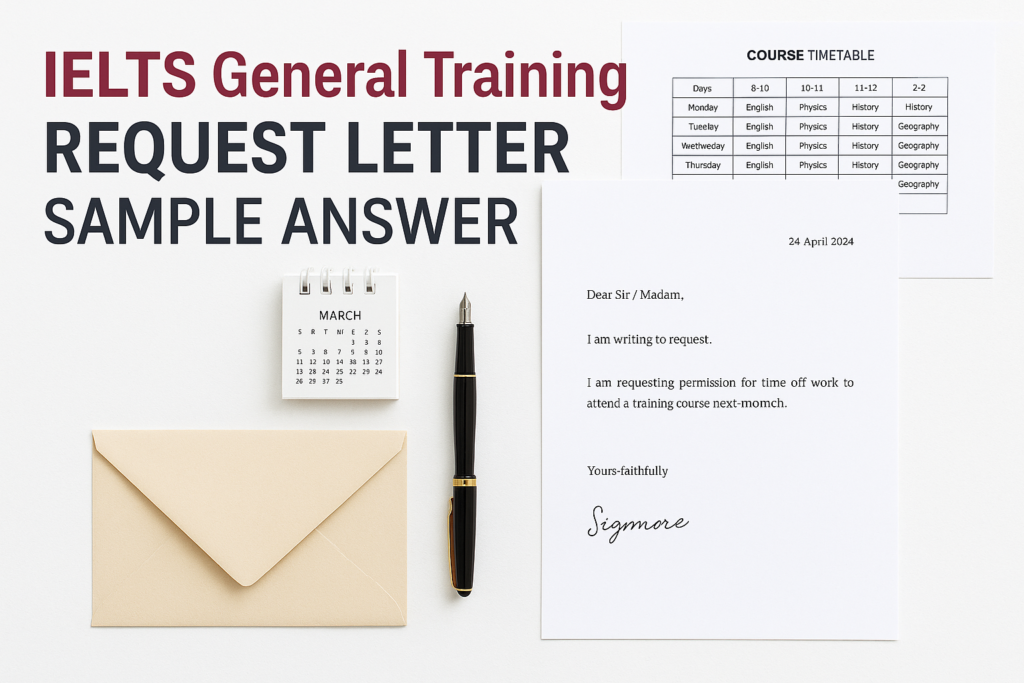
An IELTS General Training request letter sample answer is most useful when you can see why each detail has been included. A strong response does more than ask politely: it identifies the situation quickly, covers every bullet point, uses the right level of formality and makes the requested action easy to understand. If you want a quick benchmark before practising, the IELTS Express Pre-Test gives you a personalised band prediction and a 14-day improvement plan.
This guide uses a realistic semi-formal task and shows how to plan, organise and check the letter. You will also see a complete model answer, useful request phrases and the common mistakes that make an otherwise fluent letter less effective.
Understand The Request Letter Task
In General Training Writing Task 1, you receive a situation and three bullet points. You must write at least 150 words in about 20 minutes. A request may involve asking a manager for time off, asking a landlord to arrange a repair, asking an organisation for information or asking someone you know for help.
Your first decision is the relationship between you and the reader. That relationship determines whether the tone should be formal, semi-formal or informal. A letter to a company you have never contacted is formal. A letter to a manager, teacher or landlord you know is usually semi-formal. A request to a close friend is informal. The request itself does not decide the tone; the reader does.
Task achievement depends on covering all three bullet points clearly. Treat them as required functions, not optional suggestions. If the task asks you to explain a situation, state why you need help and suggest a suitable arrangement, the examiner must be able to find all three elements without searching.
Sample IELTS General Training Request Letter Question
You are taking an evening course at a local college. Because of a change in your work schedule, you cannot attend one class each week. Write a letter to the course coordinator. In your letter:
- explain the change in your circumstances
- say why you want to continue the course
- ask whether another arrangement is possible
This is a semi-formal letter. You know the coordinator in a professional context, but the relationship is not personal. A greeting such as “Dear Ms Taylor” and a closing such as “Yours sincerely” are appropriate. Contractions and highly casual expressions would be less suitable.
Before writing, convert each bullet point into one plain answer. For example: my roster has changed; the course is important for a promotion; could I attend Tuesday’s class or receive the missed materials? Those three answers become the centre of the body paragraphs.
A Simple Four-Paragraph Plan
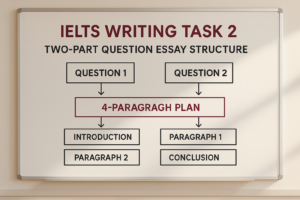
A reliable plan prevents repetition and makes the purpose visible from the beginning. You do not need a long introduction or a separate address block. Start with the greeting, then organise the content into four short paragraphs.
- Paragraph 1: state why you are writing and identify the course.
- Paragraph 2: explain the change in your work schedule and its effect.
- Paragraph 3: explain why continuing the course matters to you.
- Paragraph 4: make a specific request and offer practical alternatives.
The final paragraph should make it easy for the reader to respond. “Please help me” is polite but vague. “Would it be possible for me to join the Tuesday class, or otherwise receive the Wednesday materials by email?” gives the coordinator two workable options.
Once you have practised the structure slowly, use unlimited IELTS mock tests to apply it under realistic time pressure. Timed repetition helps you learn when to stop planning and begin writing.
IELTS General Training Request Letter Sample Answer
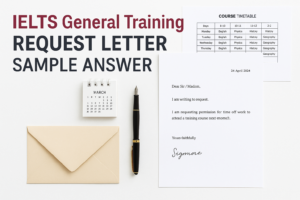
Dear Ms Taylor,
I am writing about the Business Communication evening course that I currently attend on Wednesdays. A recent change to my work roster means that I will be unable to attend the Wednesday class for the next six weeks.
My employer has asked me to supervise the late shift every Wednesday while a colleague completes training. The shift finishes at 8.30 pm, so even if I leave work immediately, I cannot reach the college before the lesson ends. This arrangement begins next week and is expected to continue until 4 November.
I am keen to remain on the course because the communication skills are directly relevant to my role. I have also applied for a team leader position, and completing the course will strengthen my application. I have attended every class so far and would prefer not to postpone my studies until the next intake.
Would it be possible for me to attend the Tuesday evening class during this period? If that class is full, I would be grateful if you could email me the lesson materials and allow me to submit the weekly exercises online. Please let me know whether either arrangement would be suitable.
Thank you for considering my request.
Yours sincerely,
Daniel Morris
The answer is comfortably above 150 words, but it does not add irrelevant history. The purpose appears in the first paragraph. The second and third paragraphs address the first two bullet points, while the final paragraph handles the request with two practical options. Dates, times and reasons make the situation credible without relying on invented statistics or elaborate storytelling.
Why This Sample Can Score Well
The model demonstrates clear task coverage. Every bullet point receives enough development, and no paragraph performs several unrelated jobs. The reader knows what changed, why the course matters and exactly what response would help.
The tone is polite but direct. Phrases such as “Would it be possible” and “I would be grateful if” soften the requests. At the same time, the writer avoids exaggerated language such as “I desperately beg you” or indirect wording that hides the action being requested.
Cohesion comes mainly from logical paragraph order and accurate reference. The letter does not depend on a large number of mechanical connectors. Expressions such as “during this period”, “if that class is full” and “either arrangement” connect ideas naturally.
Vocabulary is specific to the situation: “work roster”, “late shift”, “next intake” and “submit the weekly exercises”. These phrases communicate precise meanings. They are more effective than forcing unusual synonyms into every sentence. Grammar also shows controlled variety, including a relative clause, a conditional sentence and polite modal forms.
If you want to compare tone across different letter purposes, study this recent IELTS General Training complaint letter sample answer. A complaint can remain courteous, but it normally needs firmer language and a clearer statement of the problem.
Useful Language For Making Requests
Polite request language should match the relationship and the size of the favour. Formal and semi-formal letters often use modal questions or conditional phrases. Informal letters can be warmer and more direct.
- Formal or semi-formal: “Could you please confirm whether places are available?”
- Formal or semi-formal: “I would appreciate it if you could send the details by Friday.”
- Formal or semi-formal: “Would it be possible to change my booking?”
- Offering an alternative: “If this is not possible, I would be happy to attend on another date.”
- Informal: “Could you give me a hand with the move?”
- Informal: “Would you mind picking me up from the station?”
Do not fill the letter with memorised politeness. One clear request can be enough. Repeating “I would be grateful” in several paragraphs sounds unnatural and uses words that could develop the task. Choose a phrase, state the requested action and add any deadline or alternative the reader needs.
For an example of a more relaxed relationship, compare the language with the IELTS General Training informal letter sample. Notice how the organisation stays clear even though the greeting, vocabulary and sentence rhythm become more personal.
Common Request Letter Mistakes
A frequent problem is spending too many words explaining the background. Candidates sometimes create a detailed story but leave only one sentence for the actual request. The solution is to identify the three assessed bullet points during planning and reserve a paragraph for each function.
- Wrong tone: casual expressions to an unknown official can sound disrespectful, while legalistic language to a friend sounds artificial.
- Hidden purpose: the reader should understand the reason for the letter in the opening paragraph.
- Vague action: specify what you want the reader to do, and when necessary offer an alternative.
- Missing bullet point: check each instruction once during planning and once after writing.
- Overused templates: memorised lines may not fit the exact relationship or request.
- Inconsistent details: make sure days, dates, people and proposed arrangements agree throughout the letter.
- Excessive length: a very long response creates more opportunities for errors and can reduce checking time.
Another mistake is believing that advanced vocabulary automatically improves the score. Accuracy and appropriacy matter more. “Could you send me the revised timetable?” is stronger than an elaborate sentence whose meaning is uncertain. Use vocabulary that makes the circumstances and action precise.
A 20-Minute Writing Routine
Use the first three minutes to identify the reader, tone, purpose and three bullet-point answers. Write short notes rather than complete sentences. Spend about 14 minutes drafting, leaving roughly three minutes to check. This is a guide, not a rigid formula, but it protects time for a final review.
During drafting, keep the purpose near the start and let each paragraph do one main job. If you cannot remember a sophisticated phrase accurately, choose a simpler form you control. A clear sentence is better than a risky sentence written only to appear advanced.
During checking, ask practical questions. Is the greeting suitable? Is the request visible? Have all bullet points been developed? Are verb tenses consistent? Check articles, prepositions, singular and plural endings, punctuation and spelling. Finally, count approximately: if you have four developed body paragraphs, you are likely above 150 words, but make sure you have not written an unnecessarily long response.
Final Checklist For Your Request Letter
- Identify the reader and choose a consistent level of formality.
- State the purpose in the opening paragraph.
- Cover every bullet point with relevant, specific detail.
- Make the requested action clear and realistic.
- Use polite language without repeating memorised phrases.
- Organise the letter into purposeful paragraphs.
- Use an appropriate greeting and closing.
- Write at least 150 words and leave time to check.
A good request letter feels easy to answer. The reader understands the circumstances, sees why the request matters and knows what action you would like. Keep that practical goal in mind when you practise. For structured preparation across all four skills, explore Career Wise English.
Ready to find out your IELTS band score?
Take the IELTS Express Pre-Test for just $4.99 and get your personalised band prediction with a 14-day improvement plan.
FAQ: IELTS General Training Request Letters
Should a request letter always be formal?
No. Tone depends on your relationship with the reader. A letter to an unknown organisation is formal, a letter to a course coordinator or manager you know is often semi-formal, and a letter asking a close friend for help is informal.
How many paragraphs should I write?
Four or five body paragraphs usually work well, including a brief opening that states the purpose. There is no required number. The better test is whether each paragraph has a clear function and all three bullet points are easy to locate.
Can I invent details in an IELTS request letter?
Yes. You are expected to create reasonable details when the prompt does not provide them. Keep names, dates and circumstances consistent, and add only details that help explain a bullet point or make the request specific.
What is the best phrase for a polite request?
There is no single best phrase. “Could you please…?”, “Would it be possible to…?” and “I would appreciate it if you could…” are all useful in formal or semi-formal letters. Choose one that fits the grammar of your sentence and avoid unnecessary repetition.
Will I lose marks if I write fewer than 150 words?
A response below 150 words is unlikely to develop the task adequately and can hurt your performance. Aim to move a little beyond the minimum while staying relevant. Do not add an unrelated paragraph simply to increase the word count.