
An IELTS General Training job application letter sample is useful when it shows how to answer a particular task, not when it becomes a script to memorise. Your reader needs to understand which position you want, why your experience fits and what you are asking them to do next. Clear organisation and a consistently professional tone make those details easy to find.
This guide provides an original practice task, a model response and a practical method for writing your own version. You can explore broader preparation options at Career Wise English. Use the sample below as a learning exercise: change the details, write under time pressure and check whether your answer actually addresses the instructions.
1. Read the job application task before choosing your language
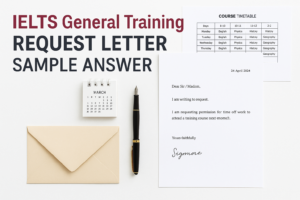
Imagine this practice question: You have seen an advertisement for a part-time receptionist at a local sports centre. Write a letter to the manager. Explain why you are interested in the job, describe relevant skills and experience, and give details of your availability. The advertisement does not name the manager. This is an invented IELTS-style exercise, not an official examination question.
The situation gives you three content requirements and a relationship. You are writing to a potential employer you do not know, so a formal, courteous style is appropriate. You should not write as though you are messaging a friend. Equally, you do not need legalistic language or elaborate compliments. A direct explanation of your purpose is more useful than a long introduction about the importance of employment.
Before writing, make a short plan with one concrete idea for each bullet. For interest, you might mention combining customer service with your interest in sport. For experience, choose a previous role involving enquiries and bookings. For availability, state specific days and a possible starting date. These details are easy to develop without inventing an entire life story or adding unrelated qualifications.
Do not assume that every job application task has the same requirements. Another question might ask where you saw the advertisement, why you are suitable or when you could attend an interview. Reusing the structure can help; reusing facts without reading the bullets can leave part of the task unanswered.
2. IELTS General Training job application letter sample
The following response answers the sports-centre task. Notice how each paragraph has a clear job to do and how the availability information is specific enough for the manager to use.
Dear Sir or Madam,
I am writing to apply for the part-time receptionist position advertised on your sports centre website. As a regular visitor to the centre and an experienced customer service assistant, I would welcome the opportunity to support your front-desk team.
I am particularly interested in this role because I enjoy helping people find activities that suit their needs. Having attended your evening swimming sessions, I am familiar with the centre's facilities and appreciate the friendly service your staff provide.
For the past two years, I have worked at a community library, where I answer telephone enquiries, register new members and manage room bookings. This experience has taught me to explain procedures clearly and remain patient during busy periods. I also use an online booking system daily, so I would be comfortable learning the software used at your reception desk.
I am available on Tuesday and Thursday evenings and throughout the weekend. My current notice period is two weeks, after which I could begin work immediately. I would also be pleased to attend an interview at a time convenient for you.
Thank you for considering my application. I look forward to hearing from you.
Yours faithfully,
Alex Morgan
This is one possible response, not a guaranteed band-score answer. Your result depends on the complete performance, including how effectively you meet the task, organise information and control vocabulary and grammar. The useful lesson is the relationship between the prompt and the content, rather than any individual phrase.
3. Understand why the sample works
The opening identifies the position immediately. The manager does not have to infer why Alex is writing. Mentioning the advertisement also makes the context clear, although the practice task does not require a detailed account of where the advert appeared. The first paragraph stays short enough to leave room for the three main points.
The interest paragraph connects a personal reason with knowledge of the workplace. It does not simply say that the applicant needs money or that the job is wonderful. Familiarity with swimming sessions gives the claim a plausible basis. In your own answer, one relevant supporting detail will usually be more effective than several vague statements of enthusiasm.
The experience paragraph uses actions as evidence. Answering enquiries, registering members and managing bookings all relate to reception work. The applicant then explains what those activities demonstrate: clear communication, patience and familiarity with booking software. This connection helps the reader understand why the previous job matters even though it was in a different setting.
The availability paragraph answers the final bullet explicitly. Days, a notice period and willingness to attend an interview are practical details. The response does not contradict itself by saying that the writer can start today but must also give two weeks' notice. When checking your own letter, look for these small consistency problems as well as grammar mistakes.
4. Keep the tone professional without making it stiff
A formal job application can use straightforward sentences such as “I am writing to apply for…” and “I am available on…”. These expressions are useful because their purpose is clear. You do not need to replace every ordinary word with a longer synonym. “I answer customer enquiries” is more informative than “I possess exceptional interpersonal capabilities” when no example follows.
Choose the greeting and closing to fit the information in the task. In conventional formal British-style correspondence, an unnamed recipient can be addressed as “Dear Sir or Madam” and the letter closed with “Yours faithfully”. A named recipient can be addressed using their appropriate title and surname, with “Yours sincerely” as the closing. Avoid inventing a name if the task provides none.
Maintain that level of formality throughout. Expressions such as “Hey”, “Cheers” or “Give me a shout” would create a different relationship from the one established in the sample. On the other hand, repeated phrases such as “I humbly beseech you” can sound unnatural. Professional writing is courteous, precise and focused on the reader's needs.
Compare this situation with our General Training thank-you letter sample. Both tasks require attention to the relationship, but the purpose changes the information you should include. Practising different letter types helps you choose a tone instead of applying one memorised voice to every prompt.
5. Build relevant vocabulary and controlled sentences
Learn small groups of language connected with job applications: apply for a position, answer enquiries, manage bookings, relevant experience, notice period and attend an interview. Then practise using them in sentences with different subjects and tenses. Check the whole phrase rather than learning an isolated noun and guessing which preposition follows it.
Be accurate about what your examples mean. “I have worked at a library for two years” suggests a period continuing to the present. “I worked at a library for two years” describes a completed period. Either can be appropriate, but the rest of the letter should support your choice. A consistent employment timeline is easier to follow than an impressive sentence with unclear timing.
Use a mixture of sentence forms when they help express a relationship. “Although my previous role was in retail, it required similar customer service skills” explains why experience from another sector is relevant. Do not add subordinate clauses merely to make sentences longer. If you cannot control the punctuation or the meaning becomes difficult to follow, simplify the structure.
Our guide to grammatical range and accuracy discusses useful editing habits. It focuses on Task 2, so its essay structure is not a template for a letter. The transferable habit is to check whether your grammar communicates the intended relationship clearly.
6. Practise, review and write a second version
For your first attempt, read the task and write a brief three-point plan. Draft the letter without looking at the model, then compare the coverage rather than the wording. Have you explained your interest, supported your relevant skills and given usable availability details? If one bullet appears only in a vague sentence, develop it before polishing vocabulary.
Next, check paragraph order. A reader should be able to locate the application purpose, suitability and practical arrangements quickly. Remove introductions that delay the purpose and details that do not support a task bullet. Extra length is not automatically extra development; a long account of your childhood interest in sport can crowd out the availability information the task actually requests.
Use IELTS mock tests to build a more complete practice routine, and include focused work with a mock-test practice plan. Check the format and audience of each practice exercise before applying this letter framework. Academic Task 1 tasks require a different response type.
Review the current preparation options and prices before choosing a service that fits your study needs. Finally, rewrite your letter for a different job, such as a weekend shop assistant. Change the skills and examples, not just the job title. If you can adapt the structure to new requirements without forcing irrelevant sentences into the answer, you are developing a useful writing method rather than relying on a memorised sample.
Frequently asked questions
Should I copy a sample job application letter?
No. Study how the sample answers the task, then write your own response to a new prompt. Copied details may not fit the advertised job or the bullet points. A flexible paragraph structure and a few reliable phrases are more useful than memorising an entire letter.
Do I need real work experience for the practice answer?
You can use plausible invented details for this writing exercise. Keep them simple and consistent so they help answer the question. The aim is to demonstrate written communication, not to provide a verified employment history or a genuine job application.
Should I include a CV or postal address?
Follow the task instructions and focus on the letter itself. Do not spend valuable writing space creating a separate CV or elaborate address block. You can mention a relevant qualification in a sentence when it helps explain your suitability, but avoid adding documents the task does not request.
How can I tell whether my letter is developed enough?
Check each bullet for both a clear answer and an appropriate supporting detail. A skill should have an example, a reason should be explained and availability should be specific. Then remove repetition and check that the greeting, body and closing maintain the same professional relationship.