Your IELTS computer test day checklist for Australia should begin with three things: the identification used for your booking, your centre’s confirmation instructions and a realistic travel plan. Knowing what happens before you sit at the screen helps you spend less energy on logistics and more on answering questions.
This guide is for candidates attending a test centre, not taking a remote test at home. Procedures can differ between providers, venues and booked formats. Treat your own confirmation email as the final authority on arrival time, permitted belongings and your Speaking appointment. The suggestions below are a practical preparation routine, not a replacement for your centre’s rules.
1. Check your booking before test morning
Open your confirmation email the evening before the test. Check your name, test date, venue address, test module and booked delivery format. Academic and General Training have different Reading and Writing tasks, so make sure the booking matches what you actually need. Do not rely on the name of a building remembered from an earlier practice session.
Record the required arrival time separately from the test start time. Registration and security checks happen before testing, and arriving at the advertised starting time may leave you too late for admission. Set your departure time using the arrival instruction, then add your own travel buffer. Check train disruptions, parking restrictions or the walking route from the nearest stop.
Confirm the Speaking appointment independently. Do not assume it begins immediately after Writing or takes place in the same room. If the email contains separate instructions, save both sets. Contact the centre before test day if any timing, identity detail or accessibility arrangement is unclear.
2. Pack identification and keep belongings simple
Official IELTS test-day advice says to bring the identification document used when booking and to leave personal belongings outside the test room. Check the accepted document and validity requirements in your Australian centre’s instructions; another form of ID is not automatically a substitute.
Place the required original document somewhere you can reach easily. Check that you have the actual document rather than a photograph of it. If your passport has been renewed, lost or changed since booking, contact the centre in advance instead of hoping staff can resolve the mismatch at reception.
Travel with only what you need. Plan to store your phone, watch, earphones and other personal items as directed. Do not assume that switching a device to silent makes it permitted. Ask the centre beforehand about medication, medical equipment or any item you need to keep with you. Necessary arrangements are easier to confirm before a busy registration queue.
- Required original identification, checked against the booking.
- Venue address and required arrival time saved for travel.
- Speaking appointment details checked separately.
- Transport plan with a backup route.
- Any approved support arrangements confirmed in writing.
3. Prepare your body and your routine
Test morning is a poor time to experiment with unfamiliar food, excessive caffeine or an entirely new study strategy. Aim for your normal breakfast and a comfortable routine. Choose clothing that lets you sit comfortably, and check venue guidance before packing drinks or extra items. You want fewer decisions to make once you leave home.
The previous evening, review your own short error list rather than completing another exhausting mock test. Useful reminders might include checking plural endings, answering the exact question and leaving time to proofread. A page of familiar reminders is more useful at this stage than fifty new expressions that you have not practised using.
If you still have several days available, use the IELTS Express pre-test to identify priorities, then keep the final evening light. A diagnostic activity can guide preparation, but it cannot promise a particular result. Stop studying early enough to organise your bag and give yourself a reasonable opportunity to sleep.
4. Know what to do at registration
When you arrive, follow signs and staff directions rather than entering a testing room uninvited. Have your identification ready. Registration may involve document checks, photography and other security procedures. Allow staff to explain where belongings go and which items may remain with you. Procedures are there to protect the integrity of the test.
Use the waiting time to settle yourself. Check any displayed instructions, listen for your group and avoid comparing preparation with other candidates. Another person’s confident claim about timing or allowed equipment is not an official instruction. If advice conflicts, ask a member of staff.
Tell staff promptly about a problem. That includes feeling unwell, discovering an identity discrepancy or finding that an agreed arrangement appears to be missing. Quietly hoping an issue will disappear can make it harder to address later. Keep your explanation factual: what the issue is, what was confirmed and what help you need.
5. Get comfortable at the computer before answering
Practise with the official familiarisation materials before test day so the screen layout is not completely new. At the venue, follow the supplied instructions for logging in and starting. Check that your displayed details and test are correct. If something looks wrong, alert the invigilator rather than continuing and hoping it is only a display problem.
When directed to check the audio, make sure you can hear comfortably. Report a technical difficulty immediately. Do not try to repair equipment yourself or change settings that staff have not authorised. Asking for help with a faulty headset is different from asking for assistance with an answer.
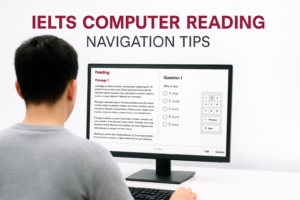
For Reading, practise moving between the passage and questions without losing your place. For Writing, rehearse typing, selecting text and making small edits under time pressure. Speed alone is not the goal: clear paragraphing, accurate answers and controlled checking matter more than impressive typing with frequent errors. Use only the features available in your booked test format.
6. Use a simple plan for each skill
In Listening, follow the on-screen instructions and keep track of the current question. If you miss an answer, recover your place instead of mentally replaying the missed section. Read word limits carefully. Do not assume the answer-transfer procedure is identical to a paper test; practise the computer version’s timing and follow the instructions you receive.
In Reading, decide when you will move on from a difficult question. One stubborn item should not consume the time needed for an entire group. Use evidence in the passage, check the required answer form and return to uncertain items when time allows. Familiarity with navigation helps, but it does not replace careful reading.
In Writing, reserve a brief planning stage and a final checking stage. Identify all parts of the prompt before drafting. Proofread for errors you actually make, such as missing articles or unclear pronoun references. If you need a focused refresher, our guide to grammatical range and accuracy explains how to think about sentence control without treating complex grammar as decoration.
For Speaking, focus on listening to the question and developing a relevant answer. Rehearsing a full script can make it harder to respond naturally when the question changes. Our Speaking mock-test preparation guide can help you build a practice routine before the appointment, rather than cramming memorised speeches in the waiting area.
7. Finish with a practical final checklist
Before leaving home, physically check your identification one last time. Confirm that you are travelling to the correct location and that your route gets you there before the required arrival time. Keep contact details accessible in case travel goes wrong, while remembering that contacting the centre does not guarantee admission after a late arrival.
Before the test begins, understand the instructions for requesting assistance. During testing, raise a problem promptly and follow the invigilator’s directions. After your session, check whether you have any remaining appointment or administrative step. Avoid making immediate travel commitments based on an assumed finishing time.
For ongoing preparation, explore unlimited IELTS mock tests and choose practice that addresses your actual weaknesses. You can also visit Career Wise English for preparation resources. The aim of this checklist is straightforward: remove avoidable uncertainty so you can approach the test with a clear, familiar routine.
Frequently asked questions
What identification should I bring to IELTS on computer in Australia?
Bring the same required original identification document used for your booking, following the validity and document rules in your centre’s confirmation. Do not assume another card or a phone image will be accepted. Contact the centre beforehand if your document has changed.
How early should I arrive?
Use the required arrival time in your confirmation, not an arrival estimate from another candidate. Allow your own transport buffer before that time. Registration requirements and venue arrangements can vary, so a universal number of minutes is less reliable than your booking instructions.
Can I keep my phone or smartwatch with me?
Plan to switch off and store electronic devices as instructed by test-day staff. Do not treat silent mode as permission to carry them into the room. Check your centre’s rules about all watches and other belongings before you travel.
What if the headphones or computer do not work properly?
Alert the invigilator immediately using the instructed method. Describe the technical problem clearly and follow staff directions. Do not attempt your own repair or leave the problem unreported until after the session, when it may be harder to investigate.
Will my Speaking test definitely be straight after Writing?
Do not assume that. Check the Speaking time and location in your booking information separately, and follow any updated centre instructions. Organise work, transport and other commitments around confirmed appointments rather than someone else’s previous test-day schedule.
Checked November 2026. Centre instructions and booked-format details take precedence. For Australian guidance, consult the official IELTS Australia test-day FAQs.