
IELTS Writing Task 2 grammatical range and accuracy at Band 7 is about controlled flexibility. You need to express relationships between ideas using different sentence structures, while keeping your meaning clear. Filling an essay with long sentences is not the goal. A useful target is writing that lets the reader follow your argument without repeatedly stopping to work out what a sentence means.
This guide shows how to practise that control, recognise common errors and edit an essay efficiently. If you are organising your wider preparation, start with Career Wise English. Then use the examples below to make your next writing session specific: choose one structure to improve and one recurring mistake to reduce.
What Band 7 grammar means in practice
Grammatical range and accuracy is one of the four IELTS Writing assessment criteria. The other areas concern your response to the task, the organisation of ideas and your vocabulary. For grammar, examiners consider both the structures you use and how successfully you control them. Band 7 does not mean that every sentence must be perfect, but frequent, distracting errors are not a sound foundation for that level.
In practical terms, aim for a variety of complex structures, effective punctuation and many clearly accurate sentences. Any remaining mistakes should not obstruct the argument. There is no published rule saying that using a particular number of relative clauses or conditionals guarantees Band 7. An examiner assesses the writing as a whole, not a checklist of impressive constructions.
Consider this sentence: “Although public transport can be expensive to improve, it may reduce congestion in densely populated cities.” The opening clause introduces a concession; the main clause gives the argument. The structure serves a clear purpose. Compare it with a sentence containing several loosely connected claims and no obvious main point. More words would not make that second sentence better.
Your grammar practice should therefore have two questions: can I express the relationship I need, and can I do it accurately under time pressure? A reliable sentence you understand is more useful than an elaborate construction you cannot explain.
Build range around the ideas you need to express
Start with the relationships that Task 2 essays regularly require: reasons, contrasts, consequences, examples and conditions. Each relationship gives you a reason to vary your grammar. Instead of trying to insert every structure you know, select the construction that makes your point easiest to understand.
For a reason, you might write: “Some employees prefer remote work because it removes the daily commute.” To express contrast, try: “While remote work offers flexibility, it can make informal collaboration more difficult.” A condition might be: “If employers provide clear communication systems, staff may find remote teamwork easier.” Notice that these examples make different claims. Changing the grammar should not accidentally change your argument.
Relative clauses can define a group precisely: “Workers who have caring responsibilities may benefit from flexible schedules.” Here, the clause identifies which workers you mean. An additional-information clause works differently: “The new library, which opened last year, offers evening study spaces.” The commas mark information added about an already identified library.
Other useful options include a well-controlled passive construction when the action matters more than the actor, and a noun clause when discussing beliefs or proposals. For example: “More funding should be allocated to local services” and “Whether this policy is affordable depends on the size of the programme.” Practise these constructions with your own topics before using them in a timed essay.
Keep simple sentences in your toolkit. A short statement can establish a position before you explain it in greater detail. Sentence variety includes variation in length and function, not just different ways of making sentences longer.
Fix the errors that repeatedly weaken accuracy
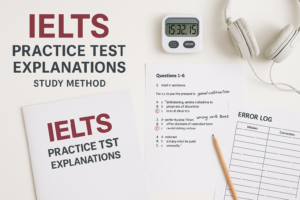
A personal error log is more valuable than an enormous grammar workbook you never finish. After reviewing an essay, record the original sentence, a corrected version and a short explanation. Group similar errors so you can see which ones recur. Three repeated article mistakes deserve more attention than one unusual mistake you are unlikely to make again.
Subject–verb agreement is a useful starting point. “The cost of these services are high” is incorrect because the subject is “cost,” not “services.” Write “The cost of these services is high.” Longer subjects can hide this relationship, so find the main noun before choosing the verb.
Articles and countability also cause persistent problems. Write “an effective policy” when introducing one policy, but “effective policies” when discussing policies generally. “Information” is normally uncountable: “useful information,” not “useful informations.” Learn nouns together with a natural phrase rather than memorising isolated labels.
Watch for sentence fragments. “Although many residents support the proposal” leaves the thought unfinished. Add a main clause: “Although many residents support the proposal, others question its cost.” Also avoid joining independent sentences with a comma alone. “Housing is expensive, young adults often live with their parents” needs a conjunction, a suitable punctuation change or two separate sentences.
Verb tense should match your time reference. General arguments often use the present, but an example about a completed event may need the past. Do not change tense simply to demonstrate variety. Control means choosing the form that expresses your intended meaning, including how certain or hypothetical a claim is.
Improve a paragraph without making it harder to read
Here is a deliberately rough paragraph: “Many people uses cars. Public transport is unreliable, people do not use it. Although governments spend money on roads. This create more traffic.” The ideas could form an argument, but agreement errors, a comma splice and an unfinished clause make the paragraph difficult to follow.
A clearer revision is: “Many people use cars because public transport is unreliable. Although governments often invest in roads, this approach may encourage further car use. Improving bus frequency could give commuters a practical alternative.” The revised paragraph uses a reason clause, a concession and a modal construction. It also replaces an overly certain causal claim with a more cautious one.
This is a sentence-level demonstration, not a complete Band 7 model paragraph. A full essay would need relevant development and support. However, it illustrates an important editing principle: first establish the intended meaning, then choose grammar that expresses it clearly. Correcting individual verbs will not rescue an argument whose relationships are unclear.
Vocabulary decisions interact with grammar too. A word may be suitable but require a different preposition or sentence pattern. The companion guide to Band 7 lexical resource in Task 2 explains how to develop vocabulary without treating rare words as a shortcut. Combine precise vocabulary with structures you can control.
Use a focused practice routine rather than random exercises
Begin with a short diagnostic essay using an unfamiliar question. Write under realistic conditions, then review the result separately. If you correct every sentence while composing, you may never discover which structures you can produce independently. A first draft gives you evidence; a revision gives you a chance to learn from it.
Next, select one grammar target. For example, spend a session explaining concessions with “although” and “while.” Write five sentences on different topics, check their clause structure, and turn two of them into developed paragraphs. This makes the practice transferable rather than tied to one memorised essay.
Then complete a timed response using a question from the IELTS Writing Task 2 practice test. Do not force your target construction into every paragraph. Use it only when the argument needs it, and check whether the rest of your writing remains accurate when the clock is running.
Finally, rewrite one paragraph without looking at the corrected version. If you can reproduce the improvement the next day, you are beginning to build a usable skill. If the same error returns, reduce the difficulty and practise the underlying pattern again. Feedback is most useful when it changes what you can write independently.
Keep grammar work connected to organisation. The guide to Band 7 coherence and cohesion can help you check whether each sentence contributes to a clear paragraph. Accurate sentences still need a logical sequence and a relevant central idea.
Edit strategically in the final minutes
Leave time to review, but make the review selective. Read once for incomplete or overloaded sentences. Check that each sentence has a clear main clause and that any introductory dependent clause connects to it. If a sentence is difficult to follow, splitting it may be safer than adding another linking phrase.
On a second pass, look for your own common errors. If you often miss singular verbs, inspect the subjects of your main clauses. If articles are the problem, check singular countable nouns. A personalised check is more efficient than trying to reconsider every rule of English in the last few minutes.
Do not replace a correct sentence with a complicated alternative simply because it looks too easy. Likewise, avoid adding a conditional or passive sentence just to display range. Your final edits should improve clarity, accuracy or precision. If you cannot identify the benefit, leave the sentence alone.
If you want a structured preparation option, compare the IELTS course packages with the support you actually need. Use the IELTS Express pre-test to help identify a starting point, then compare your study priorities with the support available. No course or grammar technique can guarantee a particular band score; consistent practice and useful feedback matter more than collecting resources.
Frequently asked questions
Do I need complicated grammar in every sentence?
No. You need enough variety to express ideas flexibly, but every construction should serve the meaning. A mixture of accurate simple and complex sentences is more effective than a sequence of long, unstable sentences. Use complexity where the relationship between ideas calls for it.
Can I reach Band 7 if I make some grammar mistakes?
Band 7 does not require completely error-free writing. However, the frequency and nature of errors matter, along with your overall control and range. Do not treat this as permission to ignore recurring mistakes. Work towards reliable accuracy rather than trying to calculate an allowed number of errors.
How many complex sentences should I include?
There is no fixed quota that guarantees a score. Plan the argument first, then use subordinate clauses, relative clauses and other structures where appropriate. Counting complex sentences can encourage unnatural writing and distract you from whether the essay answers the question clearly.
Should I memorise sentences before the test?
Learn useful patterns, but practise adapting them to new meanings. A memorised sentence may not fit the question, and changing one word can create a grammar problem elsewhere. Build confidence by writing fresh examples and checking that you understand how each part of the sentence works.
What should I practise first if my grammar is weak?
Start with complete sentences, subject–verb agreement and basic punctuation. Then add a small set of reason, contrast and condition structures. Review your own writing to choose priorities. Accurate foundations make it easier to expand your range without losing control of the paragraph.