An IELTS speaking mock test online is most useful when it gives you a clear practice cycle: speak under time pressure, review what happened, and choose one change for your next attempt. Simply completing more questions can make you comfortable with familiar topics without improving your ability to respond spontaneously. This guide explains how to prepare your setup, practise realistic conversations and compare online options without confusing a practice result with an official score.
Start with the preparation resources at Career Wise English, then decide whether your immediate need is independent speaking practice, structured lessons or individual feedback. The right choice depends on the problems you can identify in your own recordings, not on the number of mock tests a provider advertises.
Choose the purpose of your online speaking mock test
Before booking or opening a test, write down one question you want it to answer. Perhaps you lose your train of thought during a long response. Perhaps you understand the question but cannot develop an example. Alternatively, you may speak confidently yet find that listeners struggle with particular words. Each problem needs a different review method, so a vague goal such as improving everything makes the session harder to use.
A first mock can establish a baseline. Treat it as a sample of your current performance rather than a prediction you must achieve on test day. Record the topic, conditions and type of feedback you received. Later comparisons are more meaningful when the conditions are similar and the questions are unfamiliar. Repeating an answer until it sounds polished is useful rehearsal, but it is not the same as testing spontaneous speaking.
When comparing IELTS mock tests, check precisely what is included. A question bank, an automated recording activity and a live conversation are different services. Look for a clear explanation of whether anyone reviews your responses, what the feedback covers and how you can act on it. Do not assume that a mock package includes a personal speaking assessment unless the description explicitly says so.
Set up a realistic and reliable practice environment
Choose a quiet place where you can speak at normal conversational volume. Test your microphone by recording a short answer, then listen back with headphones. Check that your voice is clear and that background noise does not dominate the recording. A technically poor recording can make pronunciation review frustrating, even when your actual speech is understandable. Close notifications and keep only the tools needed for the session open.
If the activity involves a live tutor, check the meeting instructions and time zone before the session. Keep a backup way to contact the provider if the connection fails. These checks are practical preparation, not language improvement, but they prevent avoidable distractions. For independent practice, a simple timer and voice recorder are usually enough; extra software is helpful only if you actually use its feedback.
Keep your first attempt free from scripts, dictionaries and prepared paragraphs. You can study vocabulary after the recording. During the mock, practise finding another way to express an idea when a word is missing. This is a valuable speaking skill: a clear explanation using familiar language usually communicates more effectively than a long pause while searching for an impressive expression.
Practise short answers, longer turns and discussion
Build variety into your session rather than practising only the task you enjoy. Begin with familiar questions about daily life and give a direct answer followed by a reason or small detail. Avoid turning every short question into a memorised speech. For example, if asked about your neighbourhood, identify one feature and explain why it matters to you. The aim is a natural response that actually answers the question.
For a longer turn, use brief planning notes rather than complete sentences. Identify the person, place or experience you will describe, then choose a simple sequence. You might move from background to what happened, followed by why it was important. If you finish an idea early, add a specific example or explain how you felt. Do not fill the remaining time by repeating the opening statement in different words.
For discussion practice, move beyond personal experience. Give a position, explain the reason and consider a limitation or alternative view. A question about technology in education could lead to an example about access, followed by a qualification about unequal internet availability. You do not need specialist knowledge; you need to make your reasoning understandable. If a topic feels unfamiliar, begin with a cautious general point and develop it logically.
Practise with topics you have not rehearsed. Otherwise, improvements may reflect familiarity rather than greater flexibility. Rotate themes across sessions and ask a partner to select questions. If working alone, choose the question immediately before recording, not the night before. Keep rehearsed examples as learning material, but do not rely on them fitting every future prompt.
Review recordings using a manageable checklist
Listen to the full recording once without stopping. Ask whether your answers are easy to follow and whether they respond to the questions. On a second listen, focus on one area: organisation, vocabulary, grammar or pronunciation. Trying to identify every mistake at once can produce a long list with no clear next step. A small number of repeated patterns is more actionable than dozens of isolated observations.
For organisation, note places where you abandon an idea or use several linking phrases without adding meaning. For vocabulary, identify repeated words and expressions you used inaccurately. For grammar, look for recurring difficulties such as switching time references unexpectedly. For pronunciation, mark words or phrases that are hard to understand, then consider whether stress, sound production or rushed delivery contributed. Accent alone is not a useful measure of clarity.
Transcribe a short section if you need a closer look. A written transcript can expose repetition, but it cannot show every feature of spoken communication. Always return to the audio before deciding what to change. If an automated transcript gets a word wrong, that does not by itself prove you pronounced it incorrectly. Recording quality and the software's limitations can also affect the result.
Choose one repair task. You could record the same idea more concisely, practise a troublesome phrase in several sentences or answer a new question using a clearer example. Then test that skill again with fresh material. This final transfer step matters because a corrected version of one answer does not automatically become a reliable habit.
Compare feedback and structured preparation options
Good feedback identifies evidence in your response and suggests something specific to practise. A comment such as “develop your answer” is more useful when it points to a moment where you made a claim without explaining it. Ask whether feedback includes examples, whether it distinguishes recurring weaknesses from occasional slips and whether you can review it after the session. These details matter more than a colourful score report.
Automated tools can make frequent practice convenient, while a knowledgeable teacher can help interpret patterns and discuss alternatives. Neither format should be chosen solely because it produces a number. Practice estimates are not official results, and different services may assess responses differently. Avoid treating a small change between two mock scores as definitive evidence of improvement or decline.
If recordings reveal gaps in basic sentence building or answer development, compare the current IELTS preparation prices and options for structured support alongside your mock sessions. Check the current course content and support arrangements before purchasing. A course and a mock test serve different purposes: one can teach and organise practice, while the other can help you observe performance under constraints.
For broader planning, the IELTS Academic online practice study plan can help you fit speaking into a balanced routine. Protect time for reviewing your recordings rather than using every available minute to start another test. Improvement depends on what you do between attempts as well as how often you practise.
Build a weekly speaking practice cycle
Use your first session to record a baseline and select a priority. On the next day, practise a targeted skill in short activities. For example, develop five answers by adding a reason and a concrete example. Later in the week, complete an unfamiliar set of questions without assistance. Compare the recordings for the specific behaviour you practised, rather than asking only whether the second recording sounds generally better.
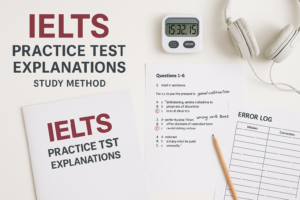
Keep a short log containing the date, topic, one strength, one recurring difficulty and the next action. A useful entry might say: “Examples were clear, but I restarted sentences frequently; next session I will pause briefly before beginning.” Avoid turning your log into a catalogue of everything you dislike about your English. Noticing a strength helps you preserve what already works while changing one weaker habit.
As test day approaches, prioritise consistency, rest and familiar equipment. Do not introduce a complicated new method at the last minute. A mock test should help you make a practical decision about your next study session; it should not become a source of constant score checking. If results fluctuate, examine topic familiarity, tiredness and recording conditions before changing your whole preparation plan.
Frequently asked questions
Can I practise an online speaking mock test by myself?
Yes. Use unfamiliar questions, a timer and a recorder, then review the audio systematically. Independent practice is especially useful for building a routine and noticing habits. However, self-review has limits. If you cannot explain a recurring problem or decide how to fix it, seek targeted feedback rather than repeatedly guessing at the cause.
Should I memorise answers before a mock test?
Learn useful language and practise expressing your own experiences, but avoid memorising complete responses. A prepared paragraph may not answer the actual question. Practise adapting ideas to different prompts and explaining unfamiliar words with simpler language. This builds flexibility and makes the mock a more realistic sample of your speaking.
How often should I complete a full speaking mock?
Choose a frequency that leaves enough time for review and targeted practice. One carefully reviewed session can be more productive than several unrevised recordings. Increase frequency only if you can still identify a learning goal and act on the feedback. Your schedule should support improvement, not simply maximise completed tests.
Does an online mock score guarantee my official result?
No. A practice result is feedback from a particular activity under particular conditions. It is not an official score or a guarantee. Use it alongside concrete observations about clarity, answer development and language control. The most helpful outcome is knowing what to practise next and being able to demonstrate that skill on unfamiliar questions.