IELTS Writing Task 1 Process Diagram band 7 model is for Academic IELTS candidates who can follow a process but struggle to turn the stages into a clear, organised report. A process diagram is different from a chart because there are usually no percentages or years to copy. Your score depends on whether you can identify the main stages, group them logically, and use accurate sequencing language. Before you write another practice answer, take the IELTS Express Pre-Test to check your current Writing band range and see whether overview quality, stage selection, grammar, vocabulary, or timing is holding you back.
In this guide, you will see a complete Band 7 process diagram model answer and the thinking behind it. The aim is not to memorise one response. The aim is to learn a repeatable process: read the diagram carefully, find the start and end points, group the stages, write a calm overview, and describe the sequence in controlled formal English.
What Band 7 Means For A Process Diagram
Band 7 in Writing Task 1 usually means the answer presents the main features clearly, includes a clear overview, organises information logically, and uses a good range of vocabulary and grammar with mostly accurate control. For a process diagram, the examiner wants to see that you understand how the process works from beginning to end. You do not need perfect sentences, but the reader should be able to follow the sequence without checking the original diagram every few seconds.
The biggest Band 7 skill is selection and grouping. A weaker answer describes every tiny arrow and label in order with no sense of structure. A stronger answer identifies the main stages, groups related steps, and explains the overall purpose of the process. That is what turns a list of labels into a real report.
- Find the starting point and the final product first.
- Count the main stages before you write.
- Write a separate overview that summarises the whole process.
- Group small steps instead of describing every label separately.
- Use passive verbs and sequencing language accurately.
The Band 7 Process Diagram Structure
A reliable process diagram report has four short paragraphs. The first paragraph paraphrases the task. The second gives the overview. The third describes the first half of the process. The fourth describes the remaining stages and the final product. This is simple, but it works because process tasks reward clarity more than dramatic language.
Do not write a story that jumps around the diagram. Follow the natural order of the process. At the same time, do not turn the answer into a robotic list of first, then, next, after that. A Band 7 answer uses sequencing language, but it also uses passive grammar, purpose phrases, and grouping so the report sounds formal and controlled.
For wider Task 1 practice, use the IELTS Writing Task 1 practice test after studying this model so you can apply the same structure to line graphs, tables, maps, pie charts, and mixed charts.
Sample IELTS Process Diagram Task
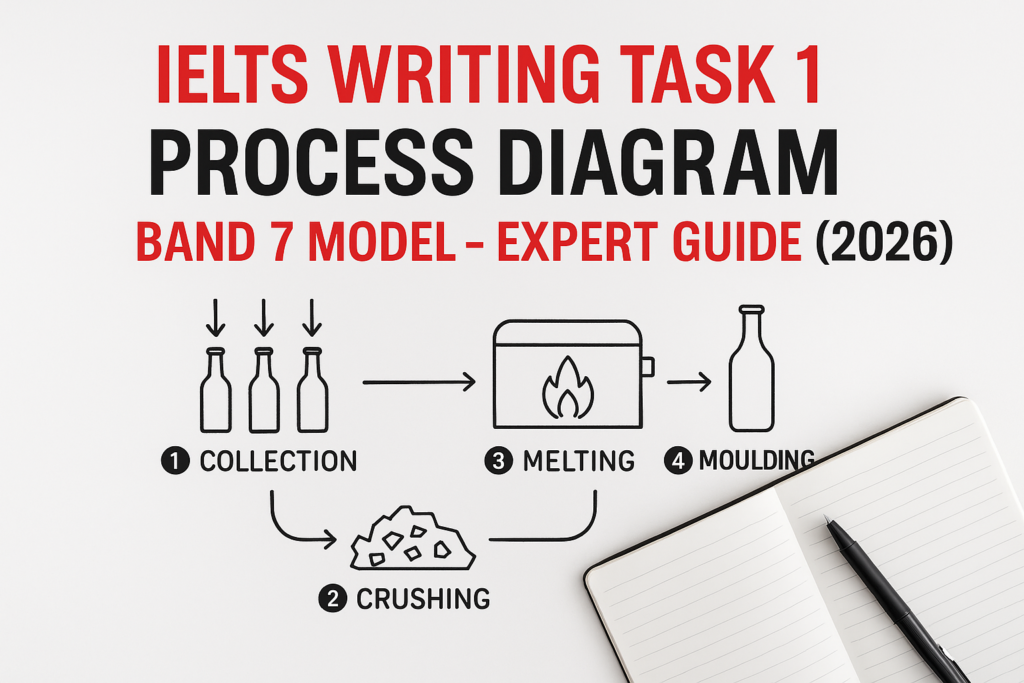
Imagine the diagram shows how recycled glass is turned into new glass bottles. First, used bottles are collected and transported to a recycling plant. Next, they are sorted by colour, washed, and crushed into small pieces called cullet. The cullet is then mixed with raw materials, heated in a furnace, and shaped into new bottles. Finally, the bottles are cooled, inspected, and delivered to manufacturers for reuse.
This task is typical because it has a clear start and end, several linked stages, and a practical industrial purpose. A Band 7 answer should not simply copy every label. It should explain that the process has two broad parts: preparing the old glass, and manufacturing the new bottles. That kind of overview shows real understanding.
The model below is longer than a real exam answer because it is being used for teaching. In the test, the answer itself would usually be around 170 to 200 words.
Band 7 Model Answer
The diagram illustrates the process by which recycled glass is converted into new glass bottles.
Overall, the process consists of two main stages: preparing the used glass and manufacturing the new bottles. It begins with the collection of old bottles and ends with finished bottles being delivered for reuse.
In the first stage, used glass bottles are collected and transported to a recycling plant. There, they are sorted according to colour before being thoroughly washed to remove dirt and labels. Once cleaned, the bottles are crushed into small pieces known as cullet, which can then be stored or moved on to the production stage.
In the next stage, the cullet is mixed with other raw materials and heated in a furnace until it becomes molten glass. This liquid glass is then shaped into new bottles. After shaping, the bottles are cooled, carefully inspected for quality, and finally delivered to manufacturers so that they can be filled and used again.
Why This Model Reaches Band 7
The model reaches Band 7 because it has a clear overview and logical grouping. The overview does not list every action. It explains the main structure of the process: preparation first, manufacturing second. That gives the examiner the big picture immediately.
The body paragraphs are grouped by stage. The first detail paragraph focuses on collection, sorting, washing, and crushing. The second focuses on mixing, heating, shaping, cooling, inspection, and delivery. This is much easier to follow than a long chain of disconnected sentences.
The language is also controlled. The answer uses passive forms such as are collected, are sorted, is mixed, and are inspected. These are natural for process diagrams because the focus is on what happens to the materials, not on who does each action. If you want to practise this under exam pressure, access unlimited IELTS mock tests and check whether your process reports include a genuine overview and grouped body paragraphs.
How To Read A Process Diagram Quickly
Start by finding the beginning and the end. Some diagrams start with raw materials, while others start with waste, water, air, or an unfinished product. Knowing the start and finish helps you write both the introduction and the overview.
Next, count the main stages. Do not panic if there are many small arrows. Several small actions often belong to one larger stage. For example, sorting, washing, and crushing can all be part of preparation. Mixing, heating, and shaping can belong to production.
Finally, look for any cycle. Some process diagrams are linear, while others return materials to an earlier stage. If waste heat, leftover material, or water is reused, mention that in the overview or in the final body paragraph because it is often one of the main features.
Writing A Strong Overview
A strong process overview describes the whole system without small details. It might say the process has several stages, begins with collection, ends with a finished product, or includes both natural and man-made steps. It should not list every action.
For the sample task, the overview says the process has two main stages: preparing used glass and manufacturing new bottles. It also names the start and end points. That is enough. The details come later.
A weak overview says there are many steps in the diagram. That is too vague. The examiner needs to know what kind of process it is and how it is organised.
Choosing Details For Body Paragraphs
Good process details are chosen because they support the overview. If your overview says the first half is preparation, include collection, sorting, washing, and crushing. If your overview says the second half is manufacturing, include mixing, heating, shaping, cooling, and inspection.
Choose a grouping method before writing. You can group by early and later stages, by natural and factory stages, or by input and output. In the sample task, preparation and production is the clearest split.
For more help with Task 1 selection and paragraph planning, read the IELTS Writing Task 1 tips and strategies guide before your next practice answer.
Process Vocabulary For Band 7
Band 7 vocabulary should be precise and controlled. Useful verbs include collected, transported, sorted, washed, crushed, mixed, heated, melted, shaped, moulded, cooled, inspected, packaged, and delivered. Many process sentences use the passive because the materials are more important than the workers.
Useful sequencing phrases include first, next, then, after that, once, at this stage, following this, subsequently, and finally. Useful purpose phrases include in order to, so that, and which allows. Use these naturally. Do not begin every sentence with then.
Avoid vague phrases such as things are done or the process continues somehow. Name the action and the material clearly.
Grammar Patterns That Help Your Score
Process diagrams are excellent for passive grammar. You can write: the bottles are sorted by colour, the glass is heated in a furnace, and the finished bottles are inspected. These sentences are clear, formal, and appropriate for Task 1.
You can also use once and after to show sequence cleanly. For example: once the bottles have been washed, they are crushed into cullet. This helps you connect stages without sounding repetitive.
Relative clauses can also help when used carefully. For example: the cullet, which is mixed with raw materials, is heated until it becomes molten glass. The rule is accuracy first. A simple passive sentence written correctly is stronger than a long sentence with confusing order.
Common Process Diagram Mistakes
The first mistake is missing the overview. Without a clear overview, Task Achievement is limited, even if the stages are accurate. The second mistake is copying labels without grouping them. A process answer should explain the system, not just rename every box in the diagram.
The third mistake is using active grammar awkwardly. Sentences like workers take bottles and workers heat glass can sound unnatural if repeated too often. Passive forms are usually clearer. The fourth mistake is inventing reasons or extra stages that are not shown. Describe only what the diagram shows.
If timing is a repeated weakness, see our IELTS preparation plans and choose support that helps you build a realistic Writing routine.
A 20-Minute Practice Routine
Spend the first two minutes finding the start, the end, and the main stages. Spend another two minutes choosing the overview and deciding how to split the body paragraphs. Then write the introduction and overview before moving into the details.
Use twelve minutes for the body paragraphs. Keep each paragraph focused on one half of the process. Do not stop to search for rare vocabulary. Clear verbs such as collected, sorted, heated, shaped, and inspected are enough when they are used accurately.
Save the final two minutes for checking. Look for passive forms, articles, plurals, sequencing logic, and spelling of technical words from the diagram. A short check can protect marks you have already earned.
Final Checklist Before You Submit
Before you finish an IELTS process diagram report, check that the introduction paraphrases the task, the overview gives the main structure of the process, the body paragraphs are grouped logically, and the details follow the correct order.
Also check that you used passive language where natural, avoided personal opinions, did not invent missing stages, and did not repeat the post title as a body heading. A process report should be sequential, organised, and easy to follow.
An IELTS Writing Task 1 Process Diagram band 7 model is useful only if you copy the thinking behind it. Read the diagram, find the main stages, group the details, and write in clean controlled English.
Ready to find out your IELTS band score?
Take the IELTS Express Pre-Test for just $4.99 and get your personalised band prediction with a 14-day improvement plan.
FAQ: IELTS Writing Task 1 Process Diagram Band 7 Model
How do I write a Band 7 IELTS process diagram answer?
Use a clear four-paragraph structure: introduction, overview, first group of stages, and second group of stages. Identify the start and end, summarise the whole process, and describe the sequence with accurate passive and sequencing language.
What should the overview include in a process diagram?
The overview should include the overall structure of the process, such as how many main stages there are, where it begins, where it ends, and whether it is linear or cyclical. Avoid listing every small step.
Should I use passive voice in IELTS process diagrams?
Yes, passive voice is often the most natural choice because the focus is on what happens to materials or products. Forms like are collected, is heated, and are inspected are common and useful.
How many stages should I describe in detail?
Describe all the main stages, but group small related actions together. You do not need a separate sentence for every tiny label if several labels belong to one larger stage.
How long should a process diagram answer be?
A strong answer is usually around 170 to 200 words. You need at least 150 words, but writing far more can waste time and increase the risk of grammar errors.