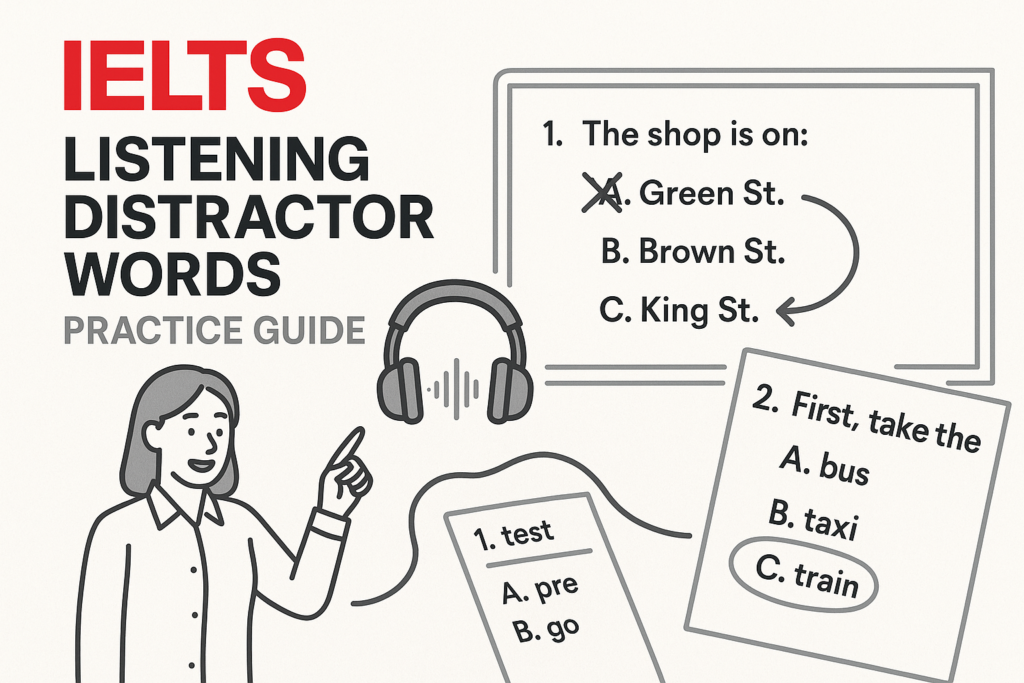
IELTS Listening Distractor Words practice guide is for candidates who often hear the right topic but choose the wrong answer because the recording changes direction. In IELTS Listening, a distractor is not random noise. It is usually an old plan, a rejected option, a correction, a contrast, or a tempting keyword that appears before the real answer. Before you do another full Listening paper, take the IELTS Express Pre-Test to check your current band range and see whether distractors, paraphrase, spelling, or late-answer panic are costing you marks.
The good news is that distractor control is trainable. You do not need to understand every word in the recording. You need to notice when the speaker confirms, cancels, compares, corrects, or chooses between options. Once you learn those signals, IELTS Listening becomes less about chasing keywords and more about waiting for the final meaning.
Why Distractor Words Matter In IELTS Listening
Distractor words matter because IELTS often mentions more than one possible answer. A speaker may give an appointment time, then move it. Two students may discuss three presentation topics before choosing one. A lecturer may mention a common belief, then explain why it is wrong. If you write the first familiar word you hear, you can lose a mark even though you understood the topic.
This is why Listening practice should include error diagnosis, not only answer checking. When you mark a wrong answer, ask whether you fell for a correction, contrast, rejected option, similar-sounding word, word-limit trap, or paraphrase. That small label tells you what to practise next.
- Do not write an answer just because it matches a keyword on the page.
- Listen for correction language such as actually, no, sorry, instead, and changed to.
- Wait for final confirmation when two or more options are mentioned.
- Use grammar around the gap to reject words that do not fit.
- Review mistakes by distractor type after every practice test.
The Core Distractor Routine
Start by reading the question before the audio begins. Decide what information you need: a date, number, place, reason, opinion, problem, feature, or final choice. This makes it easier to notice when the speaker is only discussing possibilities rather than giving the answer.
Next, underline the part of the question that controls meaning. If the question asks why a student rejected an idea, the answer is not the idea itself. If it asks what was finally chosen, wait until the speakers settle the decision. If it asks which feature each person liked, track the person as well as the feature.
During the audio, keep a light pencil mark beside tempting options. If you hear an option but it is followed by however, but, actually, or not now, be careful. The answer often comes after the turn in meaning.
Correction Words That Change The Answer
Correction language is the most obvious distractor pattern. You may hear a speaker give one detail and then correct it. Common signals include actually, sorry, I mean, no, that’s not right, it has changed, instead, rather than, and I should say. The corrected detail is normally more important than the first detail.
For example, a speaker might say the meeting was planned for Tuesday but it has been moved to Thursday. Tuesday is a distractor. Thursday is the final answer. If you write too early, you lose an easy mark.
For wider Listening foundations, use the IELTS Listening practice guide alongside this distractor routine so you build accuracy across all four sections.
Contrast Words That Reveal The Real Meaning
Contrast language often points to the answer. Words such as but, however, although, despite, whereas, while, on the other hand, and in contrast tell you that the speaker is changing direction. Many candidates hear the first half of the sentence clearly and miss the second half, where the answer actually sits.
If the recording says the course is popular but expensive, and the question asks for the disadvantage, expensive is the answer. If it says the room is small but well-equipped, and the question asks for the benefit, well-equipped is the answer. The contrast word tells you which side matters.
Do not panic when you hear two opposite ideas. Pause mentally for one second and connect the question to the correct side of the contrast.
Rejected Options In Multiple Choice
Multiple choice questions are full of distractors because IELTS can mention every option. One answer may be an old preference, one may be another person’s idea, and one may be the final decision. Your job is to listen for evaluation, not just recognition.
Useful rejection phrases include that might be too expensive, I don’t think that would work, we tried that before, it is less suitable, the tutor advised against it, and it sounds good but. If an option is rejected, cross it out lightly or stop considering it.
For realistic pressure after learning this routine, access unlimited IELTS mock tests and review each Listening mistake by distractor type, not just by the correct letter.
Paraphrase Distractors And Similar Meanings
Some distractors are not corrected directly. They are tempting because they sound close to the question. The question may say improve safety, while the recording mentions reducing accidents, stronger supervision, or clearer instructions. The correct answer may be paraphrased, while another option repeats a keyword but has the wrong meaning.
Train yourself to listen for meaning families. If the question is about cost, listen for fee, charge, price, affordable, expensive, budget, discount, and funding. If it is about location, listen for area, site, venue, building, campus, room, entrance, and nearby.
Keyword matching is useful, but meaning matching is safer. When a word sounds familiar, check whether it answers the question exactly.
Number And Date Distractors
Numbers, prices, dates, times, room numbers, postcodes, and phone numbers are easy to distract. A speaker may say one price for adults and another for students. They may mention the old opening time before giving the new time. They may say a phone number, then correct one digit.
Write numbers clearly, but keep listening until the speaker confirms the final version. If you hear correction language after a number, update your answer. If the question already prints a unit such as dollars, minutes, or kilometres, avoid repeating the unit unless the instructions require it.
During checking time, look for impossible formats. A date should look like a date, a phone number should have enough digits, and a price should fit the context.
Speaker Opinion Distractors
In Section 3, distractors often come from different speakers. One student may suggest an option, another may disagree, and the tutor may make the final recommendation. If the question asks what Maria thinks, do not choose David’s opinion just because he speaks more confidently.
Use speaker names as anchors. When Maria speaks, move your eyes to Maria’s question or option. When David interrupts, wait to see whether the answer belongs to him or whether Maria accepts his point. Speaker ownership is a real Listening skill.
If your Listening score is close to your target but distractors keep pulling you off course, see our IELTS preparation plans and choose support that helps you identify the exact pattern behind lost marks.
Grammar Helps You Reject Distractors
Grammar is a useful filter in completion tasks. If the gap needs a noun and the word you heard is an adjective, be careful. If the sentence says several blank were available, a singular answer may not fit. If the note says the course was blank, the answer may need an adjective, not a noun phrase.
This matters because distractors often appear near the answer. A speaker may mention a related noun, then give the real adjective later. The printed sentence controls what can be correct.
Before listening, label each gap quickly: noun, adjective, number, place, date, verb, or short phrase. That tiny prediction helps you ignore attractive words that do not complete the sentence.
A 20-Minute Distractor Drill
Choose one IELTS Listening section with a transcript. First, complete it under test conditions without pausing. After checking answers, do not move on immediately. Replay the recording with the transcript and highlight every place where a wrong option, old detail, correction, contrast, or rejected idea appears.
For every mistake, write one label: correction, contrast, rejected option, wrong speaker, paraphrase, number change, grammar mismatch, word limit, spelling, or lost place. This turns practice from passive repetition into a focused training loop.
Repeat the same task two days later. Your goal is not to memorise the answers. Your goal is to notice the warning signals earlier and wait for final confirmation.
Seven-Day Distractor Practice Plan
On day one, practise correction words with Section 1 forms and enquiries. On day two, focus on contrast words in short conversations. On day three, practise multiple choice and cross out rejected options. On day four, review number and date changes.
On day five, work on Section 3 speaker opinions. On day six, complete a full Listening test and label every lost mark by cause. On day seven, repeat your weakest distractor type with a fresh recording and a transcript review.
What A Strong Distractor Routine Looks Like
A strong Listening attempt feels patient. You hear a tempting keyword but wait for the sentence to finish. You notice when the speaker says but, actually, instead, or finally. You track who owns each opinion. You keep your answer short enough for the word limit and grammatical enough for the printed sentence.
You also recover quickly. If you realise one option was rejected, you do not panic. You cross it out mentally and follow the next clue. IELTS Listening rewards candidates who stay flexible until the final answer is clear.
Final Checklist Before Test Day
Before your IELTS test, make sure you can recognise correction language, contrast language, rejected options, speaker-opinion shifts, number changes, paraphrase traps, grammar clues, and final confirmation phrases.
IELTS Listening distractor words are manageable when you know what they are doing. Listen for movement in meaning, not just matching words. Wait for the final answer, check that it fits the question, and review every practice error by distractor type.
Ready to find out your IELTS band score?
Take the IELTS Express Pre-Test for just $4.99 and get your personalised band prediction with a 14-day improvement plan.
FAQ: IELTS Listening Distractor Words Practice Guide
What are distractor words in IELTS Listening?
Distractor words are details that sound possible but are not the final answer. They often appear as old plans, corrections, rejected options, contrast ideas, or tempting keywords.
How do I avoid distractors in IELTS Listening?
Read the question carefully, listen for correction and contrast language, wait for final confirmation, track the correct speaker, and check that the answer fits the grammar of the question.
Are distractors common in IELTS multiple choice?
Yes. Multiple choice often mentions all options, so you need to identify which option is accepted, rejected, changed, or only partly true.
What words signal a correction in IELTS Listening?
Common correction signals include actually, sorry, I mean, instead, rather than, no, that’s changed, and I should say. The answer usually comes after the correction.
Can grammar help with IELTS Listening distractors?
Yes. If a word does not fit the grammar of the sentence or note, it may be a distractor even if it sounds related to the topic.