A good IELTS General Training thank you letter sample answer shows more than polite vocabulary. It makes the reason for writing clear, covers every part of the situation and sounds appropriate for the person receiving it. This lesson walks you through an original practice task, a complete response and a repeatable editing routine. Use it to understand the choices behind a letter, not as a script to memorise.
At Career Wise English, you can connect focused letter practice with a wider preparation routine. Start by writing your own response to the task below before reading the model. Comparing two versions helps you notice missing details much more effectively than copying a polished answer.
Understand the thank you letter task
Imagine this practice question: You recently stayed with a friend while attending a training course in another city. Write a letter to your friend. Thank your friend for your stay, explain what you enjoyed most, and invite your friend to visit you. Begin your letter with “Dear Alex”. This is an original practice prompt, not a reproduced examination question.
The relationship gives you the tone. Alex is a friend, so a warm, personal style fits. You do not need business expressions such as “I wish to express my sincere appreciation for the accommodation provided”. That sentence is grammatical, but it creates distance in a situation that calls for familiarity. A straightforward opening can communicate gratitude more naturally.
The three instructions also give you a useful content map. You need a clear thank you, a specific account of something you enjoyed, and an invitation that feels usable. Saying “Thank you for everything” and then describing your course would not fully develop the purpose. Keep your attention on the visit and your relationship with the reader.
Read the complete sample answer
The following model demonstrates one possible response. It is a teaching example rather than an officially assessed script or a guaranteed band score. Notice how each paragraph has a distinct job while the letter still sounds like a real message between friends.
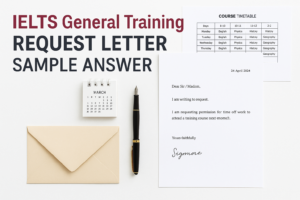
Dear Alex,
Thanks so much for letting me stay with you last week while I was taking my training course. Having a comfortable place to come back to each evening made a busy week much less stressful, and I really appreciated all the meals you cooked.
The highlight for me was our walk along the river on Saturday. After spending most of the week indoors, it was lovely to get outside, catch up properly and explore a part of the city I would never have found on my own. I am still thinking about the delicious lunch we had at that little cafe you recommended!
I would love to return the favour, so why not come and stay with me next month? The spare room is finally ready, and we could spend a day at the coast if the weather is good. You mentioned wanting a quiet weekend away, so this could be the perfect chance.
Let me know which weekend would suit you. Thanks again for making me feel so welcome.
Best wishes,
Sam
Read the letter aloud once. The writer is thankful without repeating the same compliment in every paragraph. The invitation follows naturally from the hospitality already received. Those connections make the response feel purposeful rather than like three unrelated answers placed together.
See how the answer develops each bullet point
The first paragraph names the help and explains its effect. “Letting me stay with you” identifies what Alex did. The reference to returning after a busy course explains why that help mattered. The meals provide a second concrete detail without turning the opening into a list of every favour.
The next paragraph selects one memorable experience instead of briefly mentioning several activities. The river walk is developed through a contrast with being indoors, a chance to talk and the discovery of an unfamiliar area. The cafe detail adds a personal touch. None of these details needs to be dramatic; ordinary experiences work well when they are relevant.
The invitation gives a possible time, confirms there is somewhere to stay and suggests a shared activity. It also refers to Alex wanting a quiet weekend, which makes the offer personal. A final request for a suitable weekend gives the recipient something simple to respond to. This is more effective communication than an unsupported “Please visit me sometime”.
For another example of building a practical invitation, compare the General Training invitation letter sample answer. Focus on how the writer supplies enough information for the reader, rather than borrowing complete sentences from a different situation.
Choose natural vocabulary and a consistent tone
Useful expressions include “Thanks so much for”, “I really appreciated”, “The highlight for me was” and “I would love to return the favour”. Each phrase performs a clear function. Choose a small number and adapt them to the actual task. A letter filled with elaborate expressions of gratitude can sound repetitive even when individual phrases are correct.
Vocabulary accuracy matters more than rarity. You can thank someone for their hospitality, appreciate their help or say that they made you feel welcome. Be careful with word patterns: “thank you for helping me” works, while “thank you to help me” does not express the same idea naturally. Similarly, “I appreciated your help” does not need an extra “for”.
Keep the relationship consistent from greeting to closing. A friendly opening followed by legalistic or ceremonial language can feel uneven. If the recipient is someone you know less well, choose a more restrained version: “Thank you for your generous hospitality during my visit” may fit better than “You are an absolute legend”. The task, not your favourite phrase, should guide the choice.
The recent guide to lexical resource and precise vocabulary discusses word choice in an essay context. The transferable lesson is to prefer appropriate, accurate language; do not assume that essay organisation or an argumentative tone belongs in a personal letter.
Plan your own response before writing
Begin with three short notes, one for each instruction. For this prompt, your notes might be: spare room and dinners; river walk and cafe; next month and coastal trip. These are planning cues, not sentences. They prevent you from spending all your attention on the first paragraph and rushing the invitation at the end.
Next, decide how the letter will move through time. Thanking Alex refers to the recent past, describing the favourite experience continues that past narrative, and the invitation moves into a possible future. This simple timeline helps you select verb forms naturally. You do not need to force a complicated grammatical structure into every paragraph.
Write a complete first version before polishing individual words. If a sentence becomes difficult to control, simplify it and continue. A clear explanation of how the host helped you is more valuable than an unfinished sentence containing an ambitious expression. During review, you can combine short sentences where the connection is useful and easy to follow.
Use IELTS mock tests to practise moving between tasks under time pressure. Then return to focused letter writing to investigate one weakness at a time. Compare preparation options and prices before choosing support that matches the problems you actually notice in your writing.
Edit with a practical thank you letter checklist
First, check coverage. Underline the sentence that thanks the recipient, the details explaining what you enjoyed and the actual invitation. If one part is difficult to find, make it more explicit. Do not rely on the examiner to infer a missing instruction from the general friendliness of your response.
Second, check references. If you mention “that place” or “the experience”, ask whether the reader knows what you mean. Replace vague wording with a concrete noun where necessary. Also check that your invented details agree: an invitation for next month should not suddenly become a visit scheduled for tomorrow without explanation.
Finally, check manageable language features: past-tense endings, subject–verb agreement, articles, sentence boundaries and the spelling of common words. Read the closing with the opening to see whether the tone still matches. Keep a short error log after each practice session, and use it to choose your next exercise rather than rewriting every sentence for the sake of variety.
Frequently asked questions
Should I memorise this sample answer?
No. Learn the paragraph functions and useful word patterns, then write a fresh response to a different situation. A memorised visit narrative can become irrelevant if the prompt asks you to thank a colleague for help with a project or a neighbour for looking after your home.
Does every thank you letter need an informal tone?
No. The relationship and purpose determine the style. A letter to a close friend can sound warm and conversational. A message to an organisation or someone you barely know normally needs more restrained wording. Read the situation carefully before deciding on the greeting and register.
Can I invent details about the visit?
Yes, use plausible details to develop the situation. Keep them relevant and internally consistent. You do not need a complicated story or specialist knowledge. A meal, a shared walk or a convenient place to stay can provide enough material for clear, specific appreciation.
How can I improve after comparing my answer with the model?
Choose one content issue and one language issue. For example, develop a vague invitation and correct repeated verb-pattern errors. Rewrite only the affected section, then try a new prompt. This turns comparison into deliberate practice instead of a general feeling that the model sounds better.