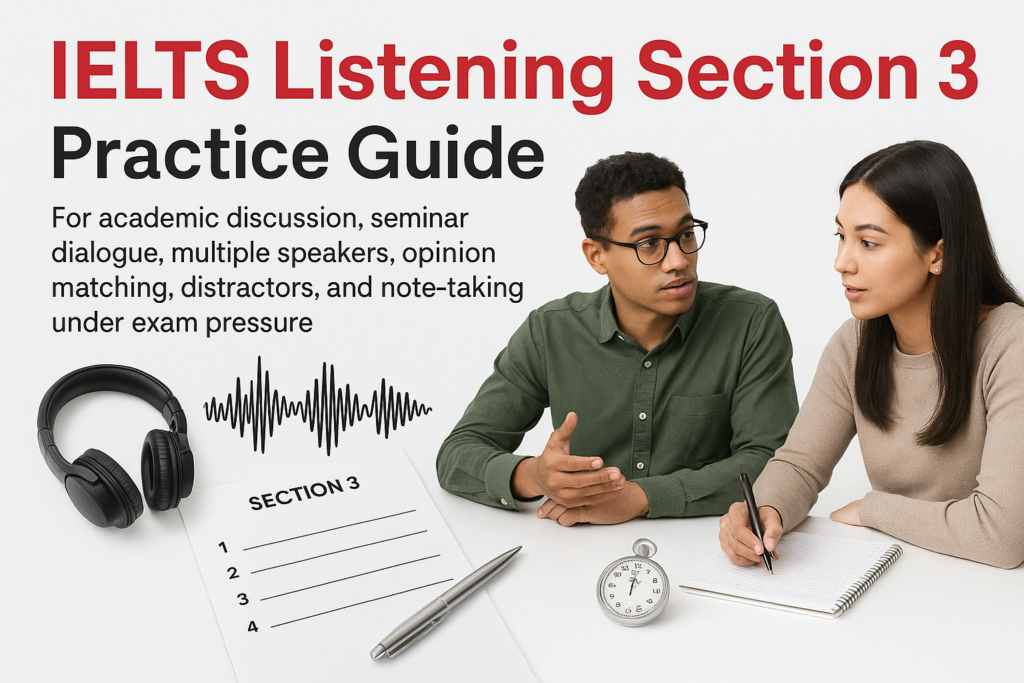
IELTS Listening Section 3 Practice practice guide is for candidates who can follow everyday Listening sections but lose confidence when the recording becomes a university-style discussion. Section 3 usually has two to four speakers talking about a course, assignment, presentation, research project, tutorial, field trip, placement, or academic problem. Before you do another full Listening paper, take the IELTS Express Pre-Test to check your current band range and see whether Section 3 speaker tracking, paraphrase, or distractors are costing you marks.
Section 3 feels harder because answers are hidden inside discussion, not simple information exchange. Speakers agree, disagree, change their minds, suggest options, reject earlier ideas, and use academic vocabulary. The solution is not to memorise more words. You need a routine for reading the task, identifying speakers, following opinions, and moving with the recording even when the conversation becomes busy.
Why IELTS Listening Section 3 Matters
Section 3 is often the bridge between practical listening and academic listening. It may involve students planning a seminar, discussing feedback with a tutor, comparing research methods, choosing presentation topics, or reviewing an assignment. The topic is still accessible, but the thinking is more complex than Section 1 or Section 2.
This section is important because it exposes weak tracking habits. Candidates may understand individual sentences but miss who said what. They may hear every option mentioned but choose the one that was rejected. They may know the vocabulary but lose their place when the question type changes.
- Read speaker names, roles, headings, and question stems before the audio starts.
- Predict whether each question asks for an opinion, decision, reason, problem, or recommendation.
- Listen for agreement, disagreement, correction, and final decisions.
- Track paraphrase instead of waiting for exact words from the question paper.
- Review every mistake by cause, not only by correct answer.
The Core Section 3 Routine
Start with the task title and instructions. If the task is multiple choice, check whether you need one answer or more than one. If it is matching, check whether each option can be used once, more than once, or not at all. If it is completion, check the word limit before you listen.
Next, scan the full question set. Section 3 often uses several task types in one recording, such as multiple choice followed by matching, or sentence completion followed by a table. Know where the change happens so you are not surprised halfway through the conversation.
Finally, identify the speakers. If names are printed, circle or mentally mark them. If the question asks what one student thinks, listen for that student, not the loudest or most confident speaker. Speaker ownership is one of the biggest Section 3 skills.
Read Questions For Function, Not Just Keywords
In Section 3, a question rarely asks for a simple fact. It may ask why students chose a topic, what problem they had, what the tutor recommends, what one speaker thinks about a method, or which feature each person liked. That means you should read for function before listening.
If the question asks for a reason, listen for because, due to, the main issue, what worries me, or that is why. If it asks for a recommendation, listen for should, need to, it would be better to, I suggest, or the tutor wants them to. If it asks for a decision, wait for the final choice, not the first idea.
For broader Listening foundations, use the IELTS Listening practice guide alongside this Section 3 routine so your section-specific practice sits inside a full test strategy.
Track Speakers And Opinions
Many Section 3 mistakes happen because candidates remember an idea but forget who said it. In a discussion, one speaker may suggest using interviews, another may prefer questionnaires, and the tutor may reject both unless the students explain their sample clearly. The answer depends on the right person and the final meaning.
Use the printed names as anchors. When a speaker talks, move your eyes to their name or to the question connected with them. If the audio uses pronouns such as she, he, or they, connect those pronouns back to the speaker names quickly.
Also listen for attitude. A speaker may sound uncertain, enthusiastic, disappointed, cautious, or relieved. IELTS does not test emotion for its own sake, but attitude often shows whether a speaker supports or rejects an option.
Handle Multiple Choice Without Falling For Distractors
Section 3 multiple choice is rarely about hearing one magic word. The recording may mention all three options. One option may be an old plan, another may be a partial problem, and the final answer may come after a correction or discussion.
Before listening, identify the difference between the options. Do not read A, B, and C as three long sentences. Ask yourself what changes: the reason, the timing, the person, the benefit, the problem, or the final decision. During listening, focus on the difference.
For realistic pressure after learning the routine, access unlimited IELTS mock tests and review Section 3 errors by speaker confusion, option trap, paraphrase, missed correction, and lost place.
Matching Tasks In Section 3
Matching tasks can feel crowded because you may have a list of speakers, topics, comments, or features. The key is to treat the options as meanings, not words to wait for. Underline the part that makes each option different from the others.
If several options look similar, convert them into simple labels in your head. For example, one option may mean too expensive, another may mean not enough time, and another may mean useful for beginners. When you hear the discussion, listen for those meanings even if the wording changes.
Be careful with temporary opinions. A student might initially dislike a topic, then change their view after the tutor explains its value. In matching, the final attitude or assigned feature is usually what matters.
Note Completion And Academic Vocabulary
Section 3 completion tasks often involve assignment notes, presentation plans, research methods, feedback points, or project stages. The vocabulary may be academic, but the answer still has to fit the printed sentence or note.
Predict grammar before listening. If the note says the students need more blank, the answer may be a plural noun or an uncountable noun. If it says the method was blank, the answer may be an adjective. If it says they will interview blank, the answer is probably a group of people.
Do not write too much. If the instruction says no more than two words, a correct phrase with three words is still wrong. Section 3 often includes longer explanations around a short answer, so choose the smallest answer that completes the sentence accurately.
Common Section 3 Traps
The first trap is choosing the first option mentioned. Academic discussions naturally explore ideas before reaching a decision. Wait for confirmation language such as so we will use, that seems best, the tutor agreed, or in the end.
The second trap is missing disagreement. Phrases such as I am not sure, that might be difficult, I see your point but, actually, or wouldn’t it be better to often introduce a change in direction. These small phrases carry the answer.
The third trap is exact-word matching. The question may say research participants, while the speaker says people who completed the survey. If your Listening score is close to your target but small Section 3 errors keep appearing, see our IELTS preparation plans and choose support that helps you diagnose question-type weaknesses.
How To Recover When The Discussion Gets Busy
If you lose your place in Section 3, do not chase the missed answer. Put a small mark beside it and move to the next question stem, speaker name, or option set. The recording will keep moving, and recovering quickly protects the next marks.
Use task changes as recovery points. When the recording moves from questions 21 to 24 into questions 25 to 30, there is often a clear shift in the conversation. If you missed one part, prepare for the next part instead of replaying the mistake in your head.
Recovery is a skill you can practise. After a missed answer, train yourself to find the next printed anchor within two seconds. Strong candidates are not perfect listeners; they are quick recoverers.
A 20-Minute Section 3 Drill
Choose one Section 3 recording. Before playing it, spend three minutes reading all questions, marking speaker names, identifying task changes, and predicting what each question is asking for. Then play the recording once under test conditions.
After checking answers, replay the recording with the transcript. For each answer, highlight the phrase that gave the meaning and the phrase that acted as a distractor. This turns the transcript into a training tool instead of just an answer check.
Write one short label for every error: wrong speaker, first option trap, missed disagreement, paraphrase, word limit, spelling, grammar, or lost place. Repeat the same recording two days later and check whether the routine improves your tracking.
Seven-Day Section 3 Practice Plan
On day one, practise reading Section 3 questions without audio and identifying what each question is really asking. On day two, focus on speaker tracking. On day three, practise multiple choice and option elimination. On day four, practise matching tasks and paraphrase.
On day five, complete two timed Section 3 tasks and review every error by cause. On day six, complete a full Listening test and compare Section 3 with your other sections. On day seven, repeat your weakest area: speaker ownership, distractors, matching, completion, or recovery after losing your place.
What A Strong Section 3 Attempt Looks Like
A strong Section 3 attempt feels active, not passive. You know the topic, the speakers, the task change, and the function of each question before the audio begins. During the recording, you move with the discussion and wait for final meaning rather than reacting to every familiar word.
You also accept that Section 3 is meant to include traps. Distractors are not unfair; they are part of testing whether you can follow a real discussion. Once you expect corrections, disagreement, and paraphrase, the section becomes much more manageable.
Final Checklist Before Test Day
Before your IELTS test, make sure you can track speakers, identify opinions, handle multiple choice, complete matching tasks, predict grammar for notes, ignore rejected options, and recover quickly after one missed answer.
IELTS Listening Section 3 practice should train discussion tracking. Read the task for function, connect ideas to the correct speaker, wait for final decisions, and review mistakes by cause. Do that consistently and Section 3 becomes less chaotic and much more score-friendly.
Ready to find out your IELTS band score?
Take the IELTS Express Pre-Test for just $4.99 and get your personalised band prediction with a 14-day improvement plan.
FAQ: IELTS Listening Section 3 Practice Guide
What is IELTS Listening Section 3?
Section 3 is usually an academic or training-related discussion between two to four people, often students and sometimes a tutor, about an assignment, presentation, research task, or course issue.
Why is Section 3 harder than Section 2?
Section 3 is harder because several speakers may discuss options, disagree, change their minds, and use paraphrase. You must track who says what and wait for final meaning.
How do I improve IELTS Listening Section 3?
Read the full question set before listening, mark speaker names, identify task changes, listen for agreement and disagreement, and review mistakes by cause after each practice recording.
Are Section 3 answers in order?
Usually, yes. Answers generally follow the order of the recording, but discussion, examples, and rejected options may appear between answers.
What should I check after Section 3 practice?
Check whether errors came from wrong speaker tracking, option traps, missed disagreement, paraphrase, word limits, spelling, grammar, or losing your place after one missed answer.