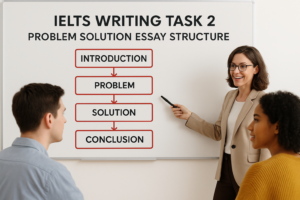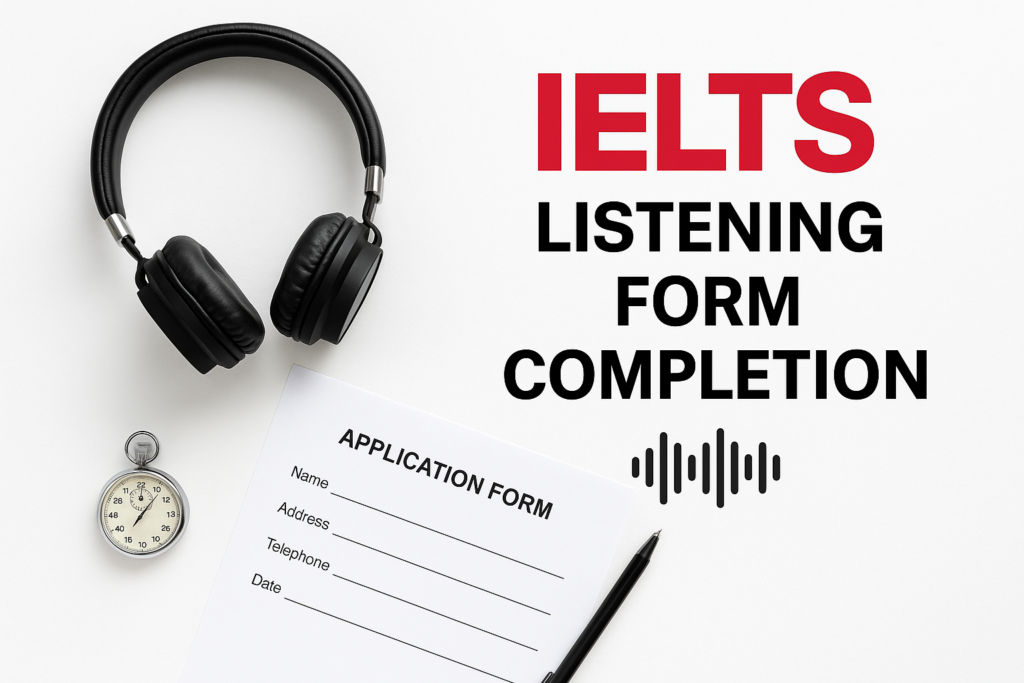
IELTS Listening Form Completion practice guide is for candidates who lose marks on names, numbers, dates, addresses, prices, booking details, and short notes even when the conversation feels easy. Form completion looks simple, but it tests accuracy under pressure. You must predict the type of information, follow the word limit, catch spelling, and write the answer while the recording continues. Before you do another full Listening paper, take the IELTS Express Pre-Test to check your current band range and see whether listening accuracy, spelling, or test timing is costing you marks.
The good news is that form completion improves quickly when you use a fixed routine. You do not need to understand every word in the conversation. You need to know what detail is missing, listen for the clue before the gap, write only the required words, and check grammar after the answer is placed in the form.
Why IELTS Listening Form Completion Feels Easy But Costs Marks
Form completion often appears in Listening Section 1, where two speakers discuss practical information such as an enquiry, booking, registration, membership, application, or service request. The topic may feel familiar, so many candidates relax too much. That is when careless mistakes happen.
The test may ask for a surname, postcode, street name, phone number, price, date, time, or short description. One wrong letter can make an answer incorrect. If the answer is plural and you write the singular form, you may also lose the mark. Accuracy matters more than general understanding.
- Read the form before the audio starts.
- Predict whether each gap needs a name, number, date, place, noun, or adjective.
- Check the word limit before writing.
- Listen for spelling, corrections, and repeated details.
- Review grammar and plural forms as soon as the section ends.
The Core Form Completion Routine
Start with the instructions. If the task says no more than one word and/or a number, do not write two words. If it says no more than two words, a three-word answer is still wrong even if the meaning is correct. Word limits are not suggestions.
Next, scan the form from top to bottom. Notice headings such as name, address, course, membership, travel details, emergency contact, facilities, or payment. These headings tell you what kind of answer is likely. A gap after postcode will not need an opinion. A gap after preferred time will probably need a time or part of the day.
Finally, look at the words before and after each gap. They often control the grammar. If the form says type of accommodation: blank, the answer may be a noun phrase such as hostel or single room. If it says payment made by: blank, the answer may be card, cash, or bank transfer.
Read The Form Before You Listen
The preparation time before the recording is not empty time. Use it to reduce pressure. Read the labels first, then the gaps. Try to predict the category of each answer. You may not know the exact word, but you can often know whether it will be a number, date, place, name, or object.
For example, if a form includes arrival date, number of guests, room type, and special request, you already know the listening path. The speakers will probably move through those details in order. This makes the audio easier to follow.
For broader listening skill work, use the IELTS Listening practice guide alongside this form-completion routine.
Predict The Type Of Answer
Prediction is the biggest difference between passive listening and exam listening. Before the audio starts, ask: what kind of information can fit this blank? If the label says contact number, listen for digits. If it says occupation, listen for a job title. If it says reason for visit, listen for a short noun phrase.
Prediction also helps you ignore irrelevant language. In a booking conversation, the speaker may mention several dates before confirming the final one. If the gap asks for preferred date, wait for the confirmed answer, not the first date you hear.
You can mark each gap with a quick note: N for name, # for number, D for date, P for place, T for time, or W for word. Keep the marks tiny. They are there to guide your ears, not decorate the paper.
Names, Addresses And Spelling
IELTS form completion often tests spelling because real-life forms require exact information. If a name is unusual, the speaker may spell it. Listen carefully to letters that sound similar, such as B and P, M and N, A and E, or G and J.
Addresses can be tricky because they may include a house number, street name, suburb, postcode, or unit number. Do not write extra information if the gap only asks for one part of the address. If the label says street, write the street name, not the full address.
When a word is spelled, write it immediately. Do not wait and hope you will remember it later. If you miss one letter, keep listening and use the next repetition or confirmation to recover.
Numbers, Dates, Prices And Times
Numbers are common in form completion. You may hear phone numbers, membership numbers, reference numbers, prices, dates, room numbers, ages, or quantities. The difficulty is not always the number itself; it is correction. A speaker may say one number, then correct it.
Listen for phrases such as sorry, actually, no, I mean, let me check, that should be, or it has changed to. The final corrected detail is usually the answer. Do not lock in the first number too quickly.
Dates and times also need careful format control. If the form already includes the month, you may only need the day. If the form asks for time, check whether the answer should include am, pm, morning, afternoon, or evening. For realistic pressure after learning the routine, access unlimited IELTS mock tests and review form completion errors by detail type.
Word Limits And Grammar Checks
Many form completion marks are lost after the student has heard the correct answer. The problem is not listening; it is writing too much. If the instruction allows one word only, a correct two-word phrase will still be marked wrong.
Check whether articles are needed. In many IELTS completion answers, you do not need a, an, or the unless the grammar of the note requires it and the word limit allows it. If the form says membership type: blank, write student, family, annual, or temporary if that is what the audio gives.
After the section, read each completed line quietly in your head. Does the answer fit grammatically? If the sentence sounds broken, check whether you need a plural, a number, or a different word form.
Common Form Completion Traps
The first trap is correction. The speaker may give an old phone number, then correct it. The second trap is distractor details. A caller may ask about two courses, but only one is finally chosen. The third trap is similar spelling, especially with names and addresses.
The fourth trap is copying the unit incorrectly. If the form already includes dollars, do not write the dollar sign unless required. If it already includes pm, do not duplicate it. The fifth trap is missing plural forms. If the speaker says two seminars and you write seminar, the answer may be wrong.
If your Listening score is close to your target but inconsistent, see our IELTS preparation plans and choose support that helps you diagnose small accuracy errors instead of simply doing more tests.
A 20-Minute Practice Drill
Choose one IELTS form completion task. Before playing the audio, spend three minutes reading the form and labelling each gap by answer type. Then play the recording once under test conditions. Do not pause or replay during the first attempt.
After checking answers, replay the audio and write the exact phrase that gave each answer. Mark whether your mistake came from prediction, spelling, word limit, correction, plural form, or losing your place. This error label matters because it tells you what to fix next.
Repeat the same task two days later. The aim is not to memorise the answers. The aim is to see whether your routine is faster and cleaner when the pressure is lower.
Seven-Day Form Completion Practice Plan
On day one, practise reading forms and predicting answer types without audio. On day two, practise names and spelling, especially letters that sound similar. On day three, practise phone numbers, reference numbers, prices, and dates.
On day four, focus on corrections and final confirmed details. On day five, complete two timed form completion tasks and review every error by cause. On day six, complete a full Listening test and check whether form completion still costs marks. On day seven, repeat your weakest area: spelling, number accuracy, word limits, or recovery after missed details.
Final Checklist Before Test Day
Before your IELTS test, make sure you can read the form quickly, predict answer types, follow the order of details, catch spelling, write numbers accurately, obey word limits, and check grammar after the section.
IELTS Listening form completion rewards calm accuracy. Do not chase every word in the conversation. Read the form, predict the missing detail, wait for confirmation, write only what the instructions allow, and review your answers with a clear error system.
Ready to find out your IELTS band score?
Take the IELTS Express Pre-Test for just $4.99 and get your personalised band prediction with a 14-day improvement plan.
FAQ: IELTS Listening Form Completion Practice Guide
How do I improve IELTS Listening form completion?
Read the form before listening, predict the type of answer, follow the order of details, listen for spelling and corrections, and review mistakes by cause after each task.
Are form completion answers usually in order?
Yes, they usually follow the order of the recording. However, speakers may mention extra details or correct themselves, so wait for the final confirmed answer.
What details are common in IELTS form completion?
Common details include names, addresses, phone numbers, dates, times, prices, occupations, booking references, course names, facilities, and short descriptions.
Can spelling mistakes lose marks in IELTS Listening?
Yes. IELTS Listening answers must be spelled correctly. This is especially important for names, addresses, plural nouns, and words that are spelled out in the recording.
How can I avoid breaking the word limit?
Read the instructions before the audio starts and check each answer after the section. If the task says one word only, do not write two words even if the meaning is correct.