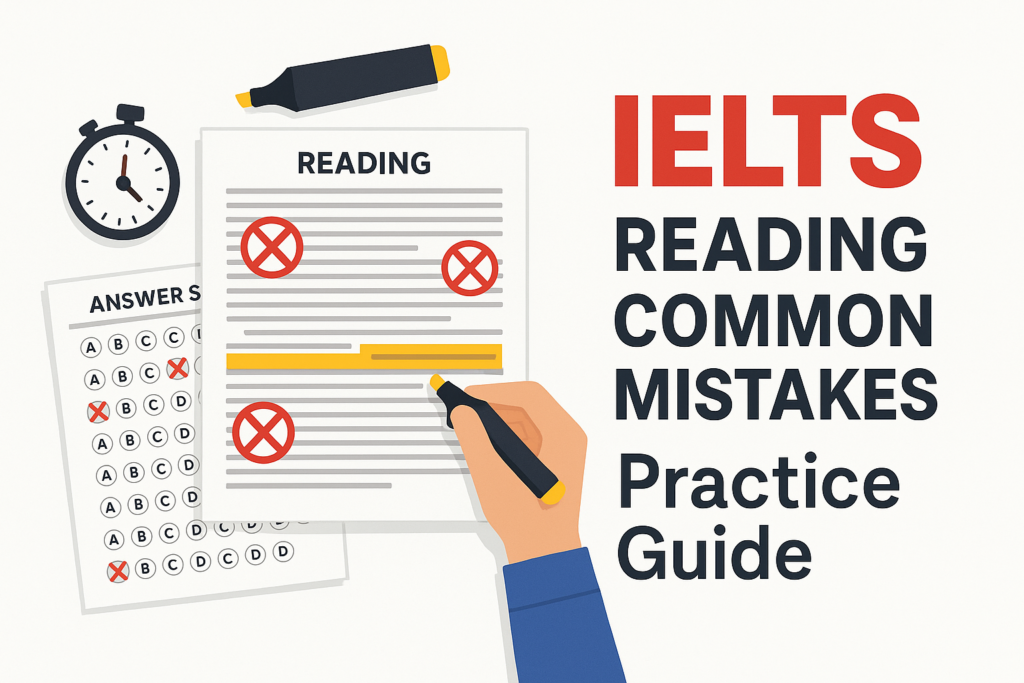
IELTS Reading Common Mistakes practice guide is for candidates who practise regularly but keep losing marks in the same frustrating ways. Reading mistakes often feel random, but they usually come from a small set of habits: chasing keywords, reading too slowly, ignoring word limits, guessing Not Given, and reviewing answers without diagnosing the cause. Before you do another full test, take the IELTS Express Pre-Test to check your current band range and see whether speed, accuracy, or question-type method is holding you back.
The good news is that most Reading mistakes are fixable. You do not need to understand every sentence perfectly. You need a repeatable way to find evidence, compare meaning, manage time, and learn from errors. This guide shows you the common mistakes, why they happen, and how to replace them with better exam habits.
Why IELTS Reading Mistakes Repeat
IELTS Reading mistakes repeat because students often practise the score, not the skill. They complete a passage, check the answer key, feel disappointed, and then move to another passage. That creates activity, but it does not always create improvement.
Every wrong answer has a cause. It may be a timing issue, a vocabulary issue, a paraphrase issue, a grammar issue, a word-limit issue, or a question-type issue. If you only write the correct answer beside your wrong answer, you miss the useful lesson.
- Record the question type for every mistake.
- Write the exact line or paragraph that proves the correct answer.
- Label the cause of the error in simple words.
- Repeat the same question type before doing another full test.
- Track whether the mistake reduces over time.
Mistake 1: Matching Keywords Instead Of Meaning
The most common IELTS Reading mistake is choosing an answer because the question and passage share similar words. IELTS often uses keyword matches as traps. A paragraph may contain the same word as the question, but the meaning may be different, incomplete, or connected to another option.
For example, the question may mention a benefit, while the passage mentions the same topic as a problem. Or the question may ask about a past situation, while the passage describes a future plan. If you stop at the keyword, you miss the grammar and logic around it.
Fix this by reading the full sentence before and after the keyword. Ask what the text actually says, not just where the word appears. Higher Reading scores come from meaning comparison, not word spotting.
Mistake 2: Reading The Whole Passage Too Slowly
Some candidates try to read the whole passage like a university textbook. This feels responsible, but it often damages the score because IELTS Reading is timed. You have 60 minutes for 40 questions, and there is no extra transfer time. Slow reading can leave you with rushed answers at the end.
You need selective reading. Preview the title, headings, paragraph structure, names, numbers, and repeated terms. Then let the question type tell you where to slow down. Matching headings needs paragraph purpose. Completion questions need exact grammar and word limits. True False Not Given needs strict statement comparison.
For a full timing system, use the IELTS Reading practice speed and accuracy guide together with this mistake checklist.
Mistake 3: Ignoring The Question Type
IELTS Reading question types are not all solved the same way. A candidate who uses one method for every task will usually waste time or make careless decisions. Matching headings, matching information, multiple choice, completion, and True False Not Given each require a different rhythm.
Before searching for answers, identify what the task is asking you to do. Are you finding a main idea, a detail, a name, a condition, a sentence completion, or a writer’s claim? That one decision changes how you read.
If the task is matching headings, focus on the whole paragraph purpose. If it is completion, check the instruction and grammar. If it is multiple choice, compare every option with the text and eliminate traps. A question-type routine protects you from rushing into the passage without a plan.
Mistake 4: Guessing Not Given Too Quickly
True False Not Given and Yes No Not Given cause many lost marks because students treat Not Given as a feeling. Not Given does not mean you cannot find the exact same words. It means the text does not give enough information to decide whether the statement is correct.
Read the statement in parts. Check the subject, verb, comparison, quantity, time phrase, and condition. A statement may look close to the passage but still be unsupported because one detail is missing. Words such as only, always, never, before, after, more than, mainly, and all are especially important.
Do not choose Not Given after a weak search. First, search for strong clues, read around the likely area, and decide whether the text confirms, contradicts, or does not address the claim. If there is no clear evidence either way, then Not Given becomes a disciplined answer, not a guess.
Mistake 5: Breaking Word Limits In Completion Tasks
Completion tasks are easy to underestimate. Students often find the correct idea but lose the mark because the answer has too many words, the wrong form, or a spelling error. If the instruction says no more than two words and/or a number, three words are wrong even when the meaning is right.
Always read the instruction before searching. After you choose the answer, put it back into the sentence. Does it fit grammatically? Does it need a plural noun? Does it need a number? Did you copy a word exactly from the text when the task requires words from the passage?
For realistic pressure and a wider range of question types, access unlimited IELTS mock tests and review completion errors by word limit, spelling, grammar, and wrong-location mistakes.
Mistake 6: Spending Too Long On One Hard Question
One difficult question should not steal five easier marks. IELTS Reading rewards total accuracy across the paper, not heroic effort on one item. If you stay too long on one question, you may finish the passage tired and rush questions you could answer correctly.
Use a time rule. If you have searched properly and still cannot decide, mark the question, choose the most reasonable answer if needed, and move on. Returning later with more context often helps. Nearby questions may reveal the right paragraph or clarify the passage structure.
This habit is especially important for candidates aiming for Band 7 or higher. The goal is not to feel certain about every answer immediately. The goal is to protect enough time to make good decisions across all 40 questions.
Mistake 7: Reviewing Only The Answer Key
Checking the answer key tells you what was right or wrong. It does not automatically teach you how to improve. Strong review means reconstructing the decision. Where was the evidence? Which word or phrase in the question was paraphrased? Why was your answer attractive but wrong?
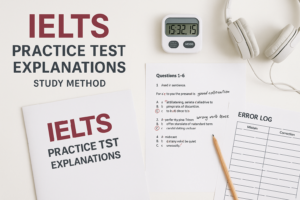
Create a simple error log with four columns: question type, your answer, correct answer, and reason for the mistake. Keep the reason short. Use labels such as keyword trap, missed paraphrase, word limit, wrong paragraph, grammar fit, spelling, or rushed guess.
If you are close to your target band but cannot identify the pattern, see our IELTS preparation plans and choose support that includes detailed Reading feedback, not just more practice material.
Mistake 8: Treating Academic And General Reading The Same
Academic and General Training Reading share many skills, but the text styles are different. Academic passages are usually denser and more abstract, so paragraph mapping and argument tracking are important. General Training starts with everyday and workplace texts, where conditions, exceptions, notices, and practical details matter.
Academic candidates should watch for cause, contrast, theory, evidence, examples, and writer attitude. General Training candidates should watch for must, may, except, unless, before, after, required, optional, and available. These small words often decide the answer.
If you are preparing for migration, use the IELTS General Training migration guide to connect your Reading practice with the band score requirements you need.
A Better Practice Routine For Avoiding Mistakes
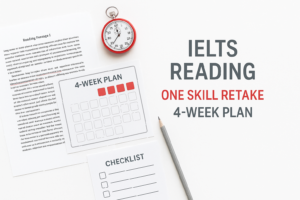
Use a seven-day routine instead of random practice. On day one, complete one passage untimed and write evidence for every answer. On day two, practise only True False Not Given. On day three, practise completion tasks and check word limits. On day four, practise matching headings and write paragraph purpose notes.
On day five, complete one timed passage and record where time disappeared. On day six, complete a full Reading test under exam conditions. On day seven, review the error log and repeat the question type that caused the most wrong answers.
This routine trains accuracy and control. It also stops you from confusing more practice with better practice. The aim is to make fewer of the same mistakes each week.
Final IELTS Reading Mistake Checklist
Before test day, check that you can preview quickly, identify question types, search with useful clues, recognise paraphrase, prove answers from the passage, follow word limits, manage the clock, and review errors by cause.
IELTS Reading improves when you become more honest about why marks are lost. If you keep a clean error log and practise the weak skill directly, common mistakes become predictable and fixable. That is much more useful than hoping the next passage will be easier.
Ready to find out your IELTS band score?
Take the IELTS Express Pre-Test for just $4.99 and get your personalised band prediction with a 14-day improvement plan.
FAQ: IELTS Reading Common Mistakes Practice Guide
What is the most common IELTS Reading mistake?
The most common mistake is matching keywords without checking meaning. Always read around the keyword and compare the full idea with the question.
Why do I keep getting Not Given questions wrong?
You may be choosing Not Given too quickly or treating it as a feeling. Search for evidence first, then decide whether the text confirms, contradicts, or does not provide enough information.
How can I stop running out of time in IELTS Reading?
Preview quickly, use question types to guide your reading, avoid spending too long on one hard item, and return to difficult questions after protecting easier marks.
How should I review IELTS Reading mistakes?
Record the question type, evidence location, correct answer, your answer, and the cause of the mistake. Then practise the weakest question type directly.
Do word limits really matter in IELTS Reading?
Yes. If the instruction says no more than two words and/or a number, an answer with three words is wrong even if the idea is correct.