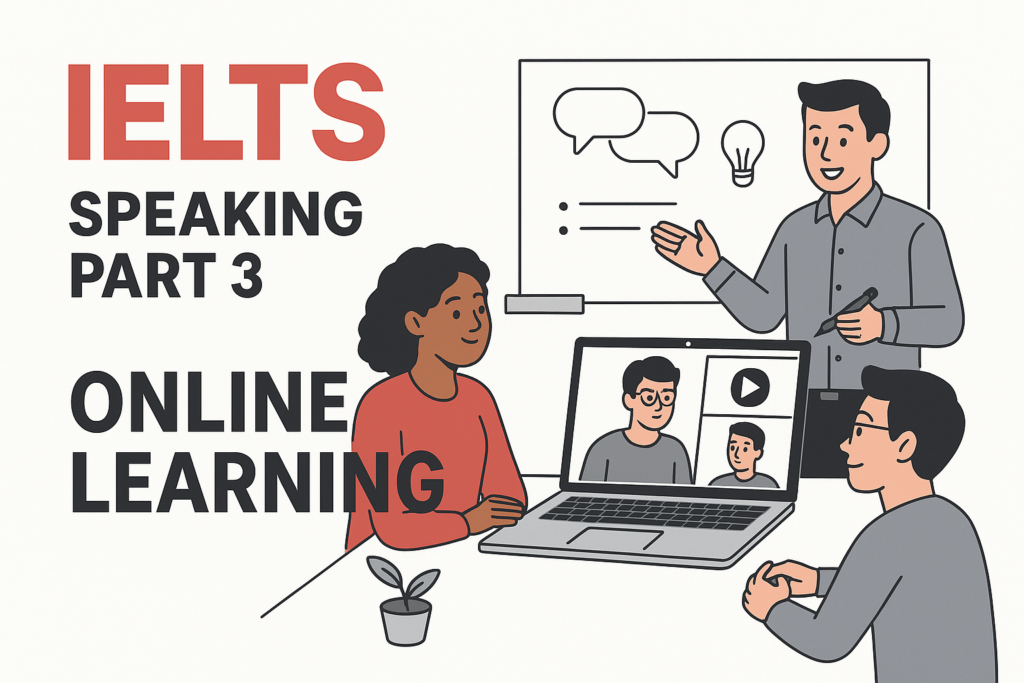
IELTS Speaking Part 3 Online Learning discussion answers need more than saying online classes are convenient. In Part 3, the examiner wants you to discuss flexibility, concentration, teacher feedback, self-discipline, technology, social interaction, cost, access, motivation, and whether digital learning can replace classrooms. Before you memorise online-learning answers, take the IELTS Express Pre-Test to check your current speaking band range and see whether fluency, vocabulary, grammar, pronunciation, or idea development is holding your score back.
Online learning is a useful IELTS topic because it connects education with technology and modern life. You may be asked whether children learn well online, whether adults prefer flexible courses, how teachers can support students remotely, or whether online education creates equal opportunities. Strong answers are balanced, specific, and natural, not a list of obvious advantages copied from a study app.
IELTS Speaking Part 3 Online Learning Discussion Answers: What Examiners Want
In Speaking Part 3, online learning questions are broader than whether you personally enjoy Zoom classes. The examiner is checking whether you can explain causes, compare learning environments, evaluate benefits and drawbacks, and make careful predictions about education in the future.
A higher-band answer usually gives a direct view, develops one or two reasons, adds a realistic example, and recognises that online learning depends on the student, the subject, the teacher, and the quality of the platform. A motivated adult preparing for IELTS may benefit from flexible online lessons, while a young child may need more face-to-face support.
- Answer the exact question first.
- Develop one clear idea instead of listing every technology benefit you know.
- Use examples such as recorded lessons, live classes, discussion boards, learning apps, mock tests, teacher feedback, and unreliable internet.
- Show balance with phrases such as in many cases, this depends on, however, and at the same time.
- Avoid extreme claims such as online learning is always better or classrooms are no longer useful.
Common IELTS Speaking Part 3 Questions About Online Learning
Practise flexible answers to questions such as: Is online learning as effective as classroom learning? What are the advantages of studying online? What are the disadvantages? Do children learn well online? Why do adults choose online courses? Can online learning replace teachers? How has technology changed education? Will universities offer more online courses in the future?
These questions test opinion, comparison, cause and effect, prediction, and evaluation. Instead of memorising one long answer, prepare idea groups. Online learning can include flexibility, independence, motivation, feedback, digital access, distractions, cost, personalisation, communication, and practical skills.
If you want broader Speaking Part 3 technique, use our IELTS Speaking Part 3 sample answers guide and notice how each response develops one clear idea instead of forcing memorised language.
Sample Answers About Online Learning Benefits
Question: What are the main advantages of online learning?
The biggest advantage is flexibility. Students can often study from home, repeat recorded lessons, and fit learning around work or family responsibilities. This is especially useful for adult learners who cannot travel to a campus every day. Online learning can also give students access to teachers or courses that are not available in their local area.
Question: Why do many adults prefer online courses?
Many adults prefer online courses because their schedules are already full. They may be working, caring for children, or preparing for migration, so travelling to a classroom can waste time. If an online course is well organised, they can study in short blocks and still receive feedback from a teacher.
Question: Can online learning save money?
Yes, it can. Students may save money on transport, accommodation, printed materials, and sometimes course fees. However, cheaper does not always mean better. If the course has poor feedback or no speaking practice, students may waste time and need extra help later.
Sample Answers About Problems With Online Learning
Question: What are the disadvantages of online learning?
The main disadvantage is that students need strong self-discipline. At home, it is easy to become distracted by phones, family members, or other tasks. Some students also feel isolated because they cannot ask quick questions before or after class. Online learning works best when the course has structure, deadlines, and regular feedback.
Question: Do students concentrate better online or in a classroom?
It depends on the student and the environment. Some students concentrate better online because they are comfortable and can control their study space. Others concentrate better in a classroom because the teacher and classmates create pressure to stay focused. For many learners, a mix of both is probably the most realistic option.
Question: Is technology a problem for online education?
It can be. If the internet connection is weak, the audio is unclear, or the platform is confusing, learning becomes frustrating. Technology should support the lesson, not become the lesson. Teachers also need to know how to use digital tools properly, otherwise students may feel that online classes are less organised than face-to-face classes.
For realistic speaking pressure after learning these patterns, access unlimited IELTS mock tests and practise answering online-learning questions without pausing to build perfect sentences.
Online Learning Versus Classroom Learning
IELTS often asks candidates to compare online learning with traditional classroom learning. A strong answer should avoid choosing one side too quickly. Each format has strengths, and the best option depends on age, subject, motivation, teacher quality, and the learner’s goals.
Question: Is online learning as effective as classroom learning?
It can be as effective for some subjects, especially when students are mature and the course includes live interaction, clear materials, and regular feedback. However, classroom learning may be better for younger students or practical subjects where the teacher needs to watch students closely. Effectiveness depends more on design than on the location.
Question: What can students get from classrooms that they may not get online?
Classrooms can provide stronger social interaction. Students can ask quick questions, read body language, work in groups, and feel part of a learning community. This can improve motivation, especially for people who find it hard to study alone.
Question: What can online classes do better than classrooms?
Online classes can be more flexible and more personalised. Students can replay explanations, use digital quizzes, submit recordings, and receive comments on specific weaknesses. For IELTS speaking, recording answers online can be very useful because students can hear their pauses, repetition, and pronunciation more clearly.
Teachers, Feedback, And Motivation Online
One mistake in IELTS answers is saying online learning means students teach themselves. In good online education, the teacher still matters. The teacher explains, checks understanding, gives feedback, corrects mistakes, and creates a routine so students do not drift.
Question: Can online learning replace teachers?
No, not completely. Online materials can explain information, but teachers help students understand what to improve and how to improve it. For example, an IELTS student may watch many speaking videos but still need a teacher to explain why their answer sounds memorised or underdeveloped.
Question: How can teachers keep online students motivated?
Teachers can keep students motivated by setting clear weekly tasks, giving personal feedback, using short live discussions, and showing progress. Motivation is easier when students can see that their work is leading somewhere. Without feedback, online courses can feel like a folder of videos rather than a real learning experience.
Question: Is feedback harder online?
It can be harder if the class is too large or the teacher only gives general comments. But online feedback can also be very precise. A teacher can comment on a recorded speaking answer, highlight grammar patterns, or send notes after a mock test. The quality of feedback matters more than whether it is delivered online or in person.
If you need teacher feedback on whether your answers are developed enough for your target band, see our IELTS preparation plans and choose support that includes Speaking Part 3 structure and fluency review.
Online Learning For Children And Teenagers
Questions about children are common because online learning affects families, schools, and screen time. Keep your answer balanced. Children can benefit from digital tools, but they often need supervision, routine, and social contact.
Question: Do children learn well online?
Some children can learn well online, especially if the lessons are interactive and parents or teachers provide structure. However, many children struggle to concentrate for long periods on a screen. They may also miss the social side of school, such as working with classmates and learning how to communicate face to face.
Question: Should schools use more online learning?
Schools should use more online tools, but not replace normal classes entirely. Digital platforms are useful for homework, revision, and extra practice. But school is also about discipline, friendships, behaviour, and teamwork, so a full online model may not suit most children.
Question: Are learning apps good for young students?
They can be good if they are used carefully. Apps can make practice more engaging and give instant feedback. The risk is that children may focus on points, games, or speed instead of deep understanding. Parents and teachers still need to guide how the app is used.
Online Learning And Equal Access
Online education can create opportunity, but it can also expose inequality. This is a useful idea for higher-band answers because it shows that you can discuss both benefits and social problems.
Question: Does online learning make education more equal?
It can make education more equal if students have internet access, devices, and a quiet place to study. A student in a small town may join a course from another city, which is a real benefit. However, students without reliable internet or family support may fall further behind, so online learning is not automatically fair.
Question: Who benefits most from online education?
People who are motivated, organised, and comfortable with technology benefit the most. Adult learners, university students, and professionals often use online education well because they know why they are studying. Younger learners or students with low confidence may need more direct support.
Question: Should governments invest in online education?
Yes, but investment should include devices, teacher training, internet access, and quality control. It is not enough to upload videos and call that education. If governments want online learning to help society, they need to make sure students can actually use the resources.
Useful Vocabulary For Online Learning Discussion Answers
You do not need technical vocabulary for IELTS online-learning questions. You need accurate phrases that help you discuss education, motivation, access, and technology clearly.
- Flexible schedule: a study timetable that can fit around work, family, or other responsibilities.
- Self-discipline: the ability to keep working without someone constantly watching you.
- Interactive lesson: a lesson where students answer, discuss, practise, or receive feedback.
- Recorded lecture: a lesson students can watch again later.
- Digital access: having the internet, device, and skills needed to use online resources.
- Face-to-face interaction: communication in the same physical place.
- Blended learning: a combination of online and classroom study.
- Personalised feedback: advice based on one student’s specific strengths and weaknesses.
Use these phrases in full answers. For example, say, “Online learning requires self-discipline,” or “Blended learning may suit students who want flexibility but still need classroom interaction.” Simple accurate language is better than complicated education jargon used unnaturally.
Grammar Patterns That Help With Online Learning Questions
Use comparison language: “Online learning is more flexible, while classroom learning often provides stronger social interaction.” This helps when the examiner asks you to compare two study formats.
Use conditionals: “If students receive regular feedback, online lessons can be very effective.” This lets you avoid overgeneralising and shows a more mature answer.
Use cautious future language: “Universities are likely to offer more blended courses,” or “Online education may become more common for adults.” Avoid saying all schools will become online unless you can explain the limits.
How To Build A Band 7 Style Online Learning Answer
A Band 7 style answer is organised, natural, and developed. Start with your main view, explain why, give an example, and add balance if the question needs it. You do not need a perfect speech. You need a clear answer that grows logically.
For example, if the examiner asks whether online learning can replace classrooms, you could say: “I do not think it can replace classrooms completely. Online learning is excellent for flexibility and revision, especially for adults. However, classrooms provide social pressure, immediate support, and group interaction, which are hard to copy online. A blended system is probably the most practical solution.” This answer is direct, balanced, and specific.
To practise this skill, record yourself answering one online-learning question. Then check whether you answered directly, explained one idea clearly, and used a realistic example. If your answer sounds like a memorised essay, simplify it.
Common Mistakes With Online Learning Discussion Answers
The first mistake is giving only easy advantages such as convenient, cheap, and fast. Those ideas are fine, but you need to explain them. Convenient for whom? Cheap compared with what? Fast in what way?
The second mistake is ignoring drawbacks. Higher-band answers often mention distractions, weak feedback, screen fatigue, poor internet, isolation, or the need for self-discipline. Balance makes your answer sound more realistic.
The third mistake is speaking too personally. If the examiner asks whether online education is good for society, do not only describe your own laptop or teacher. Discuss students, parents, schools, universities, workers, rural communities, costs, and access.
The fourth mistake is using technology words without meaning. You do not need to say artificial intelligence, virtual reality, or digital transformation unless you can explain them naturally. Clear everyday language usually scores better.
A Seven-Day Practice Plan For Online Learning Questions
On day one, practise questions about the advantages of online learning. On day two, focus on disadvantages, distractions, and self-discipline. On day three, record answers comparing online classes and classroom learning. On day four, practise questions about teachers, feedback, and motivation.
On day five, answer questions about children, schools, and screen time. On day six, practise equal access, rural students, costs, and government investment. On day seven, complete a full Speaking Part 3 set and note where your answers became too short, too general, or too one-sided.
This routine builds topic flexibility. You are not trying to memorise one perfect online-learning answer. You are learning how to discuss education, technology, access, and motivation from several angles under test pressure.
Final Checklist Before Your Speaking Test
Before test day, make sure you can discuss flexibility, cost, concentration, feedback, motivation, children, adults, teachers, learning apps, internet access, classroom interaction, blended learning, screen time, and future education. Practise giving balanced answers with one clear reason and one example.
The online-learning topic becomes easier when you organise ideas by people and systems: students, teachers, parents, schools, universities, workers, technology, benefits, risks, and future changes. If you can sort your answer quickly, you can respond confidently even when the examiner changes the question.
Ready to find out your IELTS band score?
Take the IELTS Express Pre-Test for just $4.99 and get your personalised band prediction with a 14-day improvement plan.
FAQ: IELTS Speaking Part 3 Online Learning Discussion Answers
What online learning questions are common in IELTS Speaking Part 3?
Common questions ask about the benefits of online classes, disadvantages, concentration, children studying online, teacher feedback, learning apps, digital access, and whether online education can replace classrooms.
How long should online learning answers be in Part 3?
Most answers should explain one or two ideas clearly. Aim for a direct answer, a reason, an example, and a short contrast if the question asks for balance.
What vocabulary is useful for online learning discussion answers?
Useful phrases include flexible schedule, self-discipline, interactive lesson, recorded lecture, digital access, face-to-face interaction, blended learning, and personalised feedback.
Should I say online learning is better than classroom learning?
Only if you explain the limits. A balanced answer is usually stronger: online learning is flexible and accessible, while classroom learning can provide better social interaction and immediate support.
How can I sound more natural on this topic?
Use clear structure, avoid memorised speeches, and show balance. Phrases such as in many cases, this depends on, however, and at the same time help you discuss online learning more naturally.