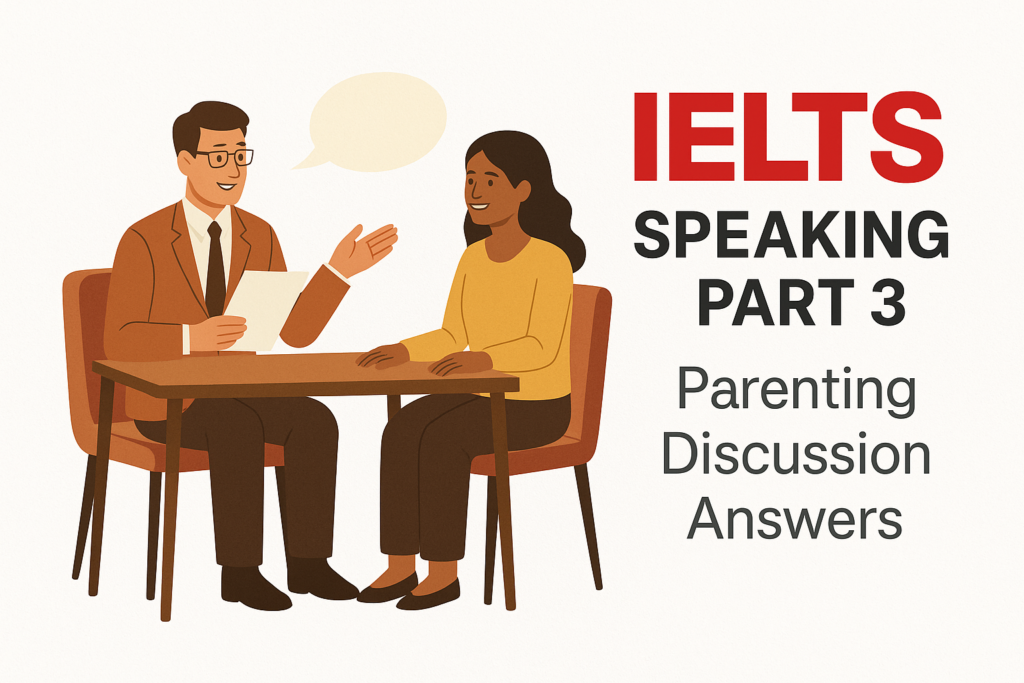
IELTS Speaking Part 3 Parenting discussion answers need more than saying parents should be kind or strict. In Part 3, the examiner wants you to discuss responsibility, discipline, independence, technology, education, family pressure, working parents, child behaviour, and how parenting may change in the future. Before you memorise parenting-topic answers, take the IELTS Express Pre-Test to check your current speaking band range and see whether fluency, vocabulary, grammar, pronunciation, or idea development is holding your score back.
Parenting appears in IELTS because it connects personal life with wider social questions. You may be asked whether parents or schools should teach manners, whether children have too much freedom, how technology affects family life, or whether parenting is harder now than in the past. Strong answers are balanced, specific, and realistic.
IELTS Speaking Part 3 Parenting Discussion Answers: What Examiners Want
In Speaking Part 3, parenting questions are broader than your own family experience. The examiner is checking whether you can explain reasons, compare generations, discuss social effects, and make careful predictions. A strong answer should not sound like a personal complaint or a memorised speech.
A higher-band answer usually gives a direct view, develops one or two reasons, adds a realistic example, and recognises that parenting depends on culture, income, work schedules, technology, education, and the child’s personality. This balance helps you sound thoughtful without becoming vague.
- Answer the exact question first.
- Develop one clear idea instead of listing every parenting issue you know.
- Use examples such as screen time, homework, manners, household rules, school pressure, and working parents.
- Show balance with phrases such as in many families, this depends on, however, and at the same time.
- Avoid extreme claims such as strict parents always produce better children or modern parents are all too soft.
Common IELTS Speaking Part 3 Questions About Parenting
Practise flexible answers to questions such as: Are parents too protective these days? Should children have more freedom? Who should teach children discipline? Is parenting harder now than in the past? How does technology affect parents and children? Should parents help with homework? Are mothers and fathers expected to do the same things?
These questions test opinion, comparison, cause and effect, prediction, and evaluation. Instead of memorising one long answer, prepare idea groups. Parenting can include safety, independence, respect, pressure, communication, school results, emotional support, money, time, and values.
If you want broader Speaking Part 3 technique, use our IELTS Speaking Part 3 sample answers guide and notice how each response develops one clear idea instead of forcing memorised language.
Sample Answers About Strict And Relaxed Parenting
Question: Is it better for parents to be strict or relaxed?
Parents probably need a balance. Children need clear rules because rules teach safety, respect, and responsibility. However, if parents are too strict, children may become afraid to explain problems or make decisions for themselves. A good parent sets limits but also listens.
Question: Do children need discipline?
Yes, but discipline should not only mean punishment. It should help children understand consequences and develop self-control. For example, if a child spends too much time on a phone, a parent can set a screen-time limit and explain why sleep, study, and family time matter.
Question: Are parents too protective today?
In some families, yes. Many parents worry about safety, online risks, school competition, and social pressure, so they try to control every part of a child’s life. The problem is that children also need chances to solve small problems, make mistakes, and become independent.
Sample Answers About Technology And Screen Time
Question: How has technology changed parenting?
Technology has made parenting more complicated. Parents can use apps, online classes, and video calls to support children, but they also have to manage screen addiction, social media, games, and online safety. The challenge is not banning technology completely. It is teaching children how to use it responsibly.
Question: Should parents limit children’s screen time?
Yes, especially for younger children. Too much screen time can affect sleep, concentration, exercise, and face-to-face communication. At the same time, older children need digital skills for school and work, so parents should guide usage rather than treat every device as harmful.
Question: Do children learn more from the internet than from parents?
They may learn more information from the internet, but parents still shape values, habits, confidence, and behaviour. A child can watch thousands of videos, but they still need adults to teach judgement, kindness, patience, and how to handle difficult situations.
For realistic speaking pressure after learning these patterns, access unlimited IELTS mock tests and practise answering parenting questions without pausing to build perfect sentences.
Sample Answers About Working Parents And Family Time
Question: Is it difficult for working parents to raise children?
It can be difficult because time and energy are limited. Many parents have to balance work, travel, housework, school messages, and children’s emotional needs. However, working parents can still build strong relationships if they use their time well and keep regular routines.
Question: Should one parent stay at home with young children?
It depends on the family’s financial situation, values, and support network. Some families benefit from one parent staying home, especially when children are very young. But it is not always possible, and many children do well when both parents work and share responsibility carefully.
Question: Has the role of fathers changed?
Yes, in many societies fathers are now expected to be more involved in daily parenting. They may help with school, cooking, emotional support, and childcare, not only earning money. This change can be positive because children benefit from active relationships with both parents.
Sample Answers About Schools, Manners And Values
Question: Who should teach children good manners?
Parents should teach manners first because children learn early behaviour at home. They notice how adults speak, apologise, share, and handle conflict. Schools can support these lessons, but they cannot replace daily examples from family life.
Question: Should schools teach parenting skills in the future?
Basic life skills can be useful, but schools do not need to turn parenting into a formal subject for everyone. It may be better to teach communication, emotional control, responsibility, and child development as part of broader life education. Those skills are useful even before someone becomes a parent.
Question: Do parents put too much pressure on children to succeed?
Some do. Parents often want their children to have secure futures, but pressure can become harmful when children feel that grades are the only measure of worth. Encouragement is useful, but children also need rest, confidence, and room to discover their own strengths.
If you need teacher feedback on whether your answers are developed enough for your target band, see our IELTS preparation plans and choose support that includes Speaking Part 3 structure and fluency review.
Useful Vocabulary For Parenting Discussion Answers
You do not need rare psychology vocabulary for IELTS parenting questions. You need accurate phrases that help you discuss family responsibility, child development, independence, and social change clearly.
- Set boundaries: create clear limits for behaviour.
- Emotional support: helping a child feel safe, understood, and confident.
- Overprotective: controlling a child too much because of fear.
- Independence: the ability to make decisions and manage tasks alone.
- Screen time: time spent using phones, tablets, computers, or television.
- Role model: someone whose behaviour is copied by others.
- Shared responsibility: parents dividing childcare and household duties fairly.
- Peer pressure: influence from friends or classmates.
Use these phrases in full sentences. For example, say, “Parents need to set boundaries around screen time,” or “Children need emotional support as well as rules.” Simple accurate vocabulary is stronger than rare words used awkwardly.
Grammar Patterns That Help With Parenting Questions
Use cause-and-effect language: “When parents control every decision, children may struggle to become independent.” This helps you explain consequences instead of only giving opinions.
Use comparison language: “In the past, parents may have focused more on obedience, while many modern parents place more emphasis on communication.” This is useful because parenting questions often compare generations.
Use cautious future language: “Parents are likely to face more challenges with technology,” or “Schools may play a larger role in teaching emotional skills.” Avoid saying all families will change in the same way.
How To Build A Band 7 Style Parenting Answer
A Band 7 style answer is organised, realistic, and natural. Start with your main view, explain why, give an example, and add balance if the issue is complex. You do not need a perfect speech. You need an answer that develops logically and sounds like normal spoken English.
For example, if the examiner asks whether parents should be strict, you could say: “They should be strict about important things like safety and respect, but flexible about smaller choices. If children never make decisions, they may depend on their parents too much. So I think rules are necessary, but parents should explain the reasons behind them.” This answer is direct, specific, and balanced.
To practise this skill, record yourself answering one parenting question. Then check whether you answered directly, explained one idea clearly, and used a realistic example. If your answer sounds like a memorised essay, simplify it.
Common Mistakes With Parenting Discussion Answers
The first mistake is being too emotional. Parenting can be personal, but IELTS Part 3 needs analysis. Instead of saying parents today are terrible or children are lazy, discuss work pressure, technology, school competition, safety, and communication.
The second mistake is using vague language such as good parents, bad children, or modern problems. Be more precise. Say boundaries, independence, screen time, emotional support, school pressure, family routines, or shared responsibility.
The third mistake is giving only personal examples. If the examiner asks whether society supports parents enough, do not only talk about your own family. Discuss childcare, schools, workplaces, community support, and government policy.
The fourth mistake is memorising fixed answers. Parenting questions can move from discipline to technology, then to fathers, schools, pressure, or future families. Prepare flexible ideas, not one long speech.
A Seven-Day Practice Plan For Parenting Questions
On day one, practise questions about strict and relaxed parenting. On day two, focus on technology, phones, and screen time. On day three, record answers about working parents and family time. On day four, practise questions about manners, values, and schools.
On day five, answer questions about pressure, success, and education. On day six, compare parenting in the past and present. On day seven, complete a full Speaking Part 3 set and note where your answers became too short, too emotional, or too general.
This routine builds topic flexibility. You are not trying to memorise one perfect parenting answer. You are learning how to discuss family roles and social change from several angles under test pressure.
Final Checklist Before Your Speaking Test
Before test day, make sure you can discuss discipline, independence, screen time, working parents, fathers and mothers, school pressure, manners, emotional support, safety, technology, and future parenting. Practise giving balanced answers with one clear reason and one example.
The parenting topic becomes easier when you organise ideas by people and systems: children, parents, schools, workplaces, communities, technology, benefits, risks, and future changes. If you can sort your answer quickly, you can respond confidently even when the examiner changes the question.
Ready to find out your IELTS band score?
Take the IELTS Express Pre-Test for just $4.99 and get your personalised band prediction with a 14-day improvement plan.
FAQ: IELTS Speaking Part 3 Parenting Discussion Answers
What parenting questions are common in IELTS Speaking Part 3?
Common questions ask about strict parents, freedom, discipline, technology, working parents, fathers and mothers, school pressure, manners, and whether parenting is harder today.
How long should parenting answers be in Part 3?
Most answers should explain one or two ideas clearly. Aim for a direct answer, a reason, an example, and a short contrast if the question asks for balance.
What vocabulary is useful for parenting discussion answers?
Useful phrases include set boundaries, emotional support, overprotective, independence, screen time, role model, shared responsibility, and peer pressure.
Should I talk about my own parents in Part 3?
You can use a brief personal example, but Part 3 should mainly discuss families, schools, technology, workplaces, and society in general. Keep the answer broader than Part 1.
How can I sound more natural on this topic?
Use clear structure, avoid memorised speeches, and show balance. Phrases such as in many families, this depends on, however, and at the same time help you discuss parenting more naturally.