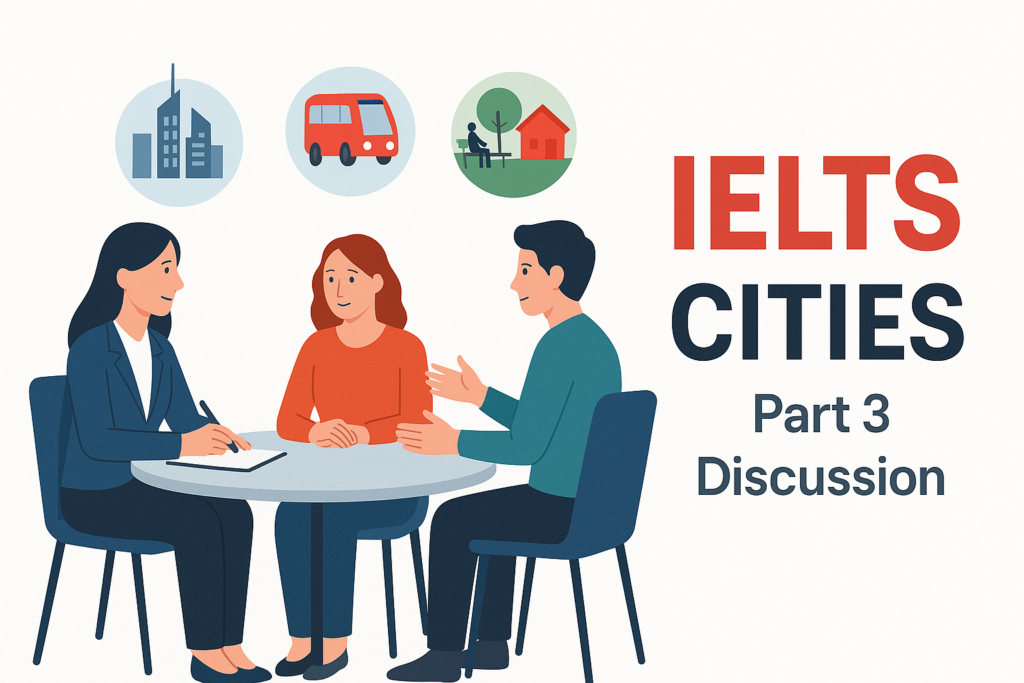
IELTS Speaking Part 3 Cities discussion answers need more than short personal opinions. In Part 3, the examiner expects you to discuss city life in a broader way: transport, housing, pollution, public services, safety, work, community, planning, and how cities may change in the future. Before you memorise city-topic answers, take the IELTS Express Pre-Test to check your current speaking band range and see whether your main issue is fluency, vocabulary, grammar, pronunciation, or idea development.
The cities topic is common because it connects with modern life. You may be asked whether cities are good places to live, why people move from rural areas to cities, what problems large cities face, whether governments should improve public transport, and how technology might change urban life. Strong answers are clear, balanced, and organised.
IELTS Speaking Part 3 Cities Discussion Answers: What Examiners Want
In Part 3, city questions are usually abstract. The examiner is not only asking about your city. They want to hear how you explain causes, compare groups of people, evaluate advantages and disadvantages, and support an opinion with examples.
A useful structure is: give your main view, explain the reason, add a concrete example, and then mention a limitation or contrast. For example, if you say cities offer better opportunities, explain whether you mean jobs, universities, hospitals, transport, or cultural activities. General claims need specific support.
- Answer the exact question before giving background.
- Use examples such as transport, rent, parks, schools, safety, and jobs.
- Show balance with phrases like however, at the same time, and this depends on.
- Compare big cities, small towns, suburbs, and rural areas.
- Avoid memorised speeches that ignore the examiner’s wording.
Common IELTS Speaking Part 3 Questions About Cities
Practise these questions aloud. The examiner may ask follow-up questions based on your answer, so prepare flexible ideas rather than fixed scripts.
- Why do many people prefer living in big cities?
- What are the main problems of living in a large city?
- How can governments reduce traffic congestion?
- Is public transport more important in cities than in small towns?
- Do you think cities are good places for families?
- Why do some people move from rural areas to cities?
- Should cities have more parks and public spaces?
- How can city life affect people’s health?
- Do rich and poor people experience cities differently?
- How might cities change in the future?
If you want to compare city answers with broader Speaking Part 3 technique, use our IELTS Speaking Part 3 sample answers guide and notice how each answer develops one clear idea instead of listing random points.
Sample Answers About Why People Live In Cities
Question: Why do many people prefer living in big cities?
Many people prefer cities because they offer more opportunities. A large city usually has more jobs, universities, hospitals, entertainment, and transport options than a small town. For young adults, especially, a city can feel like the best place to build a career and meet different kinds of people.
Question: Why do people move from rural areas to cities?
The main reason is often economic. People may move because they want higher salaries, better education, or more reliable services. However, this can create pressure on housing and transport if the city grows faster than its infrastructure.
Question: Are cities always better places to live?
No, not always. Cities can be exciting and convenient, but they can also be expensive, crowded, and stressful. Whether a city is a good place to live depends on a person’s income, family situation, commute, and lifestyle preferences.
These answers work because they are not just personal. They discuss wider social patterns and include reasons, examples, and a small amount of balance.
Sample Answers About Traffic And Public Transport
Question: What is the best way to reduce traffic congestion in cities?
I think the most effective solution is to make public transport faster, cheaper, and more reliable. If trains and buses are clean, frequent, and connected to residential areas, more people will leave their cars at home. Restrictions on cars can help, but they are unpopular unless people have a practical alternative.
Question: Should governments spend more money on public transport?
Yes, especially in large cities where road space is limited. Public transport can move thousands of people using less space than private cars, and it can also reduce pollution. The challenge is that transport projects are expensive and take years to complete, so governments need long-term planning.
Question: Is cycling a realistic solution for city transport?
It can be, but only in some places. Cycling works well when cities have safe bike lanes, reasonable distances, and a culture where drivers respect cyclists. In very hot climates or cities with dangerous roads, cycling may be less practical for daily commuting.
For realistic speaking pressure, access unlimited IELTS mock tests and practise answering city questions without pausing to build perfect sentences first.
Sample Answers About Housing And Cost Of Living
Question: Why is housing expensive in many cities?
Housing is expensive because demand is high and land is limited. Many people want to live near jobs, transport, schools, and services, so central areas become very competitive. If new housing is not built quickly enough, rents and property prices rise.
Question: What can governments do about expensive housing?
They can build more affordable housing, improve transport links to outer suburbs, and make planning rules simpler. However, there is no quick fix. If a city is attractive and growing, housing pressure is likely to continue unless supply improves.
Question: Do young people find it harder to live in cities now?
In many places, yes. Young people may have good job opportunities in cities, but their income may not keep up with rent, transport, and everyday costs. This means some people share apartments for longer or move further away from the centre.
If you often struggle to extend answers beyond one sentence, see our IELTS preparation plans and choose support that includes speaking feedback on fluency, answer structure, and idea development.
Sample Answers About Pollution And Green Spaces
Question: What environmental problems do cities face?
The most obvious problems are air pollution, waste, noise, and the loss of green space. Heavy traffic can make the air worse, while too much concrete can make cities hotter in summer. These problems affect health and quality of life, especially for children and older people.
Question: Should cities have more parks?
Yes, parks are important because they give people space to exercise, relax, and meet others. They also make dense areas more pleasant and can reduce heat. The difficulty is finding enough land, especially in older city centres where space is already crowded.
Question: How can cities become more environmentally friendly?
Cities can invest in clean transport, energy-efficient buildings, better recycling systems, and more trees. Small changes help, but the biggest improvements usually come from planning decisions that shape how people travel and where they live.
Environmental answers sound stronger when you connect the problem to daily life. Instead of only saying pollution is bad, explain who is affected and what practical changes might help.
Sample Answers About Families And Community Life
Question: Are cities good places for families?
They can be, because cities often have good schools, hospitals, libraries, activities, and public transport. However, families may struggle with small apartments, high rent, traffic, and limited outdoor space. So I would say cities are good for families if they are well planned and reasonably affordable.
Question: Is it easy to know your neighbours in a city?
Not always. In large apartment buildings, people may live close to each other but still have very little contact. City life can be busy and private, although community events, shared gardens, and local schools can help people build stronger relationships.
Question: Do cities make people lonely?
Sometimes they do. A city can be full of people, but if someone has no close friends or family nearby, they may still feel isolated. On the other hand, cities also offer clubs, classes, workplaces, and cultural communities where people can find connection.
Community questions are a good chance to show nuance. A high-band answer does not say city life is only good or only bad. It explains that the experience depends on design, affordability, and social support.
Useful Vocabulary For City Discussion Answers
You do not need rare vocabulary for the cities topic. You need accurate phrases that help you discuss urban problems and solutions clearly.
- Infrastructure: basic systems such as roads, transport, water, electricity, and public services.
- Congestion: heavy traffic that slows movement.
- Affordable housing: homes that ordinary people can reasonably pay for.
- Commute: the journey between home and work or study.
- Urban planning: the way a city is designed and organised.
- Green space: parks, gardens, trees, and open public areas.
- Population density: how many people live in a particular area.
- Quality of life: the general comfort, health, safety, and happiness of people.
Use these words in complete sentences. For example, say, “Better infrastructure can reduce congestion,” or “Affordable housing is essential for young workers.” Simple academic vocabulary used accurately is better than impressive words used awkwardly.
Grammar Patterns That Help With Cities Questions
Use cause-and-effect language: “When public transport is unreliable, people depend more on cars,” or “If rent rises quickly, low-income workers may move further from the city centre.” These patterns help you explain urban problems logically.
Use comparison language: “Big cities usually offer more opportunities than small towns, but they are also more expensive.” This allows you to show balance and range without making the answer too long.
Use modal verbs for solutions: “Governments should invest in transport,” “Cities could create more green spaces,” and “Planners need to protect affordable housing.” Modal verbs are especially useful when the examiner asks what governments or individuals can do.
How To Build A Band 7 Style City Answer
A Band 7 style answer is not necessarily long. It is relevant, organised, and flexible. Start with a direct opinion, then develop one main reason clearly. Add an example if it helps, and include a contrast if the question invites one.
For example, if the examiner asks whether cities are becoming better places to live, you could say: “In some ways, yes, because many cities now have better transport, safer public areas, and more cultural activities. However, affordability is becoming a serious problem, so the benefits are not shared equally.” This answer is short, but it contains evaluation and balance.
To practise this skill, record one answer and listen for three things: Did you answer the question directly? Did you explain one idea clearly? Did you use a natural example rather than a memorised sentence?
Common Mistakes With IELTS City Discussion Answers
The first mistake is giving Part 1 answers in Part 3. If the question asks why people move to cities, do not only say, “I like my city.” Discuss people in general and explain wider reasons.
The second mistake is listing too many ideas. An answer with jobs, schools, hospitals, traffic, pollution, crime, and entertainment may sound rushed if none of those ideas is developed. Choose one or two points and explain them properly.
The third mistake is using strong opinions without support. Saying “cities are terrible” or “cities are perfect” sounds simplistic. Add conditions, examples, and exceptions.
The fourth mistake is memorising a model answer and forcing it into a different question. The examiner may interrupt or ask a follow-up if your answer sounds rehearsed. Flexible language is safer.
A Seven-Day Practice Plan For Cities Questions
On day one, practise questions about why people live in cities. On day two, focus on traffic and public transport. On day three, record answers about housing, rent, and cost of living. On day four, practise pollution, parks, and green spaces.
On day five, compare cities with small towns and rural areas. On day six, answer questions about families, safety, community, and loneliness. On day seven, complete a full Speaking Part 3 set and note where your answers became too short or too general.
This routine helps you build topic flexibility. You are not memorising one perfect cities answer. You are learning how to discuss city issues from several angles under test pressure.
Final Checklist Before Your Speaking Test
Before test day, make sure you can discuss city opportunities, transport, congestion, housing, pollution, parks, families, community life, cost of living, and future cities. Practise giving balanced answers that include one clear reason and one example.
The cities topic becomes easier when you think in categories: people, places, problems, solutions, and future change. If you can organise your answer around those categories, you can respond confidently even when the examiner changes the question.
Ready to find out your IELTS band score?
Take the IELTS Express Pre-Test for just $4.99 and get your personalised band prediction with a 14-day improvement plan.
FAQ: IELTS Speaking Part 3 Cities Discussion Answers
What city questions are common in IELTS Speaking Part 3?
Common questions ask why people live in cities, what problems large cities face, how governments can reduce traffic, whether parks are important, and how cities may change in the future.
How long should IELTS Speaking Part 3 city answers be?
Most answers should be long enough to explain one or two ideas clearly. Aim for a direct answer, a reason, an example, and a short contrast if the question needs balance.
What vocabulary is useful for city discussion answers?
Useful words include infrastructure, congestion, affordable housing, commute, urban planning, green space, population density, and quality of life. Use them naturally in full sentences.
Should I give personal examples in Part 3 city answers?
You can use a brief example from your city, but the main answer should discuss people, society, or cities in general. Part 3 is broader than Part 1.
How can I sound more natural in city-topic answers?
Use clear structure, avoid memorised speeches, and show balance. Phrases such as in many cases, this depends on, however, and at the same time help you discuss cities more naturally.