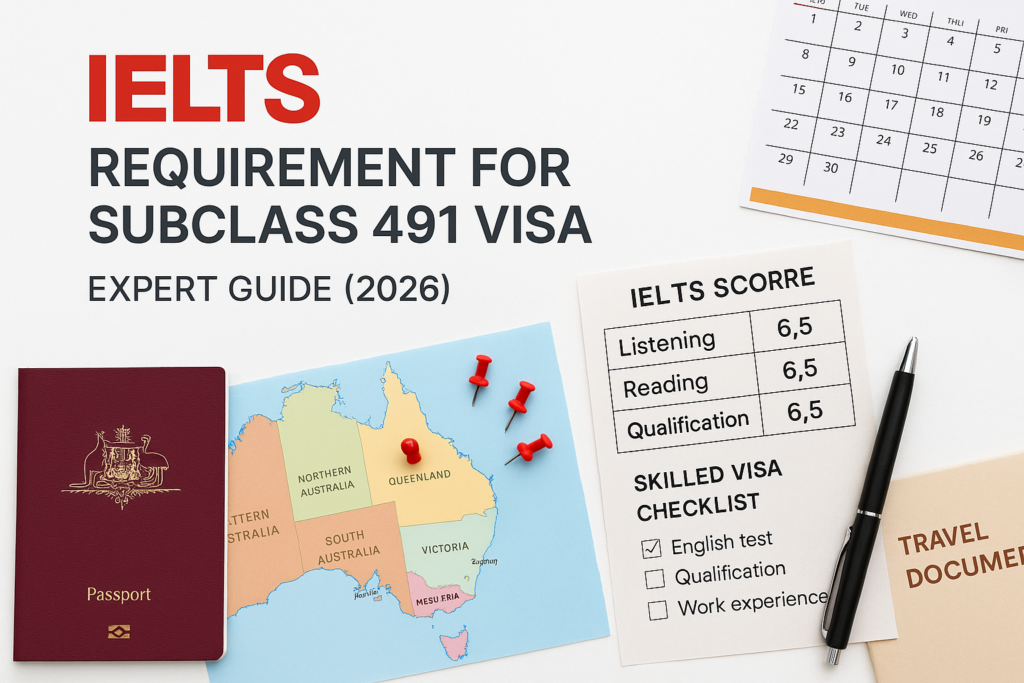
The IELTS requirement for Subclass 491 Visa applicants is not something to leave until the last week. For many skilled regional visa applicants, English is tied to eligibility, points, state or territory nomination, and sometimes professional registration. Before you book another test or guess your band level, take the IELTS Express Pre-Test to check your current band range and see which section is most likely to hold back your visa plan.
The Subclass 491 Skilled Work Regional visa is points-tested. That means English can affect both whether you meet the minimum standard and how competitive your points score looks. The key detail is that migration English is usually assessed by section scores, not only by an overall IELTS band. A strong average score will not fix one weak section if the requirement says each band must meet a minimum.
IELTS Requirement For Subclass 491 Visa: The Core Rule
For many Subclass 491 applicants, the starting point is competent English. In IELTS terms, competent English is commonly understood as at least 6.0 in each of Listening, Reading, Writing, and Speaking. Higher bands may help with points, but the section minimum matters first.
This is where many applicants get caught. They see an overall IELTS 6.5 or 7.0 and assume it is enough. For migration purposes, the result is usually checked section by section. If your scores are Listening 7.0, Reading 7.0, Writing 5.5, and Speaking 7.0, the Writing score can still block a competent English claim.
- Check every section score, not only the overall band.
- Confirm whether your pathway needs competent, proficient, or superior English.
- Check whether your skills assessment or registration body has separate English rules.
- Leave time for preparation and a retake if one section misses the target.
- Keep official test records ready for your visa evidence.
How English Scores Affect Subclass 491 Points
The Subclass 491 visa sits inside a points-tested system, so English can do more than meet a minimum. Higher English scores may add points and make your Expression of Interest stronger. This matters because many applicants are competing within occupation, state, and regional nomination settings.
In broad terms, proficient English is commonly associated with IELTS 7.0 in each section, while superior English is commonly associated with IELTS 8.0 in each section. These levels may add points, but you should always check the current Department of Home Affairs points table before relying on a claim.
If you are using IELTS for migration, the score you need should be decided from your whole pathway. Do not only ask, “What is the minimum?” Ask whether a higher English score could improve your points position enough to change your invitation chances.
Competent, Proficient, And Superior English Explained
Competent English is usually the baseline level many skilled visa applicants need. It commonly means IELTS 6.0 in each section. This is a section-by-section requirement. An overall score can look fine while one part is still below the line.
Proficient English is a stronger claim and is commonly linked with IELTS 7.0 in each section. Superior English is higher again and is commonly linked with IELTS 8.0 in each section. These levels are attractive because they may increase points, but they are harder because every section must reach the level.
For example, IELTS 8.5 Listening, 8.0 Reading, 7.5 Writing, and 8.0 Speaking is not the same as superior English if the rule requires 8.0 in each section. The Writing score controls the claim. This is why section minimum planning is more useful than chasing a high overall band.
IELTS Academic Or General Training For Subclass 491?
Many migration applicants use IELTS General Training because it is commonly accepted for migration English purposes. However, some professional registration bodies, skills assessing authorities, or study-related pathways may require Academic IELTS or may have their own rules.
The safest approach is to check the visa requirement, then check any skills assessment, registration, or nomination requirement linked to your occupation. Nurses, teachers, engineers, and health professionals may have extra English conditions depending on the body involved.
If your only purpose is migration English, General Training may be suitable. If your occupation body specifies Academic IELTS, do not assume General Training will be enough. Confirm before booking, because the wrong test type can cost both money and time.
Why Section Minimums Matter More Than Overall Band
IELTS gives both section scores and an overall band. For migration planning, section scores are usually the safer focus. A high Listening or Reading score can lift the overall average, but it does not repair a section that falls below the required level.
This matters most for Writing and Speaking. Many skilled applicants are strong in their profession but lose points because one productive skill sits at 6.5 when the target is 7.0 each, or 7.5 when the target is 8.0 each. The difference looks small, but for points claims it can be decisive.
If you need realistic pressure before the official test, access unlimited IELTS mock tests and track each section separately. A mock result is useful only when it shows which section is controlling your visa risk.
When To Take IELTS In The 491 Visa Process
Take IELTS early enough to use the result, not just collect it. If you wait until the end of the process, one missed section can delay your Expression of Interest, nomination step, or application evidence. A better approach is to test your level before the timeline becomes tight.
Start by identifying the score you need for your realistic points target. Then allow time for preparation, a full practice test, feedback, and a possible retake. Many candidates can improve with targeted work, but they need enough time to diagnose the problem properly.
Also check result validity. English test results are usually valid for a limited period for migration purposes. Do not rely on an old score without checking whether it is still acceptable at the point you need to use it.
Building A Practical IELTS Plan For Subclass 491
Your IELTS plan should begin with the target score. A candidate aiming for competent English needs a different plan from someone trying to claim proficient or superior English points. The higher the target, the more important accuracy and section balance become.
For a competent English target, the plan should protect every section from falling below 6.0. For proficient English, the plan should identify whether Writing or Speaking is likely to hold you below 7.0 each. For superior English, the plan needs strong test technique, high language control, and enough timed practice to keep all four sections at 8.0 or above.
If you are comparing structured support options, see our IELTS preparation plans and choose support that focuses on your weakest section, not just general test familiarity.
Common IELTS Problems For 491 Applicants
The first problem is relying on overall band score. This is common and risky. The second problem is preparing equally for all four sections when only one section is blocking the target. Equal practice feels balanced, but it may not solve the visa problem.
The third problem is booking a retake without changing the preparation method. If Writing was 6.5 because task response was weak, writing another timed essay without feedback may repeat the same result. If Speaking was 6.5 because answers were too short, memorising vocabulary lists will not fix the main issue.
The fourth problem is ignoring occupation-specific requirements. Your visa English claim and your professional pathway may not be identical. Check both before deciding your IELTS target.
How To Use Mock Tests Before The Official IELTS
A mock test should show more than a predicted score. It should show the section gap, timing issues, repeated mistake types, and whether the target is realistic within your deadline. Treat the result as evidence, not judgement.
For Listening and Reading, review wrong answers by category. Did you miss plurals, names, dates, headings, true false not given questions, or matching information? For Writing and Speaking, look for repeated patterns in the scoring criteria. Weak task response, thin development, grammar errors, pronunciation clarity, and limited answer depth all need different fixes.
The IELTS for Migration guide can help you connect test preparation with migration goals instead of treating IELTS as a separate academic exercise.
What If One IELTS Section Is Below The 491 Requirement?
If one section is below the target, do not panic and do not simply repeat full tests. First, identify whether the problem is language level, test technique, timing, or task understanding. The fix depends on the cause.
For Writing, many candidates need better paragraph development, clearer task response, and fewer repeated grammar errors. For Speaking, the issue may be answer length, fluency under pressure, pronunciation, or Part 3 depth. For Reading and Listening, timing and question-type strategy often matter.
Build a short repair block around the weak section. Practise the specific skill, retest under timed conditions, and compare the new result with the old one. A targeted seven-day repair block is usually more useful than seven days of random IELTS practice.
Documents And Evidence To Keep
Keep your official IELTS Test Report Form details, test date, test type, section scores, and result date. You may need these details when updating an Expression of Interest, preparing nomination evidence, or responding to a request for information.
Check that your name and personal details match your passport and application documents. If there is an error in the test record, contact the test provider early. Small inconsistencies can create admin problems at the worst possible time.
Also keep records of any retakes. If you improve from competent to proficient English, update your points claim only when you have the official result and it is valid for the purpose you are using it for.
Final Checklist Before You Claim IELTS For Subclass 491
Before claiming English points for Subclass 491, check the exact section scores, test type, test date, and validity period. Confirm that the score level matches every section, not only the overall band.
Then compare the result with the current visa rules, state or territory nomination settings, and any skills assessment or registration requirement. The safest IELTS plan is connected to the whole migration pathway.
The aim is simple: know the score you need, prepare for the section that controls the result, and avoid relying on assumptions. A clear IELTS strategy can protect your Subclass 491 timeline and may improve your points position.
Ready to find out your IELTS band score?
Take the IELTS Express Pre-Test for just $4.99 and get your personalised band prediction with a 14-day improvement plan.
FAQ: IELTS Requirement For Subclass 491 Visa
What is the IELTS requirement for Subclass 491 Visa applicants?
Many applicants need at least competent English, commonly IELTS 6.0 in each section. Higher scores may be useful for points, depending on the pathway and current rules.
Does overall IELTS 6.0 meet the Subclass 491 English requirement?
Usually, you need the required score in each section, not only the same overall band. Always check Listening, Reading, Writing, and Speaking separately before claiming English.
Can IELTS 7.0 each add points for Subclass 491?
IELTS 7.0 in each section is commonly linked with proficient English and may add points, subject to the rules in force when you apply. Confirm the current points table before relying on it.
Is IELTS General Training accepted for Subclass 491?
IELTS General Training is commonly used for migration English, but some professional bodies or skills assessments may require Academic IELTS or separate evidence. Check all requirements before booking.
When should I take IELTS for a Subclass 491 application?
Take IELTS early enough to allow diagnosis, preparation, and a possible retake. Waiting until the deadline makes one missed section much more damaging.