IELTS requirement for Subclass 190 Visa planning is not only about passing an English test. For many skilled migrants, the IELTS result affects points, state nomination competitiveness, timing, and whether an Expression of Interest is strong enough to be considered. Before you book another test date, take the IELTS Express Pre-Test to check your current band range and see which section needs the most attention.
The Subclass 190 visa is a skilled nominated visa. That means English is part of a wider points-tested process. You need to understand the minimum English requirement, the higher scores that can add points, and the way state nomination requirements may change depending on occupation, state, and competition. This guide explains the IELTS side clearly so you can prepare with fewer surprises.
IELTS Requirement For Subclass 190 Visa: The Basic Rule
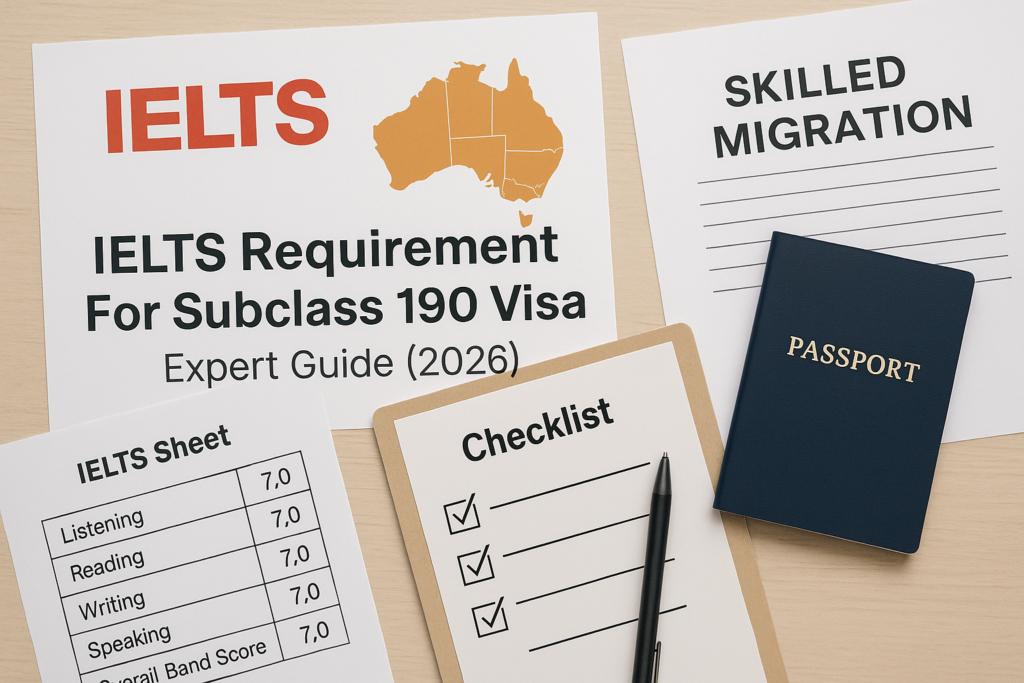
For most Subclass 190 applicants, the baseline English requirement is competent English. In IELTS terms, competent English usually means at least 6.0 in each of the four skills: Listening, Reading, Writing, and Speaking. The key phrase is each skill. A strong overall score does not fix a section below the required minimum.
For example, a candidate with Listening 7.5, Reading 7.0, Writing 5.5, and Speaking 7.0 has not met competent English through IELTS because Writing is below 6.0. The migration system usually looks at the separate bands, not only the average.
- Competent English is commonly IELTS 6.0 in each section.
- Proficient English is commonly IELTS 7.0 in each section.
- Superior English is commonly IELTS 8.0 in each section.
- Higher English bands may add migration points.
- Section minimums matter more than the overall average.
How English Scores Affect Subclass 190 Points
Subclass 190 is points tested, so English can influence more than eligibility. Competent English may satisfy the minimum requirement, but it usually does not add English points. Proficient English can add 10 points, and superior English can add 20 points, subject to the rules that apply at the time of your application.
This difference can be important. A candidate with a suitable skills assessment and state nomination may still need a stronger points profile. If English is the most realistic way to lift the score, aiming for 7.0 each or 8.0 each may be worth the extra preparation time.
If you need to practise under realistic pressure before choosing a target score, access unlimited IELTS mock tests and check whether your weakest section is close to the next points level.
Competent, Proficient, And Superior English Explained
Competent English is the common minimum level for many skilled visa applicants. In IELTS, it is usually 6.0 in Listening, Reading, Writing, and Speaking. This level shows that you can use English for work and settlement purposes, but it may not strengthen your points total.
Proficient English is the next major level. In IELTS, it is usually 7.0 in each section. This can be difficult because Writing and Speaking often lag behind Listening and Reading. Many candidates can reach an overall 7.0 before they can reach 7.0 in every skill.
Superior English is usually IELTS 8.0 in each section. This is a high target, especially in Writing. It can add more points, but it requires a serious plan, not only general English practice. The realistic question is whether those extra points are needed for your occupation and state nomination pathway.
Why Each Band Matters More Than Overall IELTS Score
IELTS gives an overall band score, but migration requirements often use minimum section bands. This is where candidates get caught. A result can look strong at first glance while one section still blocks the requirement.
Imagine a candidate who scores Listening 8.0, Reading 8.0, Writing 6.5, and Speaking 7.0. The overall score may look impressive, but it does not meet proficient English if the requirement is 7.0 in each section. Writing is the limiting factor.
This is why preparation should start with a section-by-section diagnosis. If you are below target in one skill, more general practice across all four skills may not be efficient. You need targeted work on the section that controls the result.
Subclass 190 State Nomination And English Expectations
The Subclass 190 visa includes state or territory nomination. States can set occupation lists, invitation rules, work experience expectations, and sometimes higher English preferences for certain occupations or competitive rounds. These settings can change, so applicants should check the current state nomination page before relying on a previous rule.
For some occupations, meeting competent English may be enough for eligibility but not enough to compete well. For others, registration or professional body requirements may indirectly push the English target higher. Nurses, teachers, engineers, accountants, and allied health professionals often need to think about English in relation to both migration and professional registration.
For a broader migration-English overview, read the IELTS for Migration Australia complete guide and compare your visa pathway with your occupation’s English expectations.
Which IELTS Test Type Should You Use?
For migration, many applicants use IELTS General Training. However, the right test can depend on the purpose. Academic IELTS may be needed for study, registration, or professional assessment in some contexts. General Training is often used for migration points, but you should confirm what your skills assessing authority, state nomination body, and visa rules require.
The test type matters because Academic and General Training have different Reading and Writing tasks. Preparing for the wrong version wastes time. If your migration agent, assessing authority, or state instructions specify a test type, follow that requirement rather than assuming all IELTS results are interchangeable.
Also check result validity. English test results are usually accepted only within a particular validity period. If your result expires before invitation or application, it may create timing problems.
When To Take IELTS In The Subclass 190 Process
Do not leave IELTS until the last minute. English results can affect your points claim, your Expression of Interest, and your confidence when responding to state nomination opportunities. If you wait until every other document is ready, one weak section can delay the whole pathway.
A practical approach is to diagnose early, set a target score, and allow time for at least one retake if needed. This is especially important if your goal is proficient or superior English. Candidates often need more than one attempt because one section can miss the target by 0.5.
If you are comparing preparation support, see our IELTS preparation plans and choose a plan based on your weakest skill rather than buying general practice you may not need.
How To Set A Realistic IELTS Target For Subclass 190
Your IELTS target should come from your points position. If you already have enough points and only need to satisfy the minimum English requirement, competent English may be the immediate goal. If your occupation is highly competitive, proficient or superior English may be a better strategic target.
Start by calculating your likely points without English bonus points. Then compare three scenarios: competent English, proficient English, and superior English. This shows whether IELTS is a small compliance task or a major points strategy.
Be honest about timing. Moving from 6.0 each to 7.0 each is achievable for many candidates, but it may require focused work. Moving to 8.0 each, especially in Writing, requires stronger control of grammar, task response, vocabulary, and test technique.
Common IELTS Problems For Subclass 190 Applicants
The first problem is an uneven score profile. Many skilled applicants have strong Listening and Reading but lower Writing or Speaking. This creates frustration because their overall English feels good, but the migration requirement still depends on the weakest section.
The second problem is over-relying on workplace English. Professional communication helps, but IELTS tests specific tasks. Writing Task 2, Writing Task 1, Speaking Part 2, and academic-style reading questions each need test-aware preparation.
The third problem is booking repeated tests without changing the preparation method. If Writing stays at 6.5, another test alone may not fix it. You need to know whether the issue is task response, paragraph development, grammar accuracy, vocabulary control, or timing.
A Four-Week IELTS Preparation Plan For Subclass 190
In week one, take a diagnostic test and identify the section minimum you must reach. Review each skill separately. Do not simply look at the total score. Write down the section that is furthest from your target.
In week two, focus on the weakest section while maintaining the others. If Writing is the issue, write timed essays and get feedback on task response and grammar. If Speaking is the issue, record answers and check fluency, pronunciation, and answer length.
In week three, add timed full-skill practice. This helps you manage fatigue and pacing. In week four, reduce new learning and increase review. Revisit your error log, practise test-day timing, and avoid major changes to your method in the final few days.
Documents And Evidence To Keep
Keep your official IELTS Test Report Form details, result date, test type, and section scores. You may need these when updating an Expression of Interest or providing evidence during the visa process. Store the information carefully so you do not rely on memory later.
Check that your name and personal details match your passport and application documents. Small inconsistencies can create extra admin. If there is an error in your test record, contact the test provider early rather than waiting until the application deadline.
Also keep records of any retakes. If you improve from competent to proficient English, update your points claim only when you have the official result and it is valid for the purpose you are using it for.
Final Checklist Before You Claim IELTS Points
Before claiming English points for Subclass 190, check the exact section scores, test type, result date, and validity period. Confirm that the claimed score level matches every section, not only the overall band.
Then compare the result with the current visa and state nomination requirements. If your pathway involves professional registration or a skills assessing authority, check those requirements as well. Migration English planning works best when it is connected to the whole pathway, not treated as a separate test.
The aim is simple: know the score you need, prepare for the section that controls the outcome, and avoid relying on assumptions. A clear IELTS plan can protect your Subclass 190 timeline and may strengthen your points position.
Ready to find out your IELTS band score?
Take the IELTS Express Pre-Test for just $4.99 and get your personalised band prediction with a 14-day improvement plan.
FAQ: IELTS Requirement For Subclass 190 Visa
What is the IELTS requirement for Subclass 190 Visa applicants?
Many applicants need at least competent English, which is commonly IELTS 6.0 in each section. Higher scores may be needed or useful depending on points, occupation, state nomination, and registration requirements.
Does an overall IELTS 6.0 meet the Subclass 190 English requirement?
Usually, no. Migration English requirements commonly use section minimums. You generally need the required score in Listening, Reading, Writing, and Speaking, not only a matching overall score.
Can IELTS 7.0 each add points for Subclass 190?
IELTS 7.0 in each section is commonly treated as proficient English and may add 10 points, subject to the rules that apply when you apply. Always confirm the current points table before claiming points.
Is IELTS General Training or Academic better for Subclass 190?
IELTS General Training is often used for migration purposes, but some professional or study-related requirements may need Academic IELTS. Check the visa instructions, skills assessing authority, and state nomination requirements before booking.
When should I take IELTS for a Subclass 190 application?
Take IELTS early enough to allow diagnosis, preparation, and a possible retake. Leaving English until the end can delay your Expression of Interest or weaken your points position if one section misses the target.