If you are checking the IELTS requirement for Teacher Registration Australia, you are probably trying to answer two questions at once: what score do I need, and will my evidence be accepted by the teaching registration authority? Before you spend weeks preparing without a clear baseline, take the IELTS Express Pre-Test to get a quick band prediction and a more practical starting point for your study plan.
Teacher registration is a high-stakes pathway because English evidence is often assessed alongside qualifications, supervised practice, identity documents, and state or territory requirements. IELTS can be accepted, but the details matter. The test type, score pattern, result age, and registration body rules can affect whether your result is enough.
What Is The IELTS Requirement For Teacher Registration Australia?
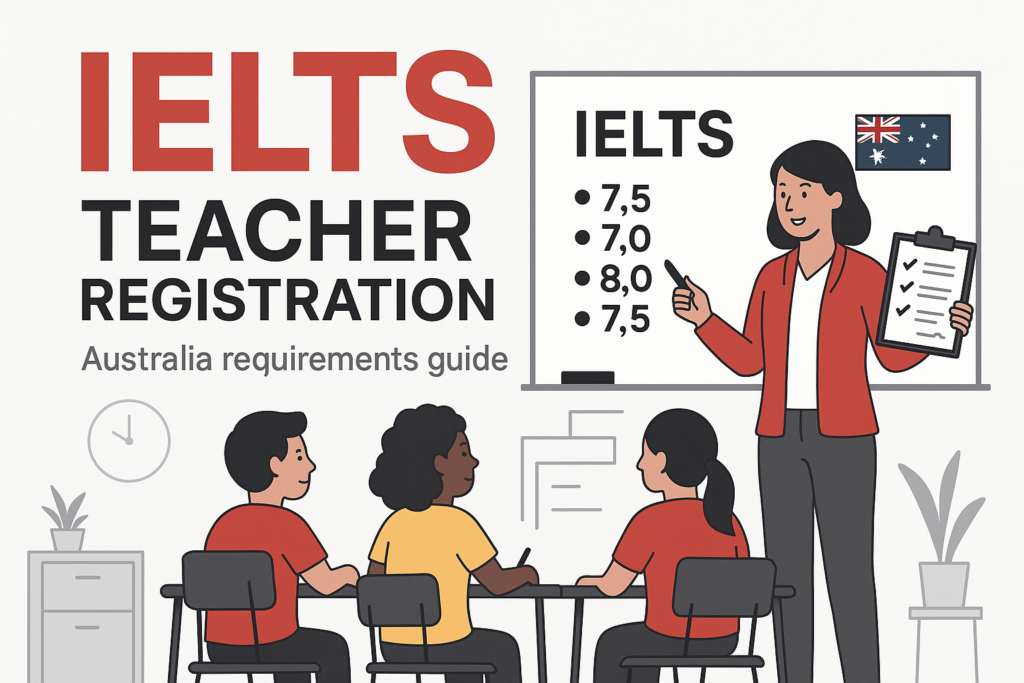
The IELTS requirement for teacher registration in Australia is the English language evidence a teacher registration authority may ask for before approving registration. In many cases, applicants use IELTS Academic, not IELTS General Training, because teaching registration is treated as a professional registration pathway rather than a migration-only pathway.
Exact requirements can vary by state or territory and by applicant background. Some applicants may be exempt because they completed recognised study in English. Others may need to provide a current English test result. The safest approach is to check the registration authority for the state or territory where you plan to teach before booking the test.
- Use the correct IELTS module, usually Academic for professional registration.
- Check whether the authority requires minimum scores in each skill.
- Confirm how old your test result can be.
- Check whether test results must be achieved in one sitting.
- Keep your official Test Report Form details ready for verification.
Why Teacher Registration English Rules Are Different From General Migration Rules
Many applicants confuse teacher registration English requirements with visa English requirements. They are related, but they are not the same thing. A visa pathway may accept one score pattern, while a teaching authority may require a different standard because the applicant will work in classrooms, write reports, speak with parents, and support student learning.
Teaching is language-heavy work. A teacher needs to explain concepts clearly, manage classroom communication, understand policy language, write professional notes, and respond to students in real time. That is why registration bodies often pay close attention to Speaking, Listening, Reading, and Writing separately rather than only looking at an overall band.
If you are also managing migration goals, read the IELTS for Migration Australia complete guide so you can separate registration evidence from visa points strategy.
IELTS Academic Or IELTS General Training For Teacher Registration?
For teacher registration, IELTS Academic is usually the version applicants need to investigate first. IELTS General Training is commonly used for migration, work, or general settlement purposes, but professional registration bodies often prefer Academic because it is designed for study and professional contexts.
Do not assume that a strong General Training result will automatically satisfy a teacher registration authority. If the authority asks for IELTS Academic, a General Training result may not be accepted even if the band scores are high. This is a frustrating mistake because it can cost both time and money.
Before booking, check the wording on the authority’s website. Look for the exact accepted tests, required module, minimum scores, validity period, and whether online or computer-delivered versions are treated differently. The booking page is not the authority. The authority’s rule is what matters.
Common IELTS Score Patterns For Teaching Registration Applicants
Teacher registration requirements often focus on strong performance across all four skills. Some authorities may require high minimum bands in Listening and Speaking because classroom communication is central to teaching. Others may also expect strong Reading and Writing because teachers need to understand curriculum material and produce written communication.
You should not rely on a general statement such as “overall 7” unless the authority clearly says that is enough. A result with a high overall band can still fail a professional requirement if one skill is below the minimum. For example, an applicant may have an overall 7.5 but a Writing 6.5, and that single section may be the problem.
Use a section-minimum mindset. Write down the required score for each skill, then prepare for the weakest section first. If you do not know your likely score yet, a pre-test or mock test can stop you from building a plan around hope instead of evidence.
How To Check Your State Or Territory Requirement
Australia does not have one single teacher registration authority for every applicant. Each state and territory has its own registration body. That means the IELTS requirement for Teacher Registration Australia should be checked against the location where you want to work, not only against general national advice.
When you check the authority, save the page or take notes. Requirements can include small details that matter later, such as whether results must be from the same sitting, how long the result remains valid, and whether alternative English tests are accepted. If you are applying close to a deadline, small details become big problems.
- Find the teacher registration body for your target state or territory.
- Open the English language requirements page.
- Confirm accepted tests and modules.
- Write down the minimum band for each skill.
- Check validity period and document submission rules.
- Contact the authority if your education history may qualify for an exemption.
When You May Not Need IELTS For Teacher Registration
Some applicants may not need IELTS if they meet an English language exemption. This often depends on where they studied, the language of instruction, the length of study, and whether the qualification meets the authority’s rules. Exemptions are not automatic just because a person speaks English well or has work experience in English.
If you believe you qualify for an exemption, gather evidence early. You may need transcripts, completion letters, or documents that show the language of instruction. Do not wait until the end of the application to discover that the authority still wants a test result.
Even if you expect an exemption, it can be sensible to check your IELTS readiness if your timeline is tight. If the exemption is refused or more evidence is requested, you will not want to start preparation from zero.
Planning Your IELTS Preparation Around A Registration Deadline
The most expensive IELTS mistake for teaching applicants is poor timing. Registration applications often involve several moving parts. If you leave IELTS until the final month, one low section score can delay the whole process. A safer plan gives you time to test, receive results, review weaknesses, and retake if needed.
Start by working backwards from your registration or employment deadline. Allow time for booking availability, result release, document checking, and possible resubmission. If you are close to the required score but not safely above it, consider unlimited IELTS mock tests so you can practise under pressure and track section scores before the official test.
A practical timeline is simple. Diagnose your current level first. Build a section-by-section plan. Take a timed mock. Fix the lowest section. Then book the official test when your practice results are consistently above the requirement, not just once on a good day.
Writing And Speaking Issues That Affect Teacher Applicants
Teaching applicants are often strong communicators, but IELTS Writing and Speaking still create problems. In Writing, the issue is often not knowledge. It is task control. Candidates may write too generally, underdevelop ideas, miss the task focus, or make repeated grammar errors under time pressure.
In Speaking, some teachers over-explain. Long answers can become less organised, especially in Part 2 and Part 3. A strong IELTS Speaking answer is clear, extended, and controlled. It should not sound memorised, but it should have a clear direction.
If Writing is your main concern, review the IELTS Writing Task 2 band score guide and compare your current answers with the criteria. If Speaking is unstable, use the IELTS Speaking Test complete guide to understand how fluency, vocabulary, grammar, and pronunciation are judged.
Document Checks Before You Submit Your IELTS Result
Once you receive your IELTS result, check the document details carefully. Make sure your name, date of birth, test date, module, and Test Report Form number match what the authority asks for. A good score can still cause delays if the identifying details are inconsistent with your application documents.
Keep a copy of your result and submit it through the authority’s required process. Some authorities verify results directly. Others may ask you to upload evidence. If your passport name, degree name, or application name differs, prepare supporting documents before the authority asks.
If you are choosing between self-study and guided preparation, compare IELTS preparation plans and choose the option that gives support for the section most likely to block registration.
A Practical 21-Day Study Plan For Teacher Registration IELTS
Use the first three days for diagnosis. Complete a short test or mock tasks in all four skills, then identify your weakest section. Do not spread your effort evenly if one skill is clearly below the requirement. Registration pathways often fail on the lowest band, not on the average score.
On days four to ten, focus on the weakest section while maintaining light practice in the others. For Writing, plan and rewrite essays. For Speaking, record answers and check whether they are developed but still organised. For Listening and Reading, review question types and timing patterns.
On days eleven to seventeen, add timed practice. Complete section tests under exam conditions and record scores. On days eighteen to twenty-one, complete a full mock or a set of section mocks, then decide whether your results are safely above the required bands. If they are not, delay the official test if your timeline allows it.
Final Checklist Before Booking IELTS For Teacher Registration
Before booking the test, confirm the authority, test type, score requirement, validity period, and submission process. Do not book IELTS General Training if the authority asks for Academic. Do not assume an overall score is enough if section minimums are listed. Do not rely on an old result unless the authority confirms it is still valid.
Then check your preparation honestly. If your practice results are below the requirement, use the remaining time to fix the lowest section first. Teacher registration is too important for vague preparation. A clear score target, a realistic timeline, and controlled practice will give you a much better chance of submitting accepted evidence the first time.
Ready to find out your IELTS band score?
Take the IELTS Express Pre-Test for just $4.99 and get your personalised band prediction with a 14-day improvement plan.
FAQ: IELTS Requirement For Teacher Registration Australia
What IELTS test do I need for teacher registration in Australia?
Many teacher registration applicants need IELTS Academic, but you must check the authority for your target state or territory. Do not assume IELTS General Training will be accepted for professional registration.
Is an overall IELTS band enough for teacher registration?
Often, no. Registration bodies may require minimum scores in each skill. A high overall band may still be rejected if Listening, Reading, Writing, or Speaking is below the listed minimum.
Can I use an old IELTS result for teacher registration?
Only if the registration authority accepts it within its validity rules. Check the maximum age of the test result before you submit, because expired evidence can delay the application.
Can overseas-trained teachers get an English exemption?
Some applicants may qualify for an exemption based on recognised study in English, but the rules depend on the authority. You may need documents showing where, how long, and in what language you studied.
Should I take IELTS before applying for teacher registration?
If the authority requires English evidence and you do not qualify for an exemption, it is usually better to prepare and test early. This gives you time to retake if one section is below the required band.