If you are searching for an IELTS Writing Task 1 Bar Chart sample answer, you probably need more than a model paragraph to copy. You need to know how the answer is planned, why the overview works, which figures are worth selecting, and how to avoid writing a list of numbers. Before you spend another week guessing your level, take the IELTS Express Pre-Test to get a quick band prediction and a clearer starting point for your Writing plan.
Bar charts are common in Academic Writing Task 1 because they test comparison. The examiner wants to see whether you can group information, report the main features, and choose accurate data. A strong answer is not long or complicated. It is organised, selective, and easy to follow.
What An IELTS Bar Chart Answer Needs To Do
An IELTS bar chart answer should summarise the main features of the chart and support those features with selected figures. You do not need to describe every bar. You need to show the examiner that you understand the most important comparisons.
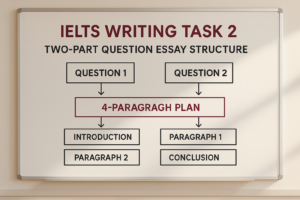
Most good answers have four parts: an introduction, an overview, body paragraph one, and body paragraph two. The introduction paraphrases the task. The overview gives the biggest trends or contrasts. The body paragraphs give precise details, grouped in a logical way.
- Write at least 150 words.
- Use a clear overview.
- Group similar information together.
- Choose important figures, not every figure.
- Use comparison language accurately.
IELTS Writing Task 1 Bar Chart Sample Answer Question
Here is a realistic Academic Task 1 bar chart question:
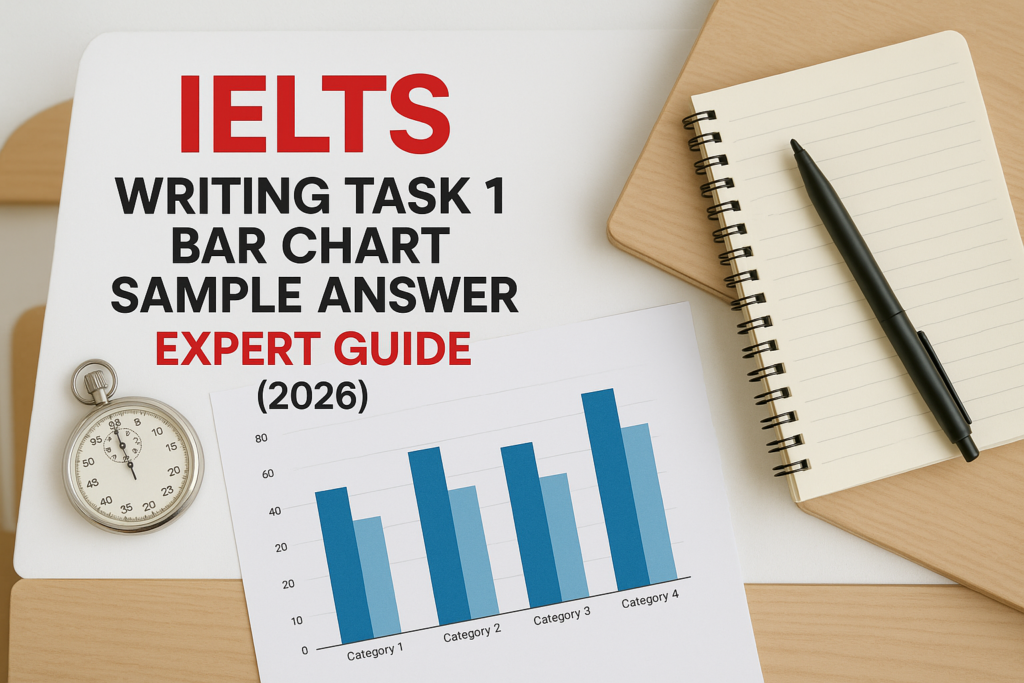
The chart shows the percentage of adults in five age groups who used online banking in Australia in 2010 and 2020. Summarise the information by selecting and reporting the main features, and make comparisons where relevant.
Assume the figures are as follows. In 2010, online banking use was 35% for ages 18-24, 42% for 25-34, 38% for 35-44, 24% for 45-54, and 12% for 55 and over. In 2020, the figures rose to 82%, 88%, 79%, 63%, and 41% respectively.
This chart has a clear overall message. Online banking increased in every age group, younger adults remained the most frequent users, and the oldest group had the lowest use in both years despite a clear rise.
Band 7 IELTS Writing Task 1 Bar Chart Sample Answer
The bar chart compares the proportion of Australian adults in five age groups who used online banking in 2010 and 2020.
Overall, online banking became more common in every age group over the period. Younger adults were the most likely to use this service in both years, while people aged 55 and over recorded the lowest percentages. However, all groups showed a noticeable increase by 2020.
In 2010, the highest figure was for adults aged 25 to 34, at 42%. This was slightly higher than the 35 to 44 group, at 38%, and the 18 to 24 group, at 35%. Use was lower among older adults, with 24% of people aged 45 to 54 using online banking and only 12% of those aged 55 and over doing the same.
By 2020, the figures had risen sharply. The 25 to 34 age group again had the highest percentage, at 88%, followed by 18 to 24 year olds at 82% and 35 to 44 year olds at 79%. The older groups also increased, although they remained lower than the younger groups. Online banking use reached 63% among 45 to 54 year olds and 41% among adults aged 55 and above.
Why This Sample Answer Works
This answer works because it does not try to report every detail with equal weight. It identifies the main trend first: all age groups increased. It then gives a clear comparison between younger and older adults. That overview is important because Task Achievement in IELTS Writing Task 1 depends heavily on whether you can summarise the main features.
The body paragraphs are also grouped sensibly. The first body paragraph explains 2010. The second explains 2020. Another possible structure would be to group younger adults together and older adults together. Either can work, as long as the grouping helps the reader understand the chart.
If you want more practice with timed charts and feedback, use unlimited IELTS mock tests to check whether your overview and data selection stay clear under exam pressure.
How To Write The Overview For A Bar Chart
The overview is usually the most important paragraph in a bar chart answer. It should report the biggest pattern without giving too many exact numbers. In the sample above, the overview says that online banking increased in every group, younger adults had higher use, and the oldest group remained lowest.
A weak overview often lists one figure or repeats the introduction. For example, “The chart shows online banking by age group” is not an overview. It does not summarise a trend or comparison. A stronger overview explains what changed and which categories were highest or lowest.
- Look for the highest and lowest bars.
- Check whether all categories move in the same direction.
- Notice any large gaps between groups.
- Avoid exact figures unless they are needed for clarity.
Useful Vocabulary For Bar Chart Comparisons
Bar charts usually need simple comparison language. You can use phrases such as higher than, lower than, the highest proportion, the lowest figure, rose from, increased to, and remained below. Do not force rare words into the answer.
For changes over time, use verbs such as rose, increased, grew, fell, declined, and remained stable. For static charts, use comparison verbs and structures instead, such as accounted for, was the largest category, and was almost twice as high as.
Accuracy matters more than drama. If a figure increases from 35% to 82%, you can say it rose sharply. If it rises from 35% to 38%, say it increased slightly. Exaggerated vocabulary can make the answer sound less precise.
Common Mistakes In Bar Chart Answers
The first mistake is missing the overview. An answer without a clear overview can lose marks even if the grammar is good. Make the overview visible and place it after the introduction.
The second mistake is describing the bars one by one. This creates a mechanical report and often wastes time. Group the data instead. In the sample answer, the age groups are compared within each year, which keeps the report readable.
The third mistake is using numbers without comparison. Writing that one group was 82% and another was 88% is useful only if you explain the relationship between them. If your reports often feel unfocused, read the IELTS Writing Task 1 band score guide and check whether your overview, comparisons, and data selection are strong enough.
How To Plan A Bar Chart Answer In Three Minutes
Spend the first minute reading the title, labels, units, and dates. Do not start writing until you know what the chart measures. The second minute should be used to find the biggest patterns. Ask yourself which category is highest, which is lowest, and whether the figures change over time.
Use the third minute to decide your paragraph structure. If the chart compares two years, you can often write one body paragraph for the first year and one for the second year. If the chart has many categories but no time period, group similar or contrasting categories together.
- Minute one: understand the chart and units.
- Minute two: find the main comparisons.
- Minute three: choose your grouping.
- Then write the overview before detailed body paragraphs.
How To Improve From A Basic Answer To Band 7
A basic answer reports data. A Band 7 style answer organises data. That difference sounds small, but it changes the whole report. The examiner should be able to read your overview and understand the main message before seeing the detailed figures.
To improve, practise rewriting only the overview for several charts. Then practise grouping the same data in two different ways. This builds flexibility. If your test date is close and you need guided support, compare IELTS preparation plans and choose a plan that gives you enough Writing feedback before the exam.
Final Tips Before You Write Your Own Bar Chart Report
Before you write, decide what the chart is really about. Is it mainly about growth, ranking, age differences, gender differences, country comparisons, or changes over time? That decision will help you choose the overview and avoid describing every bar separately.
Keep the language controlled. IELTS Writing Task 1 is not a creative writing task. Clear grouping, accurate numbers, and a clean overview will do more for your score than difficult vocabulary. If you can explain the chart to a busy reader in a logical order, you are already writing in the right direction.
Ready to find out your IELTS band score?
Take the IELTS Express Pre-Test for just $4.99 and get your personalised band prediction with a 14-day improvement plan.
FAQ: IELTS Writing Task 1 Bar Chart Sample Answer
How many words should an IELTS bar chart answer have?
You must write at least 150 words. A good target is about 170 to 200 words because it gives enough room for an overview, comparisons, and selected figures.
Do I need an overview for a bar chart?
Yes. The overview is essential in Academic Writing Task 1. It should summarise the main trends or comparisons without listing every number.
Should I describe every bar in the chart?
No. Select the main features. Focus on the highest and lowest figures, major changes, clear contrasts, and any important similarities.
Can I copy the wording from the task question?
You can use necessary labels from the chart, but the introduction should paraphrase the task. Do not copy the full question sentence word for word.
What is the safest structure for a bar chart sample answer?
Use four paragraphs: introduction, overview, body paragraph one, and body paragraph two. This structure is clear and works for most Academic Task 1 bar charts.