If you are searching for an IELTS Writing Task 1 Overview Paragraph sample answer, you are probably trying to solve one of the biggest Task 1 problems: how to summarise the main features without copying every number. A clear overview can lift the whole report because it shows the examiner that you understand the visual. Before you spend another week practising random charts, take the IELTS Express Pre-Test to check your current writing band range and see what needs the most work.
This guide gives you a practical overview paragraph model, explains why it works, and shows you how to avoid the mistakes that keep many candidates around Band 5 or Band 6. The focus is simple: choose the biggest features, group them clearly, and write an overview that sounds accurate rather than memorised.
What An Overview Paragraph Does In IELTS Writing Task 1
The overview paragraph gives the examiner the big picture of the visual. It does not list every detail. It does not explain why something happened. It summarises the most important trends, contrasts, stages, or changes shown in the chart, map, process, table, or graph.
For line graphs and bar charts, the overview often describes the highest and lowest figures, the biggest increase or decrease, and any clear contrast between categories. For maps, it may describe the main physical changes. For process diagrams, it usually summarises the number of stages and the general direction of the process.
- State the main trend or comparison.
- Mention the most noticeable high or low point if relevant.
- Group details instead of describing them one by one.
- Avoid numbers unless a figure is essential to the main point.
- Do not add reasons or opinions that are not shown.
IELTS Writing Task 1 Overview Paragraph Sample Answer
Imagine a line graph showing the percentage of households with internet access in one country from 2000 to 2020. The figure starts at 18% in 2000, rises steadily to 55% in 2010, then increases more slowly to 89% in 2020.
A strong overview could be:
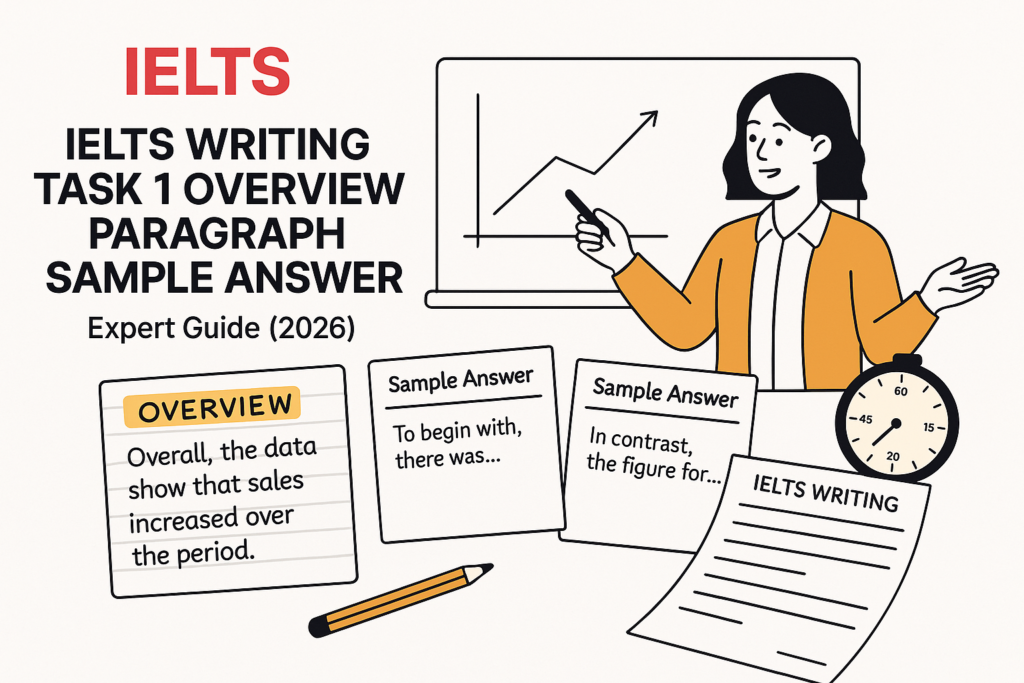
Overall, the proportion of households with internet access increased substantially over the period, with the sharpest growth occurring in the first ten years. By the end of the period, internet access had become common in most households.
This overview works because it reports the main movement, compares the speed of change, and gives the final situation in broad terms. It does not overload the paragraph with every figure. The exact numbers can appear later in the body paragraphs.
Why This Sample Overview Is Stronger Than A Basic One
A weak overview might say, “Overall, internet access changed from 2000 to 2020.” That sentence is too general. It tells the examiner almost nothing. Another weak version might say, “Overall, internet access was 18% in 2000, 55% in 2010 and 89% in 2020.” That is more like a body paragraph because it lists numbers without summarising the pattern.
The stronger sample answer does two useful things. First, it uses a broad trend phrase, “increased substantially”. Second, it identifies a comparison within the trend, “the sharpest growth occurring in the first ten years”. That is the kind of selection IELTS rewards.
If you want to compare your Task 1 writing with realistic test timing, access unlimited IELTS mock tests and check whether you can write the overview before you move into detailed data.
Where To Put The Overview Paragraph
Most candidates place the overview after the introduction. This is usually the safest structure: introduction, overview, body paragraph one, body paragraph two. It makes the main features easy for the examiner to find.
You can also place the overview at the end, but that structure is riskier. If you run out of time, the overview may be missing. Since Task Achievement depends heavily on the overview, it is better to write it early.
A good overview is usually two sentences. One sentence may be enough for a simple visual, but two sentences often give you more control. Three or four sentences can become too detailed unless the visual is unusually complex.
How To Choose The Main Features
Choosing main features is the real skill. Before writing, look at the visual for one or two minutes. Ask what changed most, what stayed stable, what was highest or lowest, and whether any categories moved in opposite directions.
Do not start with individual numbers. Start with shape and meaning. In a line graph, look at direction and speed. In a bar chart, compare the tallest and shortest bars. In a table, find the biggest contrast or the most consistent pattern. In a process, count the stages and identify whether it is natural, manufactured, linear, or circular.
The IELTS Writing Task 1 sample answers guide can help you see how overview choices change across different visual types.
Useful Overview Language That Still Sounds Natural
You do not need complicated phrases. In fact, complicated phrases often create grammar problems. Strong overview language is clear and flexible. Use words such as overall, in general, the most noticeable feature, the main change, while, whereas, by contrast, rose, fell, remained stable, and fluctuated.
For trend visuals, you might write that figures increased steadily, declined slightly, fluctuated throughout the period, or remained broadly stable. For comparison visuals, you might write that one category was consistently higher than another, or that two groups showed opposite patterns.
For maps, useful verbs include developed, expanded, was replaced, was converted, was added, and was removed. For processes, useful phrases include begins with, ends with, passes through, is produced, and is then transported. Choose language that matches the task, not language that sounds impressive.
Common Overview Paragraph Mistakes
The most serious mistake is missing the overview completely. If the report has an introduction and body paragraphs but no clear summary of main features, the Task Achievement score is likely to suffer.
The second mistake is giving too many numbers. Numbers belong mainly in the body paragraphs. The overview should usually describe broad patterns, not detailed data. A few numbers may be acceptable if they help identify the highest or lowest point, but they should not dominate the paragraph.
The third mistake is explaining reasons. IELTS Task 1 is a reporting task. If a graph shows car use increasing, do not write that it increased because people became richer unless the task states that reason. Report what is visible.
If overview writing is holding your score down, compare IELTS preparation plans and choose support that includes writing feedback, not only model answers.
Band 5 Overview Versus Band 7 Overview
For the same internet access graph, a Band 5 style overview may say: “Overall, the graph shows internet access in households from 2000 to 2020 and it changed a lot.” This is understandable, but it is vague. It repeats the task instead of selecting the main features.
A stronger version is: “Overall, household internet access rose dramatically between 2000 and 2020, although the rate of growth was faster in the first half of the period. By 2020, access had become widespread.” This gives the examiner a clearer summary.
The difference is not fancy vocabulary. The difference is selection. The stronger overview tells us the direction, the change in speed, and the final situation. That is enough to guide the rest of the answer.
A Simple Overview Writing Method
Use a three-step method. First, identify the visual type. Second, find two main features. Third, write two sentences that summarise those features without listing all the data.
For example, for a line graph, your two main features might be the overall direction and the fastest period of change. For a bar chart, they might be the highest category and the biggest contrast. For a map, they might be the main development and what stayed the same.
Once you have the overview, the body paragraphs become easier. Body paragraph one can support the first main feature. Body paragraph two can support the second. This creates a report that feels organised instead of random.
Final Checklist Before You Submit
Before you finish Task 1, check the overview carefully. Does it describe the main features? Is it easy to find? Does it avoid unsupported reasons? Does it leave detailed numbers for the body paragraphs? If the answer is yes, your report is in a much safer position.
Also check whether your overview matches the body. If the overview says the sharpest growth happened in the first ten years, the body should include figures that support that point. If the overview says one category was highest, the body should prove it with selected data.
A strong overview paragraph is not a decoration. It is the centre of a good Task 1 answer. Learn to see the big picture first, write it in plain English, and then use the body paragraphs to support it with accurate details.
Ready to find out your IELTS band score?
Take the IELTS Express Pre-Test for just $4.99 and get your personalised band prediction with a 14-day improvement plan.
FAQ: IELTS Writing Task 1 Overview Paragraph Sample Answer
How long should an IELTS Task 1 overview paragraph be?
Most overview paragraphs should be one or two sentences. Two sentences are often enough to summarise the main trend, comparison, or change without turning the overview into a body paragraph.
Can I include numbers in the overview?
You can include a number if it is essential, such as the highest or lowest figure. However, most numbers should appear in the body paragraphs so the overview stays focused on the big picture.
What happens if I forget the overview?
If the overview is missing, your Task Achievement score can drop because the examiner cannot see a clear summary of the main features. Always write the overview before detailed body paragraphs.
Should the overview come before or after the body paragraphs?
Placing it after the introduction is usually safest. It helps the examiner find the main features early and protects you if you run short of time near the end.
How do I improve overview writing quickly?
Practise finding two main features before you write. Spend one minute identifying the biggest trend, contrast, or change, then write two clear sentences before adding detailed figures.