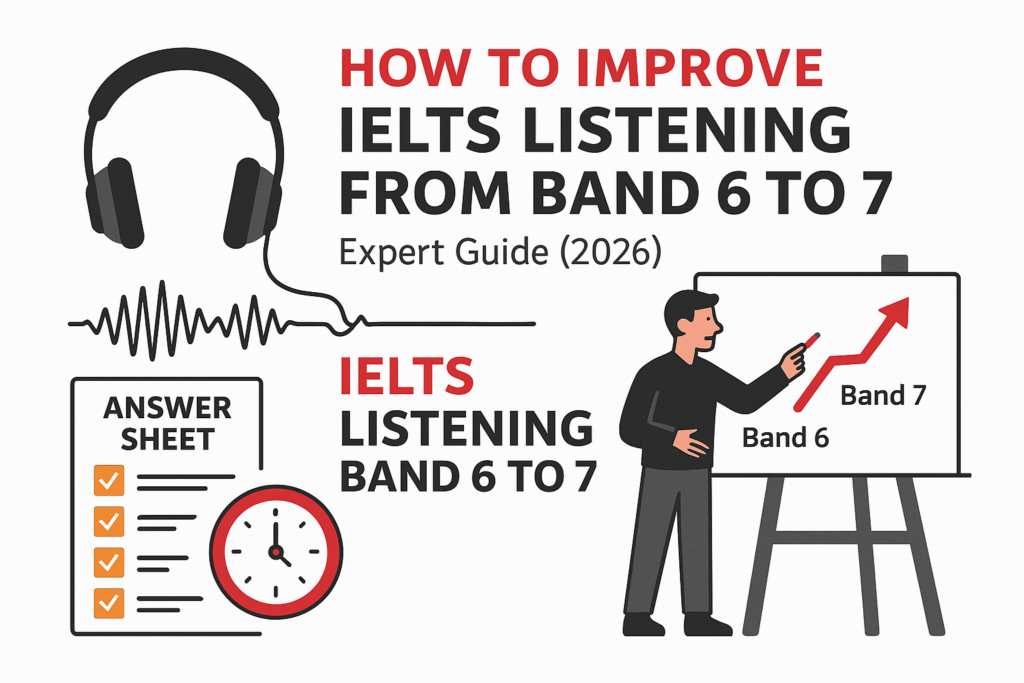
If you are asking how to improve IELTS Listening from band 6 to 7, your problem is usually not that you understand nothing. Band 6 listeners often follow the general meaning, but lose marks through missed details, distractors, spelling errors, weak prediction, or slow recovery after one difficult question. Before you build a new study plan, take the IELTS Express Pre-Test to check your current band range and get a focused 14-day improvement plan.
Moving from Band 6 to Band 7 in IELTS Listening is a precision task. You do not need to become a perfect listener. You need to reduce repeated errors, understand common question traps, and practise with a review system that changes how you listen under pressure.
What Band 6 Means In IELTS Listening
A Band 6 Listening candidate usually understands the main ideas in many recordings, especially when the topic is familiar and the speaker is clear. The difficulty appears when the answer is hidden inside a longer sentence, when the speaker corrects themselves, or when two possible answers sound similar.
Band 7 requires more reliable detail listening. You need to catch numbers, names, plurals, dates, directions, opinions, and changes of mind with fewer mistakes. The gap is often smaller than it feels, but it needs disciplined practice.
- You follow the conversation but miss exact words.
- You choose an answer before hearing the full sentence.
- You lose focus after one missed question.
- You make avoidable spelling or plural mistakes.
- You understand the recording later, but not quickly enough during the test.
How To Improve IELTS Listening From Band 6 To 7
To improve IELTS Listening from Band 6 to 7, stop measuring progress only by how many tests you complete. A full test is useful, but the review after the test is where the score changes. You need to know why each wrong answer happened.
Classify every mistake into a cause. Was it spelling? Was it a distractor? Did you fail to predict the answer type? Did you miss a synonym? Did you stop listening because you were still thinking about the previous question? Once you see the pattern, your practice becomes much more useful.
If you need regular timed practice, access unlimited IELTS mock tests and review each Listening result by question type, not only by total score.
Set The Right Band 7 Target
IELTS Listening has 40 questions. The exact raw score needed for Band 7 can vary slightly, but candidates usually need around 30 correct answers. If you are currently around Band 6, your practical goal is to find five to seven more reliable marks.
This is good news. You do not need to fix everything at once. You need to protect the easiest marks, reduce predictable errors, and stop losing two or three answers in a row when the recording becomes fast.
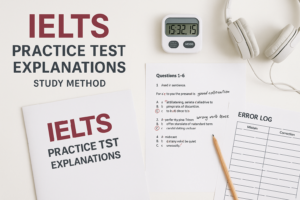
Start by completing one timed Listening test. Then make a simple table with four columns: question number, your answer, correct answer, and reason for the mistake. Do this for three tests and your score pattern will become clear.
Fix Prediction Before The Recording Starts
Prediction is one of the fastest ways to lift Listening accuracy. Before each section begins, read the questions and decide what type of answer you need. You may need a noun, number, date, adjective, place, name, or short phrase.
This helps your ear focus. If the gap says “meeting room: ____”, you are probably listening for a room name or number. If the sentence says “the main disadvantage is ____”, you are listening for a problem, not a benefit.
Do not write a guessed answer before listening. Prediction is not guessing. It is preparing your brain to catch the right kind of information when it arrives.
Train For Distractors
Distractors are a major reason Band 6 candidates stay stuck. A speaker may mention one answer, then reject it, correct it, or replace it with another option. If you write the first thing you hear, you can lose an easy mark.
Listen for correction phrases such as “actually”, “no, sorry”, “I mean”, “instead”, “rather than”, “it used to be”, and “we changed it to”. These phrases often signal that the first answer is wrong and the later answer matters.
When reviewing, replay only the distractor sentence. Write down the wrong option and the correct option. This small drill teaches you to wait for the final meaning before locking in an answer.
Improve Spelling, Plurals, And Word Forms
Spelling errors can quietly block Band 7. A candidate may hear the answer correctly but lose the mark because the written form is wrong. Plurals are another common problem. “Ticket” and “tickets” may not both be accepted.
Build a personal error list. Include months, days, common names, accommodation words, transport words, education words, and workplace vocabulary. Review the list for five minutes before each practice test.
Also check word forms. If the sentence needs a noun, do not write an adjective. If it needs a plural countable noun, listen carefully for final sounds. These details are small, but they are often the difference between Band 6.5 and Band 7.
Use Transcripts The Right Way
Many students use transcripts too early. If you read the transcript before trying to listen again, you turn Listening practice into Reading practice. The better method is to listen again first, then check the transcript after you have made a second attempt.
For each wrong answer, replay the relevant ten to twenty seconds. Try to hear the answer without reading. Then open the transcript and mark the exact phrase that gave the answer. Also mark the synonym or paraphrase used in the question.
This trains test listening. IELTS often does not repeat the exact words from the question. The recording may say “costs a lot less” while the answer option says “cheaper”. Band 7 listeners recognise that relationship quickly.
Practise Each Section Differently
IELTS Listening has four sections, and each section tests a slightly different skill. Section 1 often rewards accuracy with names, numbers, bookings, and everyday details. Section 2 often involves maps, facilities, or announcements. Section 3 is usually an academic conversation. Section 4 is a lecture-style monologue.
If you lose marks in Section 1, focus on spelling, numbers, and simple detail. If Section 3 is the problem, train for opinion, agreement, disagreement, and changes of mind. If Section 4 is weak, practise note completion and topic vocabulary.
For a broader skills overview, read the IELTS Listening band score guide and compare your current raw score with your target band.
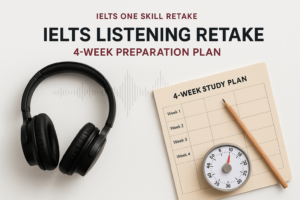
Build A 14-Day Band 6 To 7 Listening Plan
Use Days 1 and 2 for diagnosis. Complete one full Listening test, then review every wrong answer by cause. On Day 2, replay the wrong-answer sections and write down the exact phrases you missed.
Use Days 3 to 6 for targeted repair. Spend one day on spelling and plurals, one day on distractors, one day on multiple choice, and one day on note completion. Keep sessions short and focused.
Use Days 7 to 10 for timed section practice. Do not always complete full tests. Sometimes practise only Section 3 or Section 4 if that is where your score drops. Use Days 11 to 14 for two full tests, deep review, and a final error list.
Common Mistakes That Keep Candidates At Band 6
The first mistake is doing many tests without review. This creates familiarity, but it does not fix the reason marks are being lost. One carefully reviewed test is more useful than three rushed tests.
The second mistake is pausing the audio during practice too often. Paused practice can help beginners, but Band 6 to Band 7 preparation needs real test timing. You must learn to keep moving even after a missed answer.
The third mistake is ignoring easy marks. Section 1 spelling and number errors feel minor, but they matter. Protecting those marks gives you more room for difficult questions later.
When To Get Support
If your score has stayed at Band 6 or 6.5 after several full tests, you may need outside feedback on your error pattern. This is especially true if you keep saying, “I understand it when I read the transcript.” That means the problem is speed, prediction, or test processing, not general understanding.
Support can help you identify which questions deserve most attention. It can also stop you wasting time on passive listening, long videos, or random practice that does not match your score problem. Compare IELTS preparation plans if you want structured help with a specific band target.
Final Checklist Before Your Next Listening Test
Before your next timed test, check that you have a prediction method, a distractor strategy, a spelling list, and a review table. During the test, keep your eyes ahead of the audio and recover quickly if you miss one answer.
After the test, do not simply check the score. Ask what caused each lost mark. If the same cause appears repeatedly, that is your next practice focus. Band 7 Listening is built by removing repeated mistakes, not by hoping the next recording is easier.
Ready to find out your IELTS band score?
Take the IELTS Express Pre-Test for just $4.99 and get your personalised band prediction with a 14-day improvement plan.
FAQ: How To Improve IELTS Listening From Band 6 To 7
How many correct answers do I need for Band 7 in IELTS Listening?
The exact conversion can vary, but Band 7 is usually around 30 correct answers out of 40. Check recent IELTS band conversion guidance and aim for a small buffer above the minimum.
Can I improve IELTS Listening from Band 6 to 7 in two weeks?
Yes, if your current score is close and your errors are specific. Two weeks is enough to improve prediction, spelling, distractor control, and review habits, but it may not fix a large listening gap.
Should I listen to podcasts to improve IELTS Listening?
Podcasts can help general listening, but they are not enough by themselves. IELTS improvement needs test-style practice, question review, transcript work, and timed recovery.
Why do I understand the transcript but miss answers in the test?
This usually means your reading understanding is stronger than your real-time listening. Train by replaying short sections, predicting answer types, and identifying paraphrases before reading the transcript.
What is the best practice method for Band 6 to Band 7?
Complete timed practice, classify every wrong answer by cause, replay the difficult section, check the transcript, and keep a personal error list. Repeat this until the same mistakes start to disappear.