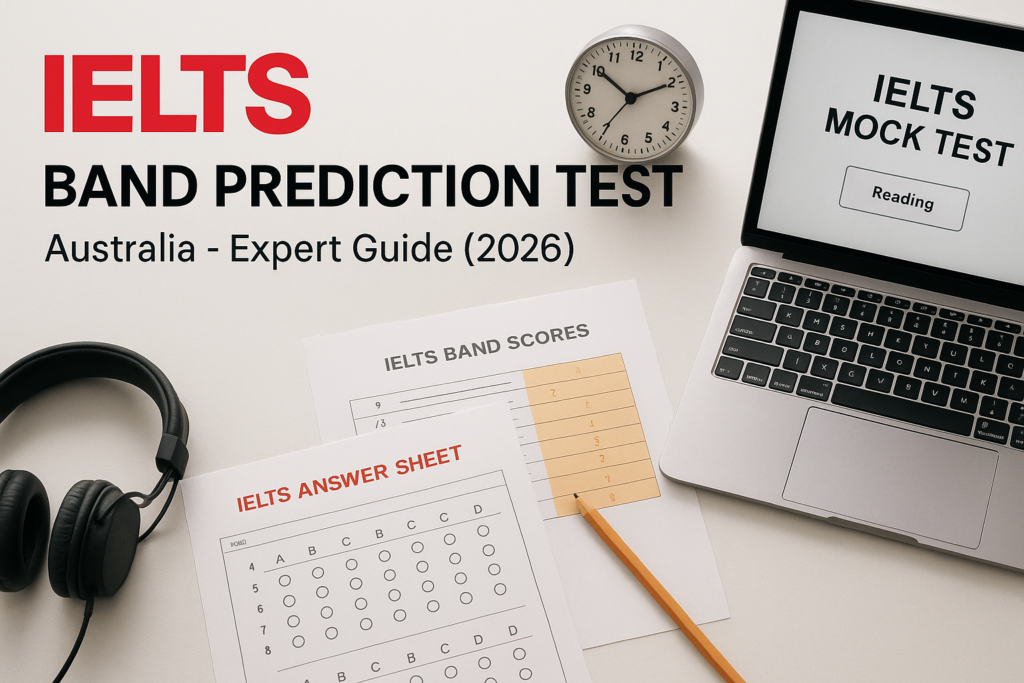
If you are looking for an IELTS band prediction test Australia option, you probably want one thing: a realistic answer before you spend more time, money, and energy on the official exam. A good prediction does not promise a magic score. It shows your likely band range, which section is pulling you down, and what to fix next. Before you book another test date, take the IELTS Express Pre-Test to check your current band range and turn the result into a practical improvement plan.
This guide explains how band prediction works, what a useful diagnostic test should include, and how Australian candidates can use practice results without fooling themselves. The aim is simple: get a clearer picture of your current level, then make a better decision about whether to book, delay, or focus on a weak section first.
What An IELTS Band Prediction Test Australia Should Tell You
An IELTS band prediction test should estimate your likely performance across Listening, Reading, Writing, and Speaking. It should not only give one overall number. Many candidates in Australia need a specific score for migration, university, professional registration, or employment, so the weakest individual section can matter more than the overall average.
A useful prediction tells you three things. First, it estimates your current band range. Second, it identifies the section with the highest risk. Third, it shows whether your target is close enough for a short preparation plan or whether you need more time. That is more helpful than a vague score calculator that ignores writing quality, speaking fluency, or timed test pressure.
- Check all four IELTS skills, not only Listening and Reading.
- Use timed conditions so the result reflects exam pressure.
- Review the reason for each lost mark or weak response.
- Compare the predicted band with your real target score.
- Build a plan from the weakest section first.
Why Band Prediction Matters Before You Book IELTS
Booking IELTS too early can be expensive. It can also create a cycle where a candidate misses the target, books again quickly, studies randomly, and repeats the same result. A prediction test helps you pause before that cycle starts. It gives evidence, not guesswork.
This matters most when your target includes section minimums. For example, a candidate may feel confident because their overall English is strong, but Writing may still sit below the required band. Another candidate may speak well in daily life but lose marks in Speaking because answers are too short, pronunciation is unclear, or grammar breaks under pressure.
If you want regular timed evidence instead of one-off guessing, access unlimited IELTS mock tests and track whether your predicted band is improving across repeated attempts.
IELTS Band Prediction Test Australia: How It Works
A band prediction normally combines objective and assessed evidence. Listening and Reading are easier to estimate because they use correct answers out of 40. Writing and Speaking need human or expert-style assessment because the score depends on criteria such as task response, coherence, vocabulary, grammar, pronunciation, and fluency.
The strongest prediction uses the same basic shape as the real IELTS exam. Listening and Reading should be timed. Writing should include the correct task type and word count. Speaking should include short Part 1 answers, a longer Part 2 response, and more abstract Part 3 discussion. If any section is skipped, the prediction becomes less reliable.
Prediction is still an estimate. Test-day performance, question difficulty, nerves, and preparation quality can shift the final result. But a good estimate is far better than assuming you are ready because you have watched lessons or completed untimed practice.
What Makes A Prediction Reliable
Reliability comes from realistic conditions. If you pause the audio, check answers halfway through, use a dictionary, or write without a timer, the result may make you feel good but it will not predict exam performance. The closer the practice conditions are to the test, the more useful the result becomes.
Reliability also comes from honest review. A Reading score of 30 out of 40 means something different if the mistakes came from vocabulary, timing, careless matching, or confusion with true, false, not given questions. The same is true in Listening. A raw score is the start of the diagnosis, not the whole diagnosis.
For Writing and Speaking, reliability depends on feedback. Self-marking can miss serious problems. Many candidates underestimate coherence issues in Writing and overestimate fluency in Speaking because they understand their own ideas. External feedback is often the difference between a hopeful guess and a useful prediction.
How To Read Your Predicted Band Score
Do not treat the predicted band as a fixed identity. Treat it as a working estimate. If your prediction is Band 6 and your target is Band 7, the next question is not, “Am I bad at English?” The better question is, “Which specific behaviours are costing the extra marks?”
Look at the spread across sections. A candidate with 7 in Listening, 7 in Reading, 6 in Speaking, and 5.5 in Writing has a different problem from a candidate who scores 6 in every section. The first candidate needs targeted Writing repair. The second may need broader language development and test strategy.
Also check consistency. One practice test can be misleading. Three timed attempts with similar results are more useful. If your scores jump wildly, your technique may not be stable yet, or the practice materials may vary too much in quality.
Common Prediction Mistakes Australian Candidates Make
The first mistake is using only free online quizzes and calling the result an IELTS prediction. Short quizzes can be useful for vocabulary or grammar, but they rarely measure full IELTS performance. They usually cannot assess Writing or Speaking properly.
The second mistake is relying on overall English confidence. Living, working, or studying in Australia can improve everyday communication, but IELTS has specific timing, task, and scoring demands. A person can communicate well at work and still lose IELTS marks through weak essay structure, unclear overview writing, spelling errors, or short speaking answers.
The third mistake is ignoring the target pathway. A student aiming for university entry may need a different module and score profile from a migration candidate or a nurse seeking registration. The prediction only matters when it is compared with the correct requirement.
Using Prediction Results For Migration, Study, And Registration
Australian IELTS candidates often prepare for practical reasons. Some need evidence for study. Some need English for professional registration. Others are planning migration, future skills assessment, or employment goals. Each pathway can have different accepted tests, modules, minimum scores, and validity rules.
That is why the predicted score must be connected to the exact goal. If your target is an overall Band 6.5 with no section below 6, a single Band 5.5 section is a major risk. If your pathway needs Band 7 in each section, then a strong overall score will not save a weak Writing or Speaking result.
For migration-focused preparation, the IELTS General Training migration guide can help you compare your predicted score with the style of preparation many candidates need.
How To Improve After A Low Prediction
A low prediction is useful if it tells you what to do next. Start by separating skill problems from test technique problems. If Listening mistakes come from missing plurals and numbers, the solution is precision practice. If Reading mistakes come from running out of time, the solution is passage strategy and question order. If Writing is weak, you may need task structure, grammar control, and feedback.
Do not try to fix everything in one week. Choose the section that creates the biggest risk for your target score. Then practise that section with a clear loop: attempt, mark, diagnose, repair, repeat. Random practice feels productive, but targeted repetition changes the score faster.
If the gap between your prediction and your target is large, compare IELTS preparation plans before booking another official test. Structured support can be cheaper than repeated test fees when the same weakness keeps appearing.
A 14-Day Band Prediction Action Plan
Use Day 1 for a diagnostic test. Complete Listening and Reading under timed conditions, then write one relevant Writing task and record a short Speaking sample. Do not edit the result to make it look better. You need the real baseline.
Use Days 2 to 4 to review the mistakes. Sort them by cause: timing, vocabulary, spelling, grammar, structure, task misunderstanding, fluency, or pronunciation. This step is where many candidates rush, but it is where the useful information lives.
Use Days 5 to 11 for targeted repair. Practise the weakest section daily, but keep the other sections warm with shorter tasks. Use Days 12 and 13 for another timed mock test. Use Day 14 to compare the new result with the first prediction and decide whether booking the official exam is sensible.
When You Are Ready To Book The Real Test
You are probably ready to book when your practice results are consistently near or above the required score, not when you achieve the target once by luck. Consistency matters because the real test includes nerves, unfamiliar topics, and strict timing.
Before booking, confirm the correct IELTS module, accepted test version, deadline, required score, and whether each section has a minimum. If you are applying for a specific visa, course, or registration body, check the official requirement rather than relying on old forum advice.
Also leave enough time for a retake if your deadline is important. A prediction test reduces risk, but it does not remove all risk. A sensible schedule gives you time to respond if one section lands below the target.
Final Checklist For A Useful Band Prediction
A useful prediction is timed, complete, honest, and connected to your goal. It includes all four skills, gives section-level feedback, and leads to a specific study plan. It should make your next step clearer, whether that step is booking the test, delaying, or repairing one weak section first.
Do not chase a perfect prediction. Chase a useful one. The question is not whether the estimate can guarantee your final score. The question is whether it helps you make a smarter preparation decision today.
If your predicted band is close to the target, focus on consistency and test-day control. If it is not close, use the result as a map. Fix the highest-risk section first, practise under timed conditions, and retest before spending money on the official exam.
Ready to find out your IELTS band score?
Take the IELTS Express Pre-Test for just $4.99 and get your personalised band prediction with a 14-day improvement plan.
FAQ: IELTS Band Prediction Test Australia
How accurate is an IELTS band prediction test?
It is an estimate, not a guarantee. It becomes more accurate when all four skills are tested under timed conditions and Writing and Speaking receive proper feedback.
Can a free quiz predict my IELTS band score?
A short quiz can indicate vocabulary or grammar level, but it usually cannot predict the full IELTS band because it does not assess real Writing, Speaking, timing, or test strategy.
Should I book IELTS if my predicted score is below my target?
If the gap is small and your deadline is flexible, you may still book after targeted practice. If the gap is large or one section is clearly weak, prepare first and retest before paying for the official exam.
Which sections are hardest to predict?
Writing and Speaking are usually hardest to predict because they require assessment against IELTS criteria. Listening and Reading are easier to estimate from raw scores.
How often should I retake a prediction test?
Retake after a focused study block, such as 10 to 14 days. Retesting every day is usually less useful than reviewing mistakes and repairing the weak section first.