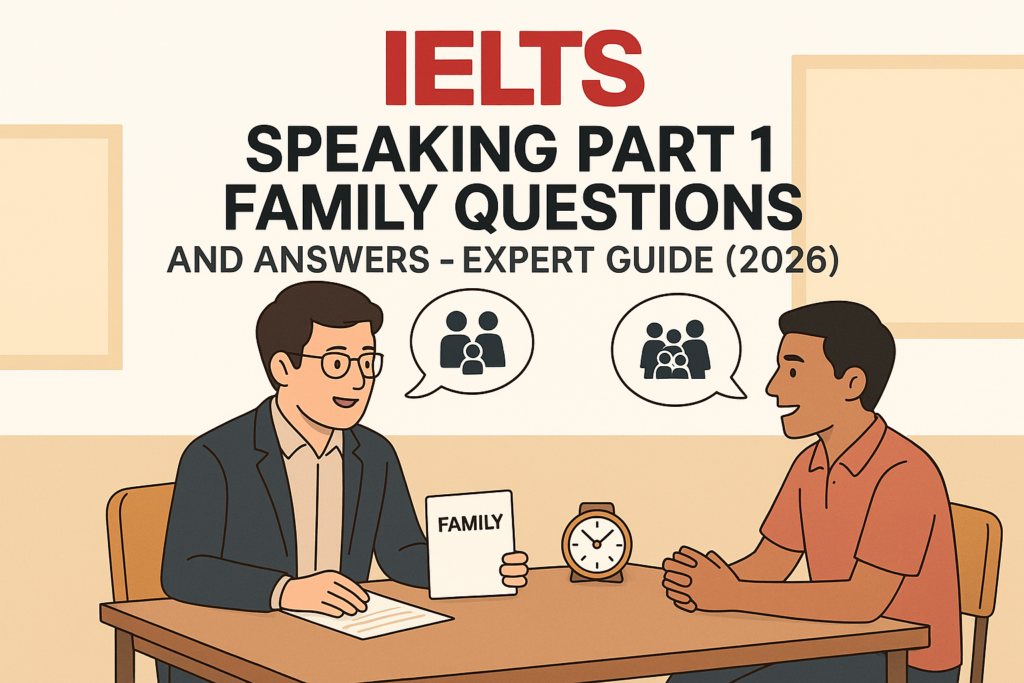
If you are practising IELTS Speaking Part 1 Family questions and answers, your goal is not to memorise perfect lines. Your goal is to sound natural, answer directly, and add enough detail to show control of grammar and vocabulary. Before you keep repeating the same short answers, take the IELTS Express Pre-Test to check your current band range and see whether Speaking is likely to hold your score back.
The family topic is common because it is familiar for most candidates. That can be helpful, but it can also make answers sound too casual or too thin. Many candidates say, “Yes, I have a big family” and stop. A stronger answer gives a clear response, one reason, and one specific detail without turning Part 1 into a long story.
How IELTS Speaking Part 1 Family Questions Work
In Speaking Part 1, the examiner asks short personal questions about everyday topics. Family questions may appear near the beginning of the test with topics such as hometown, work, study, accommodation, free time, and friends. The tone should be conversational, but the scoring is still based on fluency, vocabulary, grammar, and pronunciation.
Part 1 answers are usually two or three sentences. You do not need a long introduction, a conclusion, or a complicated opinion. The safest pattern is answer plus reason plus example. This keeps the response focused and gives the examiner enough language to assess.
- Answer the exact question first.
- Add one reason or feeling.
- Include one small example from your real life.
- Use natural family vocabulary, not memorised phrases.
- Stop before the answer becomes a Part 2 story.
Common IELTS Family Questions In Part 1
Family questions often ask about who you live with, how often you see relatives, whether families are important in your country, and what you enjoy doing with family members. You may also be asked if you prefer small or large families, or whether you are close to your parents, siblings, cousins, or grandparents.
Here are common question types: Do you have a large family? Who are you closest to in your family? How much time do you spend with your family? What do you usually do together? Are families in your country close? Did you spend more time with family when you were younger?
These questions look simple, but they test control. The examiner listens for whether you can answer without long hesitation, use accurate tenses, and explain personal experience clearly. If you want to test these answers under real timing, access unlimited IELTS mock tests and practise answering without pausing to prepare.
Sample Answer: Do You Have A Large Family?
A natural answer could be: “Not really. I come from a fairly small family, just my parents, my younger sister, and me. I actually like that because we know each other very well and it is easy to stay in touch.”
This answer works because it is direct and specific. It does not try to impress the examiner with advanced vocabulary. It uses useful phrases such as “fairly small family”, “younger sister”, and “stay in touch”. It also gives a reason, which makes the answer sound complete.
A weaker answer would be: “Yes, my family is very good and I love my family very much.” That is understandable, but it is too general. The examiner cannot hear much range or detail. Add one concrete detail and the answer improves quickly.
Sample Answer: Who Are You Closest To In Your Family?
You might say: “I am probably closest to my older brother because we have a similar sense of humour. We do not live in the same city now, but we message each other most days and talk properly on the weekend.”
This answer shows relationship vocabulary and time language. “Closest to”, “older brother”, “similar sense of humour”, and “most days” are all useful, natural phrases. The answer also avoids sounding memorised because the details feel personal.
If your real family situation is complicated, keep the answer simple and comfortable. You are not required to reveal private information. You can say you are close to one relative, or you can say your family is spread out and you mainly keep in touch online.
Sample Answer: How Much Time Do You Spend With Your Family?
A strong answer could be: “At the moment, not as much as I would like because I am busy with work and study. However, we usually have dinner together a few times a week, and I try to visit my grandparents on Sundays.”
This answer is useful because it includes contrast. The first sentence gives the reality. The second sentence gives an example. It also uses flexible time phrases: “at the moment”, “not as much as I would like”, “a few times a week”, and “on Sundays”.
For Speaking Part 1, it is fine to use everyday language. You do not need to say “familial bonding activities” when “have dinner together” is more natural. Clear, accurate English usually scores better than forced vocabulary.
Sample Answer: What Do You Usually Do With Your Family?
You could answer: “Most of the time, we do simple things together, like cooking at home, watching a film, or going for a walk. On special occasions, we might go out for a meal, but we are not a very formal family.”
This answer gives a list, but it does not become robotic. It includes a contrast between normal routines and special occasions. That contrast helps the answer sound more fluent and gives you a chance to use present simple and modal language correctly.
If you want more Speaking Part 1 practice across topics, the IELTS Speaking Part 1 sample answers guide can help you compare family answers with work, study, hobbies, and hometown responses.
Sample Answer: Are Families Important In Your Country?
A balanced answer might be: “Yes, I think family is still very important in my country, although the way people show it is changing. In the past, several generations often lived together, but now many young adults move away for work or study and keep in contact by phone.”
This is a slightly broader question, so the answer can be a little more general. It still needs to stay personal and simple. You do not need a social science lecture. One comparison between past and present is enough for Part 1.
Be careful with absolute statements such as “all families in my country are close”. It is safer to use softer language: “many families”, “in my experience”, “it is quite common”, or “it depends on the region”. This makes your answer sound more accurate.
Vocabulary For Family Answers
Useful family vocabulary includes immediate family, extended family, relatives, grandparents, cousins, siblings, only child, close-knit, get along with, look up to, keep in touch, bring up children, spend quality time, and family gathering. These phrases are useful because they describe real relationships and routines.
Do not use vocabulary you cannot pronounce confidently. If you say “intergenerational household” but stumble over it, the phrase may hurt fluency more than it helps vocabulary. A simpler phrase such as “three generations live together” is often clearer.
For a broader word bank, read the IELTS Speaking Part 1 vocabulary list and choose phrases that fit your own life. Vocabulary is easier to remember when it connects to real answers.
Grammar Patterns That Help Family Answers
Family answers often need present simple for routines, present continuous for temporary situations, past simple for childhood memories, and comparatives for changes. For example, you might say, “I live with my parents”, “I am staying with my cousin this month”, or “I spent more time with my grandparents when I was younger”.
Comparisons are especially useful. You can compare now and the past, small and large families, living together and living separately, or family life in cities and rural areas. Comparisons give your answer more range without making it too long.
If grammar is your weak point, compare IELTS preparation plans and choose support that includes speaking feedback, not just practice questions.
Common Mistakes With Family Questions
The first mistake is giving one-word answers. “Yes”, “No”, or “My mother” is not enough. Add a reason and one detail. The examiner cannot score what they cannot hear.
The second mistake is memorising a full answer. Memorised answers often sound flat, and they may not match the exact question. If the examiner asks about cousins and your memorised answer is about parents, the response feels unnatural.
The third mistake is over-sharing. You can keep personal details private. IELTS is a language test, not a counselling session. Choose a comfortable answer that lets you show language without creating stress.
A Simple Practice Method
Choose six family questions and record yourself answering each one for 20 to 30 seconds. Then listen back and check three things: did you answer the question directly, did you add a reason, and did you use one specific detail?
Next, repeat the same answers with a timer. Try not to pause for more than two seconds. If you get stuck, simplify the sentence instead of forcing a complicated one. Fluency improves when you can keep moving with accurate, flexible language.
Finally, write down your best phrases, not full scripts. For example, keep “not as much as I would like”, “we stay in touch online”, and “we are quite close-knit”. These chunks can be reused naturally in different answers.
Final Checklist Before Your Speaking Test
Before test day, prepare short answers for family size, closest relative, family routines, childhood family time, and family changes in your country. Practise enough that you know your ideas, but not so much that the answer sounds recited.
During the test, listen carefully to tense. If the question asks about your childhood, use past simple. If it asks about now, use present simple or present continuous. If it asks about change, compare then and now.
Family questions are a good opportunity to sound warm and natural. Keep your answers direct, add a real detail, and use language you can say comfortably. That is far more useful than memorising a perfect paragraph.
Ready to find out your IELTS band score?
Take the IELTS Express Pre-Test for just $4.99 and get your personalised band prediction with a 14-day improvement plan.
FAQ: IELTS Speaking Part 1 Family Questions And Answers
How long should my family answers be in IELTS Speaking Part 1?
Most answers should be two or three sentences. Give a direct answer, add one reason, and include one small example from your own life.
Can I invent family details in the IELTS Speaking test?
You can simplify or adapt details if needed, but it is usually easier to sound natural when your answer is close to real life. Do not create a complicated story you cannot maintain.
What vocabulary is useful for family questions?
Useful phrases include immediate family, extended family, siblings, close-knit, get along with, keep in touch, spend quality time, and family gathering.
What if I do not want to talk about my family?
You can keep the answer general and comfortable. Mention a relative, family routine, or common situation without sharing anything private.
How can I practise family questions quickly?
Record six short answers, listen for pauses and grammar errors, then repeat with a timer. Keep useful phrases, but avoid memorising whole answers.