IELTS Writing Task 1 Map band 7 model is for Academic IELTS candidates who can see the changes on a map but find it hard to describe them in clear, organised English. Map tasks are different from charts because there are usually no numbers to copy. Your score depends on whether you can identify the main changes, group them logically, and use accurate location and transformation language. Before you write another practice answer, take the IELTS Express Pre-Test to check your current Writing band range and see whether overview quality, paragraphing, grammar, vocabulary, or timing is holding you back.
In this guide, you will see a complete Band 7 map model answer and the thinking behind it. The aim is not to memorise one response. The aim is to learn a repeatable process: compare the two maps, choose the biggest changes, organise the town or site into zones, and write a calm report that sounds like analysis rather than a walking tour.
What Band 7 Means For An IELTS Map
Band 7 in Writing Task 1 usually means the answer presents the main features clearly, includes a clear overview, organises information logically, and uses a good range of vocabulary and grammar with mostly accurate control. For a map, the examiner wants to see that you understand what changed and where it changed. You do not need perfect sentences, but the reader should be able to picture the development without checking the original maps every few seconds.
The biggest Band 7 skill is selection. A weaker answer describes every tree, path, road, and building separately. A stronger answer identifies the main transformation: whether the area became more residential, more commercial, more accessible, more developed, less green, or better connected. Then it uses details to support that big picture.
- Compare the maps before writing.
- Choose the biggest overall changes for the overview.
- Group details by area, not by random order.
- Use location language accurately.
- Use passive verbs for changes to buildings and facilities.
The Band 7 Map Structure
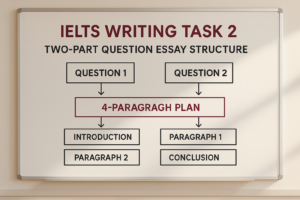
A reliable map report has four short paragraphs. The first paragraph paraphrases the task. The second gives the overview. The third describes one main area or group of changes. The fourth describes the remaining important changes. This is simple, but it works because map tasks reward clarity more than drama.
Do not write a story where you walk from the north-west corner to the south-east corner and mention everything you pass. That often becomes a list. Instead, divide the map into meaningful zones: north versus south, centre versus edges, old facilities versus new facilities, or transport changes versus building changes.
For wider Task 1 practice, use the IELTS Writing Task 1 practice test after studying this model so you can apply the same structure to line graphs, tables, bar charts, pie charts, and mixed charts.
Sample IELTS Map Task
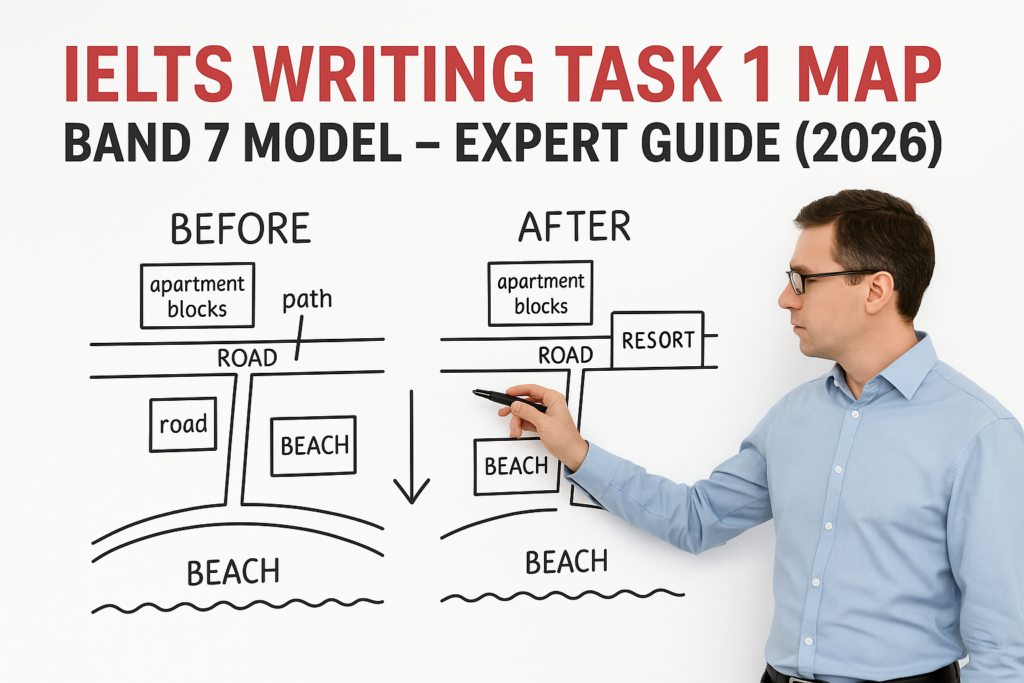
Imagine the maps show a small coastal town in 2000 and 2025. In 2000, the town had a beach in the south, a small hotel near the coast, a road running from west to east, several houses in the north-west, farmland in the north-east, and a small shop beside the road. By 2025, the hotel had been expanded into a resort, the farmland had been replaced by apartments, a car park had been built near the beach, the shop had become a supermarket, and a pedestrian path had been added along the coast.
This task is typical because the main story is development. The area has become more tourist-focused and residential, with better access to the beach. A Band 7 answer should not simply list each new feature. It should explain the overall transformation and then group the changes into coastal development, housing, commercial facilities, and access.
The model below is longer than a real exam answer because it is being used for teaching. In the test, the answer itself would usually be around 170 to 200 words.
Band 7 Model Answer
The maps compare the layout of a small coastal town in 2000 with its layout in 2025.
Overall, the town became much more developed over the twenty-five-year period, especially along the coast and in the north-east. The main changes were the expansion of tourist facilities, the replacement of farmland with housing, and the improvement of access to the beach.
In 2000, the southern part of the town was relatively simple, with a beach and a small hotel located close to the coast. By 2025, the hotel had been enlarged and converted into a resort, while a new car park had been constructed nearby. A pedestrian path was also added along the beachfront, making this area more accessible for visitors.
Further north, the residential and commercial areas also changed noticeably. The houses in the north-west remained in place, but the farmland in the north-east was replaced by a group of apartment buildings. In addition, the small shop beside the main road was redeveloped into a supermarket. The main east-west road stayed in the same position, although the surrounding land was used more intensively by 2025.
Why This Model Reaches Band 7
The model reaches Band 7 because it has a clear overview and logical grouping. The overview does not mention every detail. It explains the main direction of change: more development, more tourism, more housing, and better access. That gives the examiner the big picture immediately.
The body paragraphs are grouped by area. The first detail paragraph focuses on the coast, while the second focuses on the northern and central parts of the town. This is much easier to follow than a sentence-by-sentence list of isolated features.
If you want to practise this under exam pressure, access unlimited IELTS mock tests and check whether your map reports include a genuine overview and grouped body paragraphs.
How To Read A Map Quickly
Start by identifying the time frame. Some IELTS maps compare the past and present, while others compare the present and a proposed future plan. The tense changes depending on the task. A past-to-present map needs past simple and present perfect passive. A current-to-future plan often needs will be or is planned to be.
Next, look for unchanged features. Roads, rivers, beaches, bridges, and main buildings often stay in the same place. Mentioning what remained unchanged can strengthen your overview, but only if it helps explain the layout.
Finally, circle the biggest changes mentally. Ask whether the area became more urban, more residential, more commercial, more industrial, more tourist-oriented, or more accessible. That answer usually becomes the centre of your overview.
Writing A Strong Overview
A strong map overview describes the main transformation without small details. It might say the village became more residential, the school was expanded, the park was reduced, or the town centre was pedestrianised. It should not list every building.
For the sample task, the overview says the town became more developed, especially along the coast and in the north-east. It also names the main types of change: tourist facilities, housing, and beach access. That is enough. The details come later.
A weak overview says there were several changes to the town. That is too vague. The examiner needs to know what kind of changes occurred.
Choosing Details For Body Paragraphs
Good map details are chosen because they support the overview. If your overview says tourism increased, include the resort, car park, and coastal path. If your overview says housing expanded, include the apartments that replaced farmland. Details should prove the main message.
Choose a grouping method before writing. You can group by compass direction, by function, or by old versus new features. In the sample task, coastal changes belong together because they all relate to tourism and beach access. Northern changes belong together because they show housing and commercial redevelopment.
For more help with Task 1 selection and paragraph planning, read the IELTS Writing Task 1 tips and strategies guide before your next practice answer.
Map Vocabulary For Band 7
Band 7 vocabulary should be precise and controlled. Useful verbs include built, constructed, added, removed, replaced, converted, expanded, extended, redeveloped, relocated, widened, and pedestrianised. Many map sentences use passive grammar because the focus is on the change, not on who made it.
Useful location phrases include in the north, in the south-west corner, to the east of, next to, opposite, beside, along the coast, near the entrance, in the centre, and on the outskirts. Use these naturally. Do not overload every sentence with three directions.
Avoid vague phrases such as some things changed or many buildings appeared. Name the feature and the change clearly.
Grammar Patterns That Help Your Score
Maps are excellent for passive grammar. You can write: the farmland was replaced by apartments, the hotel was converted into a resort, and a car park was constructed near the beach. These sentences are clear, formal, and appropriate for Task 1.
You can also use while to compare areas. For example: while the main road remained unchanged, the land around it was developed more intensively. This helps you compare change and stability in one sentence.
The rule is accuracy first. A simple passive sentence written correctly is stronger than a long sentence with confusing direction language.
Common Map Mistakes
The first mistake is missing the overview. Without a clear overview, Task Achievement is limited, even if the details are accurate. The second mistake is describing the map like a route. A map answer should explain layout changes, not give walking directions.
The third mistake is using the wrong tense. If both maps are in the past, use past simple. If the second map is now, use present perfect where appropriate. If it is a future plan, use future or planning language.
The fourth mistake is writing too much. If timing is your main weakness, see our IELTS preparation plans and choose support that helps you build a realistic Writing routine.
A 20-Minute Practice Routine
Spend the first two minutes comparing the maps and identifying the biggest changes. Spend another two minutes choosing the overview and grouping the details. Then write the introduction and overview before moving into the body paragraphs.
Use twelve minutes for the details. Keep each body paragraph focused on one area or one type of change. Do not stop to search for rare vocabulary. Clear verbs such as built, replaced, expanded, and converted are enough when they are used accurately.
Save the final two minutes for checking. Look for tense consistency, passive forms, articles, plurals, spelling of facilities, and direction phrases. A short check can protect marks you have already earned.
Final Checklist Before You Submit
Before you finish an IELTS map report, check that the introduction paraphrases the task, the overview gives the main transformation, the body paragraphs are grouped logically, and the details support the overview.
Also check that you used compass directions accurately, avoided personal opinions, did not explain reasons unless they were shown, and did not repeat the post title as a body heading. A map report should be visual, organised, and concise.
An IELTS Writing Task 1 Map band 7 model is useful only if you copy the thinking behind it. Compare the maps, find the main story, group the details, and write in clean controlled English.
Ready to find out your IELTS band score?
Take the IELTS Express Pre-Test for just $4.99 and get your personalised band prediction with a 14-day improvement plan.
FAQ: IELTS Writing Task 1 Map Band 7 Model
How do I write a Band 7 IELTS map answer?
Use a four-paragraph structure: introduction, overview, first detail paragraph, and second detail paragraph. Identify the main transformation, group changes by area or function, and use accurate passive and location language.
What should the overview include for a map?
The overview should describe the biggest changes, such as redevelopment, expansion, new facilities, removed areas, improved access, or features that stayed the same. It should not list every detail.
Do IELTS map answers need numbers?
Usually no. Most map tasks test change and location rather than data. Use compass directions, facility names, and transformation verbs instead of trying to invent numbers.
What tense should I use for IELTS maps?
Use the tense shown by the maps. Past maps need past tense, present comparisons often use present perfect passive, and future plans need future or planning forms such as will be built or is planned to be added.
How long should a map answer be?
A strong IELTS Task 1 map answer is usually around 170 to 200 words in the exam. It must be at least 150 words, but clarity and selection matter more than length.