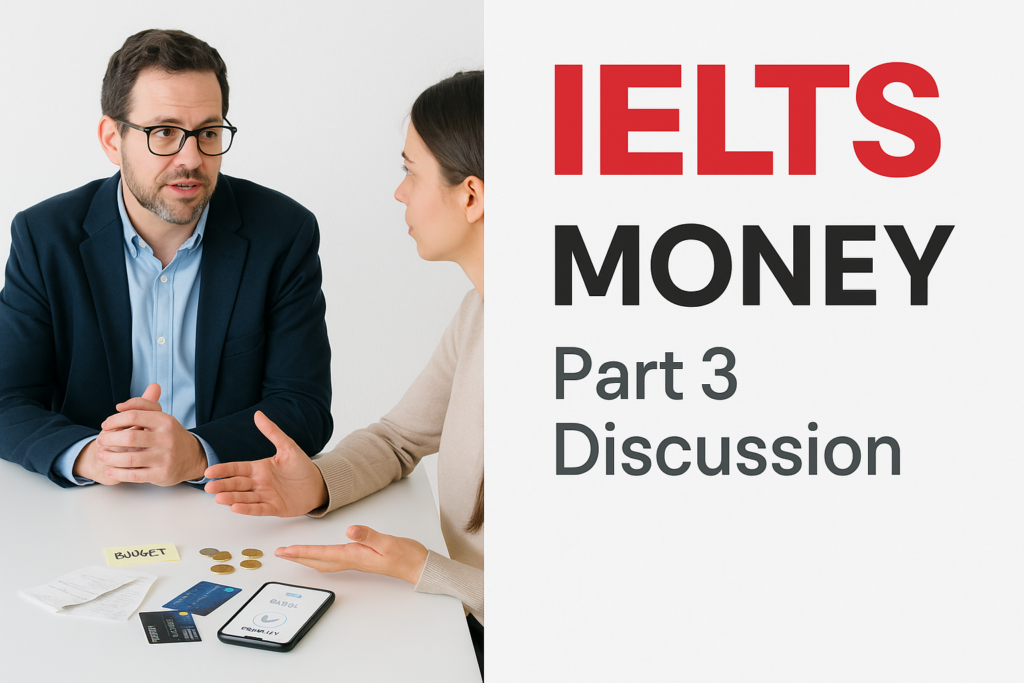
IELTS Speaking Part 3 Money discussion answers need more than saying money is important. In Part 3, the examiner wants you to discuss saving, spending, salaries, financial education, advertising, rich and poor communities, children and pocket money, government support, cashless payments, and whether money makes people happy. Before you memorise money-topic answers, take the IELTS Express Pre-Test to check your current speaking band range and see whether fluency, vocabulary, grammar, pronunciation, or idea development is holding your score back.
Money is common in IELTS because it connects everyday choices with wider social issues. You may be asked whether children should learn about money, why people buy things they do not need, whether high salaries are fair, or how digital payments are changing society. Strong answers are balanced, specific, and natural.
IELTS Speaking Part 3 Money Discussion Answers: What Examiners Want
In Speaking Part 3, money questions are usually abstract and analytical. The examiner is not only asking whether you personally like shopping or saving. They want to hear whether you can explain reasons, compare priorities, discuss social effects, and make careful predictions.
A higher-band answer usually gives a direct view, develops one or two reasons, adds a realistic example, and recognises that money decisions depend on age, income, culture, family pressure, and personal goals. If the examiner asks whether money makes people happy, a strong answer can mention security, health, relationships, freedom, stress, and expectations.
- Answer the exact question first.
- Develop one or two ideas instead of listing every money issue you know.
- Use examples such as rent, education costs, credit cards, online shopping, wages, taxes, and family budgets.
- Show balance with phrases such as in many cases, however, this depends on, and at the same time.
- Avoid extreme claims such as money always creates happiness or poor people cannot be happy.
Common IELTS Speaking Part 3 Questions About Money
Practise flexible answers to questions such as: Is money the most important thing in life? Should children learn how to manage money? Why do people spend money on luxury goods? Are high salaries always fair? Is saving more important than spending? How has online shopping changed spending habits? Should governments support people with low incomes? Will cash disappear in the future?
These questions test opinion, comparison, cause and effect, prediction, and evaluation. Instead of memorising one long speech, prepare idea groups. Money can include security, choice, status, pressure, generosity, inequality, education, debt, technology, and responsibility.
If you want broader Speaking Part 3 technique, use our IELTS Speaking Part 3 sample answers guide and notice how each response develops one clear idea instead of forcing memorised language.
Sample Answers About Money And Happiness
Question: Does money make people happy?
Money can make people happier up to a point because it reduces stress and gives them choices. If someone can pay rent, buy healthy food, study, and look after their family, their life is usually easier. However, after basic needs and comfort are covered, relationships, health, purpose, and time may matter more than extra income.
Question: Is money the most important thing in life?
No, but it is difficult to ignore. Money is important because it affects housing, education, healthcare, transport, and opportunities. At the same time, people can have a high income and still feel lonely, unhealthy, or under pressure, so money should be seen as a tool rather than the whole purpose of life.
Question: Why do some people think rich people are successful?
We often connect wealth with success because money is visible. Expensive houses, cars, holidays, and brands are easy to notice. But that view is incomplete because success can also mean being respected, helping others, raising a family well, or doing meaningful work.
Sample Answers About Saving And Spending
Question: Is it better to save money or spend it?
Both are necessary. Saving gives people security and helps them prepare for emergencies, education, or retirement. Spending is also important because people need to enjoy life and support businesses. The real skill is knowing when to save, when to spend, and when to avoid unnecessary debt.
Question: Why do people buy things they do not need?
People often buy unnecessary things because of advertising, social media, boredom, stress, or the desire to feel successful. Online shopping makes this easier because people can buy something in a few seconds. Sometimes the purchase gives a short feeling of excitement, but it may not bring long-term satisfaction.
Question: Are people more materialistic now than in the past?
In some ways, yes. People are exposed to more advertising and lifestyle content than before, so they compare themselves with others constantly. However, materialism is not new. People have always used possessions to show status; technology has simply made those comparisons more visible.
For realistic speaking pressure after learning these patterns, access unlimited IELTS mock tests and practise answering money questions without pausing to build perfect sentences.
Sample Answers About Children And Financial Education
Question: Should children learn how to manage money?
Yes, because money habits often start early. Children can learn the difference between needs and wants, how saving works, and why borrowing money has consequences. These lessons do not need to be complicated. Even pocket money can teach planning, patience, and responsibility.
Question: Should parents give children pocket money?
It can be useful if parents use it as a teaching tool. A small amount of pocket money can help children practise saving and making choices. However, parents should not use money to replace attention or allow children to think they deserve everything immediately.
Question: Do schools teach enough about money?
In many places, probably not. Schools often teach mathematics, but students may still leave without understanding budgets, interest rates, taxes, or credit cards. Basic financial education could protect young people from debt and help them make better decisions when they start working.
Sample Answers About Salaries And Fairness
Question: Should some jobs be paid much more than others?
Some difference is reasonable because jobs require different levels of skill, responsibility, training, and risk. A surgeon or engineer may need years of education, so a higher salary can be justified. However, extreme differences can feel unfair when essential workers are underpaid while some people earn huge bonuses.
Question: Are high salaries always deserved?
Not always. A high salary may reflect rare skills or major responsibility, but it can also come from market power, reputation, or working in a profitable industry. Society should reward skill and effort, but it should also make sure that basic work is paid decently.
Question: Should people choose careers mainly for money?
Money should be part of the decision, especially if someone has family responsibilities or migration goals. But choosing only for money can lead to burnout if the job is stressful or unsuitable. A better choice balances income, ability, opportunity, and long-term wellbeing.
If you need teacher feedback on whether your answers are developed enough for your target band, see our IELTS preparation plans and choose support that includes Speaking Part 3 structure and fluency review.
Sample Answers About Digital Payments And Online Shopping
Question: Will cash disappear in the future?
Cash may become less common, but I do not think it will disappear completely soon. Digital payments are convenient and fast, especially in cities. However, cash is still useful for older people, small businesses, emergencies, privacy, and places where internet access is unreliable.
Question: Has online shopping changed how people spend money?
Yes, it has made spending easier and more impulsive. People can compare prices quickly, but they can also buy things late at night or during emotional moments. Because payment details are saved, the purchase can feel less real than handing over cash.
Question: Are credit cards dangerous?
They can be dangerous if people use them as free money. Interest and fees can grow quickly, and debt can become stressful. But credit cards can also be useful for emergencies or online purchases if people pay them off regularly and understand the rules.
Useful Vocabulary For Money Discussion Answers
You do not need advanced economics vocabulary for IELTS money questions. You need accurate phrases that help you discuss everyday finance, responsibility, and society clearly.
- Financial security: having enough money to cover needs and handle emergencies.
- Disposable income: money left after basic expenses are paid.
- Budget: a plan for how money will be spent or saved.
- Debt: money that someone owes.
- Impulse buying: buying something suddenly without planning.
- Cost of living: the amount of money needed for housing, food, transport, and basic life.
- Income inequality: a large gap between people with high and low incomes.
- Cashless society: a society where most payments are made digitally.
Use these phrases in full sentences. For example, say, “Financial security can reduce stress,” or “Impulse buying is easier when payment apps are saved on a phone.” Simple accurate vocabulary is stronger than rare words used awkwardly.
Grammar Patterns That Help With Money Questions
Use cause-and-effect language: “When the cost of living rises faster than wages, people may feel anxious about the future.” This helps you explain money problems clearly instead of only saying they are bad.
Use comparison language: “Saving is important for long-term security, while spending can improve quality of life in the present.” Many money questions ask you to weigh two priorities.
Use cautious future language: “Digital payments are likely to become more common,” or “Cash may become less common in major cities.” Avoid saying everyone will stop using cash unless the question asks for a strong prediction.
How To Build A Band 7 Style Money Answer
A Band 7 style answer is organised, realistic, and natural. Start with your main view, explain why, give an example, and add balance if the issue is complex. You do not need a perfect speech. You need an answer that develops logically and sounds like normal spoken English.
For example, if the examiner asks whether children should learn about money, you could say: “Yes, because financial habits start early. If children learn to save a small amount of pocket money and wait before buying something, they become more patient and responsible. But the lesson should be simple and age-appropriate, not full of adult financial pressure.” This answer is direct, specific, and balanced.
To practise this skill, record yourself answering one money question. Then check whether you answered directly, explained one idea clearly, and used a realistic example. If your answer sounds like a memorised essay, simplify it.
Common Mistakes With Money Discussion Answers
The first mistake is giving only moral opinions. Saying rich people are greedy or poor people should work harder sounds simplistic. IELTS Part 3 needs analysis, not judgement. Discuss costs, opportunities, responsibility, education, family pressure, and society.
The second mistake is using vague language such as many money, big salary, or expensive life. Be more precise. Say income, savings, rent, debt, living costs, high salary, low income, or financial pressure.
The third mistake is being too personal. If the examiner asks whether governments should help people with low incomes, do not only talk about your own budget. Discuss workers, families, elderly people, students, taxes, housing, and public services.
The fourth mistake is memorising fixed answers. Money questions can move from children to technology, then to salaries, happiness, or advertising. Prepare flexible ideas, not one long speech.
A Seven-Day Practice Plan For Money Questions
On day one, practise questions about money and happiness. On day two, focus on saving, spending, and debt. On day three, record answers about children, pocket money, and financial education. On day four, practise salaries, fairness, and career choice.
On day five, answer questions about online shopping, advertising, and impulse buying. On day six, compare cash, cards, and digital payments. On day seven, complete a full Speaking Part 3 set and note where your answers became too short, too emotional, or too general.
This routine builds topic flexibility. You are not trying to memorise one perfect money answer. You are learning how to discuss financial choices and social effects from several angles under test pressure.
Final Checklist Before Your Speaking Test
Before test day, make sure you can discuss saving, spending, salaries, debt, children and pocket money, financial education, advertising, online shopping, cashless payments, cost of living, inequality, happiness, and government support. Practise giving balanced answers with one clear reason and one example.
The money topic becomes easier when you organise ideas by people and systems: individuals, families, schools, employers, banks, governments, technology, benefits, risks, and future changes. If you can sort your answer quickly, you can respond confidently even when the examiner changes the question.
Ready to find out your IELTS band score?
Take the IELTS Express Pre-Test for just $4.99 and get your personalised band prediction with a 14-day improvement plan.
FAQ: IELTS Speaking Part 3 Money Discussion Answers
What money questions are common in IELTS Speaking Part 3?
Common questions ask about saving, spending, salaries, children and pocket money, financial education, online shopping, cashless payments, cost of living, and whether money makes people happy.
How long should money answers be in Part 3?
Most answers should explain one or two ideas clearly. Aim for a direct answer, a reason, an example, and a short contrast if the question asks for balance.
What vocabulary is useful for money discussion answers?
Useful phrases include financial security, disposable income, budget, debt, impulse buying, cost of living, income inequality, and cashless society.
Should I give personal examples in money answers?
You can give a brief personal example, but Part 3 should mainly discuss families, schools, employers, governments, technology, and society in general. Keep the answer broader than Part 1.
How can I sound more natural on this topic?
Use clear structure, avoid memorised speeches, and show balance. Phrases such as in many cases, this depends on, however, and at the same time help you discuss money more naturally.