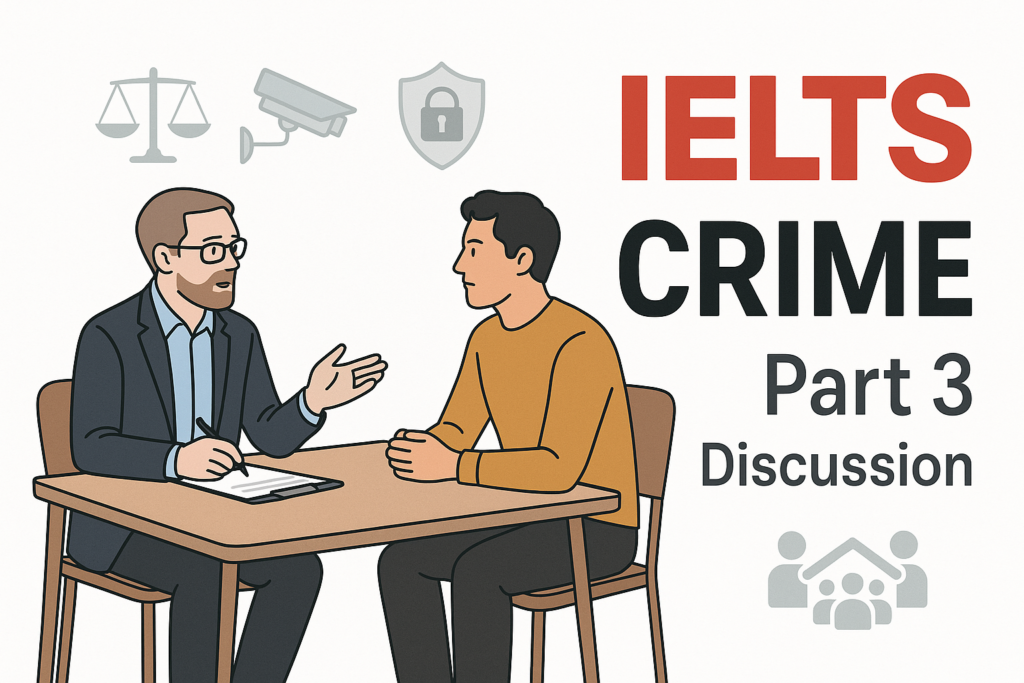
IELTS Speaking Part 3 Crime discussion answers need more than saying crime is bad or police should be stricter. In Part 3, the examiner wants you to discuss causes, prevention, punishment, rehabilitation, technology, poverty, young offenders, public safety, media influence, and whether crime may change in the future. Before you memorise crime-topic answers, take the IELTS Express Pre-Test to check your current speaking band range and see whether fluency, vocabulary, grammar, pronunciation, or idea development is holding your score back.
Crime is a common IELTS topic because it connects with families, schools, governments, technology, employment, and social fairness. You may be asked why people commit crimes, whether prison is effective, how young people can be protected from crime, or whether cameras make cities safer. Strong answers are calm, balanced, specific, and realistic.
IELTS Speaking Part 3 Crime Discussion Answers: What Examiners Want
In Speaking Part 3, crime questions are broad and analytical. The examiner is not asking you to describe a crime story from the news. They are checking whether you can explain causes, discuss consequences, compare solutions, and show balanced judgement.
A higher-band answer usually gives a direct view, explains one or two reasons, adds a realistic example, and recognises that crime is rarely caused by only one factor. For example, if the examiner asks whether prison prevents crime, a strong answer can mention punishment, public safety, education, rehabilitation, and the risk of reoffending.
- Answer the exact question first.
- Develop one or two ideas instead of listing every possible cause.
- Use examples such as unemployment, family pressure, drugs, cybercrime, youth crime, CCTV, courts, prisons, and community programs.
- Show balance with phrases such as in many cases, however, this depends on, and at the same time.
- Avoid extreme claims such as all criminals are the same or prison always solves crime.
Common IELTS Speaking Part 3 Questions About Crime
Practise flexible answers to questions such as: Why do people commit crimes? Is poverty the main cause of crime? Are punishments strict enough? Should young offenders go to prison? How can governments reduce crime? Do cameras make people safer? Is cybercrime becoming more serious? Does the media make crime seem worse than it is? Can criminals be rehabilitated? Will crime increase in the future?
These questions test opinion, comparison, prediction, and evaluation. Instead of memorising one long speech, prepare idea groups. Crime can include social causes, prevention, punishment, education, technology, policing, family support, mental health, drugs, money pressure, and public trust.
If you want broader Speaking Part 3 technique, use our IELTS Speaking Part 3 sample answers guide and notice how each response develops one clear idea rather than forcing memorised language.
Sample Answers About Causes Of Crime
Question: Why do some people commit crimes?
There is usually no single reason. Some people commit crimes because of financial pressure, lack of education, addiction, poor family support, or influence from friends. Others make selfish choices even when they have opportunities. So I think crime is caused by both personal responsibility and social conditions.
Question: Is poverty the main cause of crime?
Poverty can increase the risk of crime because people may feel desperate or excluded from normal opportunities. However, it is not the only cause. Many poor people never commit crimes, and some white-collar crimes are committed by wealthy people. Poverty matters, but it should not be used as a simple excuse for every offence.
Question: Does unemployment lead to crime?
It can contribute to crime, especially if people feel they have no legal way to support themselves. Long-term unemployment can also damage confidence and increase social isolation. But unemployment alone does not automatically produce crime, so governments need both job programs and strong community support.
Sample Answers About Punishment And Prison
Question: Is prison an effective punishment?
Prison can be effective for serious crimes because it protects the public and shows that society has clear limits. However, it is less effective if prisoners leave with no skills, no support, and stronger criminal connections. For many offenders, prison needs to include education, counselling, and a plan for life after release.
Question: Should punishments be stricter?
For violent crime, stricter punishment may be necessary because public safety comes first. But for minor offences, very harsh punishment can create more problems than it solves. A fair system should match the punishment to the seriousness of the crime and the risk to the community.
Question: Can criminals change?
Some can, especially if they are young, motivated, and given practical support. People may change when they receive education, drug treatment, stable housing, or employment. But change is not automatic. Society should offer a second chance while still protecting victims and the public.
For realistic speaking pressure after learning these patterns, access unlimited IELTS mock tests and practise answering crime questions without pausing to build perfect sentences.
Sample Answers About Young Offenders
Question: Why do some young people commit crimes?
Young people may commit crimes because of peer pressure, family problems, boredom, lack of supervision, or the desire to prove themselves. Some also grow up around violence or drugs and see illegal behaviour as normal. Early support from schools and families can make a big difference.
Question: Should young offenders be punished like adults?
Usually no, unless the crime is extremely serious. Young people are still developing judgement and self-control, so rehabilitation should be a major part of the response. At the same time, victims deserve justice, so age should reduce punishment carefully, not remove responsibility completely.
Question: How can schools help prevent crime?
Schools can help by teaching problem-solving, emotional control, digital safety, and respect for the law. They can also identify students who are at risk and connect them with counselling or mentoring. This is prevention, not just education, because it gives young people better choices before problems become serious.
Sample Answers About Police And Public Safety
Question: What can police do to reduce crime?
Police can reduce crime by responding quickly, building trust with communities, focusing on repeat offenders, and working with schools or local services. If people trust the police, they are more likely to report problems early. But policing alone cannot solve crime if the deeper causes are ignored.
Question: Do people feel less safe now than in the past?
Some people do, partly because news and social media show crime constantly. Even when crime rates are stable, repeated stories can make people feel unsafe. Real safety matters, but perception also matters because fear can change how people use public spaces.
Question: Should cities install more security cameras?
Cameras can help prevent some crimes and provide evidence after an incident. They are useful in train stations, shopping areas, and busy streets. However, cameras should be used with clear rules, because people also have a right to privacy and should not feel watched everywhere.
Sample Answers About Cybercrime And Technology
Question: Is cybercrime becoming more serious?
Yes, because more of life now happens online. Banking, shopping, work, study, and personal communication all create opportunities for scams, identity theft, hacking, and online harassment. Cybercrime can also cross borders, which makes it harder for one country to control.
Question: How can people protect themselves from online crime?
People can use strong passwords, update devices, avoid suspicious links, and be careful about sharing personal information. But individuals cannot carry all the responsibility. Banks, platforms, schools, and governments also need better systems and clearer warnings.
Question: Are online crimes less serious than physical crimes?
Not necessarily. Some online crimes cause serious financial loss, emotional stress, or damage to a person’s reputation. A victim of identity theft or online blackmail may suffer for years. The crime may happen through a screen, but the consequences are real.
If you need teacher feedback on whether your answers are developed enough for your target band, see our IELTS preparation plans and choose support that includes Speaking Part 3 structure and fluency review.
Useful Vocabulary For Crime Discussion Answers
You do not need legal textbook vocabulary for IELTS crime questions. You need accurate phrases that help you discuss causes, responsibility, safety, and solutions clearly.
- Offender: a person who commits a crime.
- Victim: a person harmed by a crime.
- Rehabilitation: helping offenders change so they do not commit crimes again.
- Reoffend: to commit another crime after being punished.
- Deterrent: something that discourages people from committing a crime.
- Cybercrime: crime committed using the internet or digital systems.
- Community service: unpaid work given as a punishment instead of prison.
- Public safety: the protection of people in society from danger or harm.
Use these phrases in full answers. For example, say, “Rehabilitation can reduce reoffending,” or “CCTV may act as a deterrent in busy public areas.” Simple accurate language is better than complex legal terms used awkwardly.
Grammar Patterns That Help With Crime Questions
Use cause-and-effect language: “When young people lack support at home and school, they may be more vulnerable to bad influences.” This helps you explain crime without sounding too simple.
Use comparison language: “Prison may be necessary for violent offenders, while community service may be more suitable for minor crimes.” Many crime questions ask you to compare punishment options or social causes.
Use cautious future language: “Cybercrime is likely to become more common as people depend more on digital services.” Avoid saying crime will definitely disappear or that technology will solve every problem.
How To Build A Band 7 Style Crime Answer
A Band 7 style answer is organised, natural, and balanced. Start with your main view, explain why, give an example, and add a short contrast if the question needs balance. You do not need a perfect speech. You need a clear answer that develops logically.
For example, if the examiner asks whether prison is the best way to reduce crime, you could say: “For serious offences, prison is necessary because society needs protection. But if the goal is to reduce future crime, prison by itself is not enough. Offenders may need education, addiction treatment, and support after release, otherwise they may return to the same behaviour.” This answer is realistic, specific, and easy to follow.
To practise this skill, record yourself answering one crime question. Then check whether you answered directly, explained one idea clearly, and used a realistic example. If your answer sounds like an essay that you memorised, simplify it.
Common Mistakes With Crime Discussion Answers
The first mistake is giving only emotional opinions. Crime is serious, but Part 3 answers need analysis. Instead of saying, “Criminals are terrible,” discuss causes, prevention, punishment, victims, and public safety.
The second mistake is being too extreme. Saying all criminals should go to prison forever sounds unrealistic. Higher-band answers usually recognise that violent crime, minor theft, cybercrime, and youth crime may need different responses.
The third mistake is using vague phrases such as bad people, illegal things, or dangerous society without explaining them. Be specific. Mention theft, fraud, violence, scams, drug offences, cybercrime, public transport safety, courts, or rehabilitation.
The fourth mistake is memorising fixed answers. Crime questions can move quickly from prison to cybercrime, then to young offenders or media influence. Prepare flexible ideas, not one long speech.
A Seven-Day Practice Plan For Crime Questions
On day one, practise questions about causes of crime and poverty. On day two, focus on prison, punishment, and rehabilitation. On day three, record answers about young offenders, schools, and family influence. On day four, practise police, cameras, and public safety.
On day five, answer questions about cybercrime, online scams, and digital privacy. On day six, compare strict punishment with prevention programs. On day seven, complete a full Speaking Part 3 set and note where your answers became too short, too emotional, or too general.
This routine builds topic flexibility. You are not trying to memorise one perfect crime answer. You are learning how to discuss public safety, responsibility, and prevention from several angles under test pressure.
Final Checklist Before Your Speaking Test
Before test day, make sure you can discuss causes of crime, unemployment, poverty, youth crime, prison, rehabilitation, police, CCTV, cybercrime, victims, media coverage, and future risks. Practise giving balanced answers with one clear reason and one example.
The crime topic becomes easier when you organise ideas by people and systems: offenders, victims, families, schools, police, courts, governments, technology, benefits, risks, and future changes. If you can sort your answer quickly, you can respond confidently even when the examiner changes the question.
Ready to find out your IELTS band score?
Take the IELTS Express Pre-Test for just $4.99 and get your personalised band prediction with a 14-day improvement plan.
FAQ: IELTS Speaking Part 3 Crime Discussion Answers
What crime questions are common in IELTS Speaking Part 3?
Common questions ask why people commit crimes, whether prison works, how governments can reduce crime, whether young offenders should be treated differently, and whether cybercrime is becoming more serious.
How long should crime answers be in Part 3?
Most answers should explain one or two ideas clearly. Aim for a direct answer, a reason, an example, and a short contrast if the question asks for balance.
What vocabulary is useful for crime discussion answers?
Useful phrases include offender, victim, rehabilitation, reoffend, deterrent, cybercrime, community service, public safety, and prevention.
Should I give personal examples in crime answers?
You can give a brief example, but Part 3 should mainly discuss society, governments, police, courts, families, technology, and prevention in general. Keep it broader than Part 1.
How can I sound more natural on this topic?
Use clear structure, avoid memorised speeches, and show balance. Phrases such as in many cases, this depends on, however, and at the same time help you discuss crime more naturally.