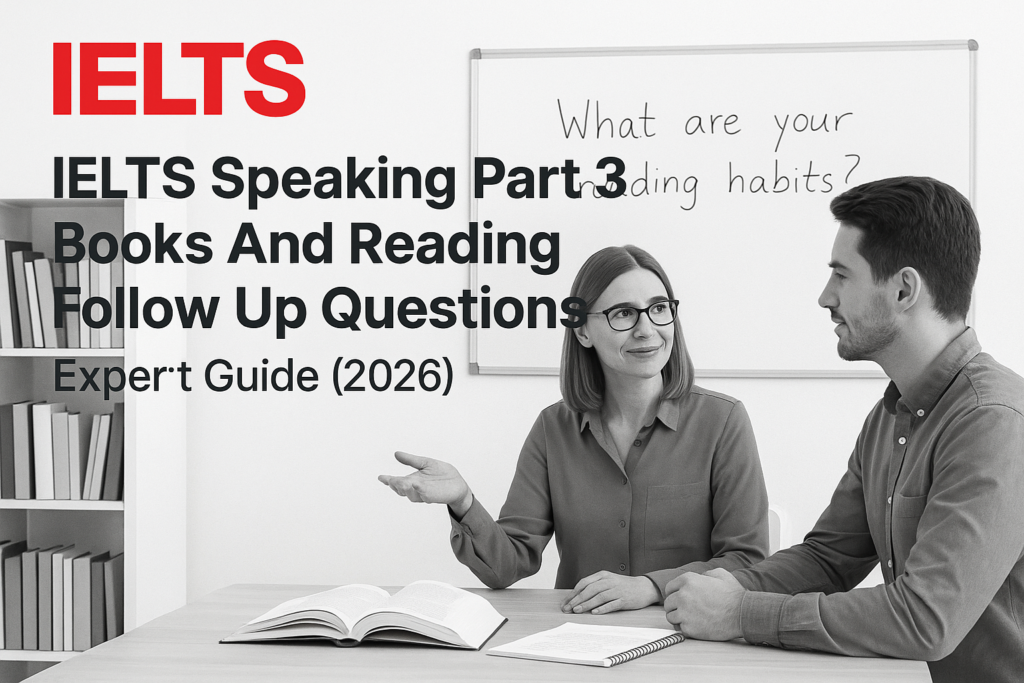
If you are preparing for IELTS Speaking Part 3 Books And Reading follow up questions, expect the examiner to move beyond your favourite book. Part 3 usually asks you to discuss reading habits, children and books, digital reading, libraries, education, imagination, attention span, book prices, and whether people still read as much as before. Before you practise a list of memorised answers, take the IELTS Express Pre-Test to check your current band level and see which speaking skills need the most attention.
Books and reading is a friendly topic, but many candidates make it too personal. They describe one novel, say reading is useful, and then run out of ideas. A stronger Part 3 answer explains why people read, how reading habits are changing, what affects children, and whether books still matter in a digital world. You do not need to sound like a literature professor. You need clear opinions, realistic examples, and enough language to compare paper books, e-books, audiobooks, school reading, online articles, and entertainment habits.
What Books And Reading Questions In Part 3 Are Testing
Part 3 tests your ability to discuss general ideas. If Part 2 asks you to describe a book you enjoyed, Part 3 may ask whether people read fewer books today, whether children should read more stories, or whether libraries are still important. The topic becomes broader, so your answer needs more development than a personal memory.
A useful answer normally has four parts: a direct answer, a reason, an example, and a result. If the examiner asks whether people read less nowadays, you could say many people read fewer traditional books, but they may still read online every day. Then explain that social media, work messages, news sites, and subtitles all involve reading, although not always deep reading. Finish by saying that the quality and length of reading may have changed more than the total amount.
- Answer the exact question first.
- Move from personal preference to a wider social point.
- Use examples from school, work, family, libraries, or online life.
- Finish with a result, comparison, or judgement.
For the full speaking test structure, read the IELTS Speaking Test complete guide while you practise this topic.
How To Build A Band 7 Books And Reading Answer
A Band 7 answer is usually clear, balanced, and specific. You do not need dramatic vocabulary. You need to show that you can explain a reading issue from more than one angle. The safest pattern is answer, explain, example, extend.
For example, if the question is “Should children be encouraged to read more books?”, you might say yes, because reading helps children build vocabulary, imagination, patience, and concentration. Then add that the book does not always have to be serious or academic. Comics, picture books, adventure stories, and short factual books can all create a reading habit. Extend the answer by saying that parents and teachers should make reading enjoyable first, because forcing difficult books too early can make children dislike it.
If you want to test this answer shape under exam pressure, use unlimited IELTS mock tests and record several Part 3 books and reading answers in one session. You will quickly hear whether your ideas stay organised when the examiner changes the question.
Common IELTS Speaking Part 3 Books And Reading Follow Up Questions
Use these questions to practise flexible thinking. Do not memorise full scripts. Prepare useful ideas for each theme so you can adapt naturally on test day.
- Do people in your country read as much as they did in the past?
- Why do some children dislike reading?
- Should parents read stories to young children?
- Are paper books better than e-books?
- Do you think libraries are still useful today?
- What kinds of books are most useful for students?
- Has the internet changed the way people read?
- Should schools allow students to choose their own books?
- Can reading fiction help people understand others?
- Will printed books disappear in the future?
Sample Answer: Do People Read Less Than In The Past?
In terms of printed books, many people probably read less than in the past. They have more entertainment options now, such as streaming, short videos, games, and social media, so long reading can feel less attractive. However, I do not think people have stopped reading completely. Many people read messages, emails, articles, captions, and online comments every day. The difference is that this reading is usually shorter and less focused. So I would say deep reading has declined more than everyday reading.
This answer works because it avoids a simple yes or no. It separates printed books from online reading and gives a more mature judgement. That gives the examiner more language to assess.
Sample Answer: Should Parents Read To Children?
Yes, I think parents should read to young children because it builds language, imagination, and emotional connection at the same time. A bedtime story, for example, can teach new words and also create a calm routine. It does not have to be a long or difficult book. Even a simple picture book can help children ask questions, describe characters, and understand how stories work. The main benefit is that children may begin to see reading as something warm and enjoyable, not just a school task.
Notice the practical detail. The answer does not only say reading is good. It explains vocabulary, routine, questions, and attitude, which makes the response more developed.
Sample Answer: Are Libraries Still Important?
Libraries are still important, although their role has changed. In the past, people mainly used libraries to borrow books. Today, libraries can also provide study spaces, internet access, children’s activities, language resources, and quiet places for people who cannot study comfortably at home. For example, a student living in a crowded house may use the library to prepare for exams. Some people may say everything is online now, but not everyone has equal access to books, computers, or quiet space. So libraries still support education and community life.
This answer gives both the old role and the modern role. That comparison is useful because many IELTS reading questions are really about social change.
Vocabulary For Books And Reading Discussion
Useful vocabulary for this topic should help you explain habits, benefits, formats, and social changes. Avoid rare literary terms unless you can use them naturally. Clear phrases used accurately are better than impressive words used awkwardly.
- reading habit: a regular pattern of reading for study, work, or enjoyment.
- deep reading: careful, focused reading of longer texts.
- digital reading: reading on phones, tablets, e-readers, or computers.
- attention span: the length of time someone can concentrate on one activity.
- imagination: the ability to create images and ideas in the mind.
- literacy skills: reading and writing abilities used in daily life and education.
- access to books: the ability to get books easily and affordably.
Use these phrases inside complete answers. Instead of only saying “attention span”, say: “Short online videos may reduce some children’s attention span because they become used to fast entertainment.” That sentence is simple, but it shows control.
How To Extend Short Books And Reading Answers
If your answer is too short, add one useful layer. You can explain a cause, give a result, compare the past and present, mention children and adults, or connect reading to school, work, technology, cost, family routine, or public spaces. Books and reading questions are easy to extend because they connect private habits with education and culture.
For example, if you say children should read more, explain why. Reading can improve vocabulary, grammar, concentration, imagination, and confidence at school. If you say people prefer screens, explain the attraction: phones are convenient, cheap, portable, and full of quick content. If you say printed books will survive, explain who still needs them: students, collectors, older readers, children learning to read, or people who want a break from screens.
- Compare paper books, e-books, audiobooks, and online articles.
- Compare deep reading with quick digital reading.
- Mention school, parents, libraries, cost, technology, or entertainment.
- Explain how reading affects children, students, workers, families, and society.
If your answers are organised but still sound basic, the IELTS Speaking Part 3 tips and strategies guide can help you build stronger discussion habits.
Common Mistakes With Books And Reading Follow Up Questions
The first mistake is only describing your favourite book. Personal examples are useful, but Part 3 needs wider discussion. If the examiner asks whether people read enough, do not only say that you personally enjoy novels. Use your experience briefly, then explain the wider trend.
The second mistake is attacking technology too simply. Saying phones are bad for reading may be partly true, but it is too general. Phones can distract people, but they can also give people access to e-books, dictionaries, articles, and audiobooks. A balanced answer gives you more room to show language.
The third mistake is using emotional claims without explanation. Saying books are important for life is not enough. Explain that reading can support vocabulary, concentration, empathy, education, job skills, and independent learning. Specific benefits sound stronger than broad praise.
- Do not turn every answer into a book review.
- Do not ignore digital reading and audiobooks.
- Do not use extreme claims about technology or young people.
- Do not memorise long answers that fail to match the exact question.
Books And Reading Answer Frames You Can Reuse
Reusable frames help you start clearly without sounding robotic. For change questions, try: “Reading has not disappeared, but the format and depth of reading have changed.” Then add paper books, phones, online articles, or audiobooks. For children’s questions, try: “Children are more likely to read if the activity feels enjoyable rather than forced.” Then explain parents, teachers, book choice, and routine.
For balance, try: “Paper books and digital books both have advantages, depending on the reader and the purpose.” This frame works for questions about e-books, libraries, school reading, and printed books. For future questions, try: “Printed books may become less common for convenience reading, but they will probably survive in education, children’s reading, and personal collections.” That gives you a natural prediction without sounding extreme.
These frames are not scripts. They are starting points. Practise them with different questions until you can change the examples naturally.
Practice Plan For This Topic
Start with six questions and answer each one for 45 to 60 seconds. Record yourself. Then listen for three things: whether you answered directly, whether you gave a clear example, and whether your final sentence finished the idea. If your answer stops too early, repeat it with one extra cause or result.
On the second round, change the angle. Move from “Should children read books?” to “Should children read paper books?” Then try “Should schools let children choose what they read?” This trains flexibility, which is exactly what Part 3 requires. You can also compare your responses with the IELTS Speaking Part 3 sample answers to see how developed answers are shaped.
If your test is close and you need a structured plan, see our IELTS preparation plans so you can choose the right level of speaking support instead of guessing what to practise next.
How To Sound Natural When Discussing Books
Natural answers usually sound specific, not romantic. Instead of saying, “Books are the best thing for everyone,” say, “Reading can help people build vocabulary, follow complex ideas, and learn without depending only on teachers or videos.” That sentence gives the examiner clearer content.
Use moderate language when the issue is complex. Phrases like “for many people”, “in some families”, “it depends on the purpose”, and “one possible reason” can help you avoid overgeneralising. This matters because reading habits are shaped by age, education, income, language level, technology access, school culture, and free time.
Also remember that reading is not only about novels. You can discuss textbooks, news articles, recipe books, workplace documents, children’s stories, online guides, subtitles, graphic novels, and audiobooks. This gives your answer more variety and helps you avoid repeating the same idea.
Ready to find out your IELTS band score?
Take the IELTS Express Pre-Test for just $4.99 and get your personalised band prediction with a 14-day improvement plan.
FAQ: IELTS Speaking Part 3 Books And Reading Follow Up Questions
How long should my Part 3 books and reading answers be?
Most strong answers are around 35 to 60 seconds. Answer directly, explain one clear idea, give a realistic example, and add a result or comparison. Very short answers usually do not show enough language.
Do I need literary vocabulary for this topic?
No. You need natural language more than specialist literary terms. Phrases like reading habit, deep reading, digital reading, attention span, literacy skills, and access to books are useful if you can use them clearly.
Can I say that I do not read many books?
Yes, but do not stop there. Explain the wider issue, such as lack of time, phone use, study pressure, or the rise of audiobooks and online articles. Part 3 rewards developed ideas, not a perfect personal habit.
Should I give both sides when comparing paper books and e-books?
Often, yes. Paper books can be easier on the eyes and better for focus, while e-books are portable and cheaper for many readers. A balanced answer sounds mature if your final view is still clear.
What if I cannot think of a book example?
Use a general example instead. You can mention children’s stories, school textbooks, online articles, workplace documents, or library books. IELTS Speaking tests communication, not your reading history.