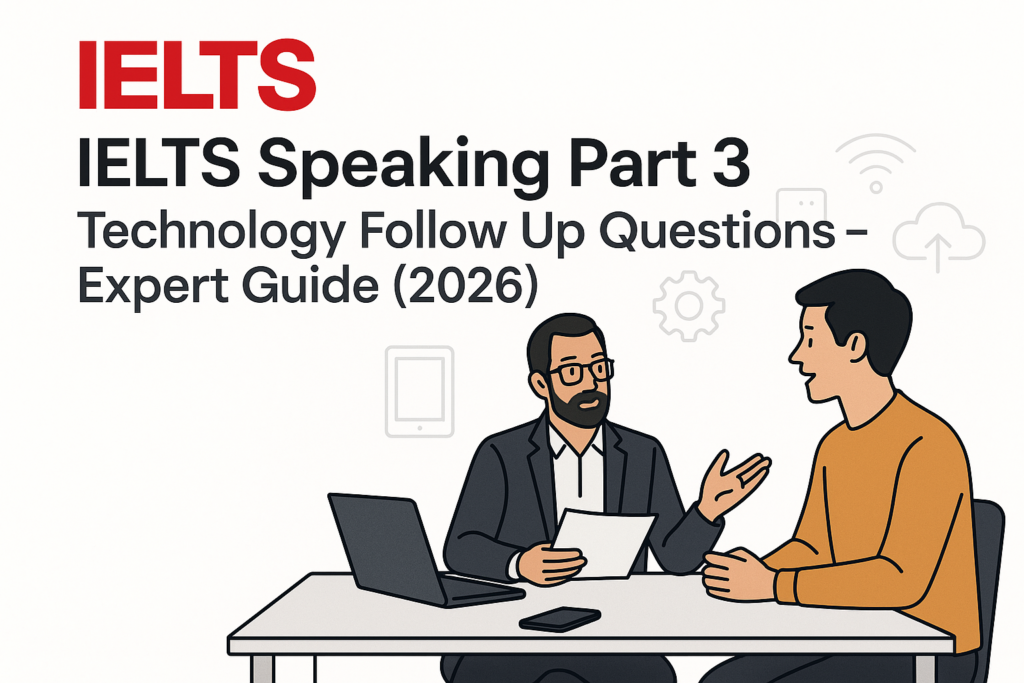
If you are preparing for IELTS Speaking Part 3 Technology follow up questions, remember that the examiner is not asking whether you like your phone. Part 3 is a wider discussion. You may need to explain how technology changes education, work, family life, communication, privacy, health, or the way people solve problems. Before you practise random answers, take the IELTS Express Pre-Test to check your current band level and get a clearer improvement plan.
Technology is one of the most common IELTS Speaking topics because it connects everyday life with bigger social ideas. A weak answer stays too simple: “Technology is useful because it is convenient.” A stronger answer explains the reason, gives a realistic example, and adds a result. You do not need to sound like an engineer. You need organised ideas, natural language, and enough flexibility to answer the examiner’s follow-up questions.
What Technology Questions In Part 3 Are Testing
Part 3 tests your ability to discuss ideas beyond your personal routine. If Part 2 asks you to describe a useful app or device, Part 3 may ask whether technology makes people less patient, whether children should use digital devices at school, or whether governments should control online information. The topic becomes more abstract, so your answer needs more than a personal story.
A useful response usually has four parts: a direct answer, a reason, an example, and a result. For example, if the examiner asks whether technology helps students, you can say yes because it gives them faster access to explanations and practice materials. Then you might mention online lessons, dictionaries, pronunciation tools, or recorded feedback. Finally, explain that this can make study more flexible, especially for people who cannot attend face-to-face classes.
- Answer the exact question first.
- Move from personal experience to a wider point.
- Use realistic examples, not memorised speeches.
- Finish with a consequence, comparison, or judgement.
For the wider test format, read the IELTS Speaking Test complete guide alongside this topic practice.
How To Build A Band 7 Technology Answer
A Band 7 style answer is usually clear rather than dramatic. It gives the examiner enough language to assess fluency, vocabulary, grammar, and coherence. The safest pattern is answer, explain, example, extend. This pattern stops you from giving one-sentence answers and helps you stay focused when the question is broad.
If the question is “Has technology changed the way people communicate?”, you might say yes, because people can now send messages, photos, voice notes, and documents instantly. Then explain that this is useful for work and families who live in different places. Add an example such as parents video calling children overseas or employees sharing updates with a team. Finally, say that communication has become faster, but sometimes less personal because people may avoid deeper face-to-face conversations.
If you want to test this answer shape under pressure, use unlimited IELTS mock tests and record several Part 3 technology answers in one sitting. You will quickly hear whether your ideas stay organised when the examiner changes the angle.
Common IELTS Speaking Part 3 Technology Follow Up Questions
Use these questions to practise flexible answers. Do not memorise complete scripts. Prepare useful ideas for each theme so you can adapt naturally in the test.
- How has technology changed the way people communicate?
- Do children use technology too much these days?
- Should schools use more digital tools in the classroom?
- Has technology made work easier or more stressful?
- Do older people and younger people use technology differently?
- What are the disadvantages of depending on technology?
- Should governments control the use of artificial intelligence?
- Can technology make people more isolated?
- How will technology change education in the future?
- Is face-to-face communication still important?
Sample Answer: How Has Technology Changed Communication?
Technology has changed communication by making it much faster and more flexible. In the past, people often had to wait for letters, phone calls, or face-to-face meetings. Now they can send a quick message, join a video call, or share a document in seconds. This is especially useful for families living in different countries and for workplaces with remote staff. However, it can also make communication feel shallow because people sometimes send short replies instead of having proper conversations. So I would say technology has improved access to communication, but it has not automatically improved the quality of communication.
This answer works because it gives a balanced view. It does not simply say technology is good. It explains the benefit, gives examples, and then adds a realistic limitation.
Sample Answer: Do Children Use Too Much Technology?
In many cases, yes, but I think the problem is not just the amount of screen time. It is also the quality of what children are doing online. If a child uses a tablet to learn vocabulary, practise pronunciation, or complete school research, that can be useful. But if they spend hours scrolling short videos or playing games without limits, it can affect concentration, sleep, and social skills. Parents and schools need to set clear boundaries, but they should also teach children how to use technology in a productive way. Completely banning devices is probably unrealistic in modern life.
Notice the examiner-safe language. Words like “in many cases”, “probably”, and “not just” help you avoid extreme claims, which is useful for Part 3.
Sample Answer: Has Technology Made Work Easier?
Technology has made many work tasks easier because people can automate simple jobs, search for information quickly, and collaborate with others without being in the same office. For example, a small business can use online booking systems, shared calendars, and digital payment tools instead of handling everything manually. At the same time, technology can make work more stressful because employees may feel expected to answer messages outside office hours. Overall, I think technology improves efficiency, but workplaces need sensible rules so people are not connected all the time.
This answer gives both sides and ends with a clear judgement. That is often stronger than a one-sided answer because many technology questions involve benefits and risks.
Vocabulary For Technology Discussion
Good vocabulary for this topic should be flexible. You do not need rare technical words. You need phrases that help you discuss reasons, impacts, comparisons, and changes clearly.
- digital tools: apps, websites, software, or devices that help people complete tasks.
- remote communication: communication between people who are not in the same place.
- screen time: the amount of time someone spends using a phone, computer, or tablet.
- automation: using technology to complete tasks with less human effort.
- privacy concerns: worries about personal information being collected or shared.
- digital literacy: the ability to use technology safely and effectively.
- over-reliance on technology: depending too much on devices or systems.
Use vocabulary inside complete ideas. Instead of only saying “digital literacy”, say: “Schools should teach digital literacy because students need to judge online information and protect their privacy.” Clear sentences score better than impressive phrases used awkwardly.
How To Extend Short Technology Answers
If your answer feels too short, add one useful layer. You can compare past and present, mention young people and older people, explain a benefit, describe a risk, or give a simple example. Technology questions are easy to extend because they connect to education, work, health, money, family life, privacy, and the future.
For example, if you say technology helps students, extend the answer by explaining which students and how. Then add a result: students in regional areas may access lessons that were previously unavailable. If you say technology creates problems, give an example such as distraction, misinformation, or privacy loss. Then explain why this matters for families, schools, workers, or governments.
- Compare online and face-to-face communication.
- Compare younger and older users.
- Mention convenience, cost, speed, privacy, access, or pressure.
- Explain how technology affects education, work, family life, or public services.
If your answers are organised but still sound too basic, the IELTS Speaking Part 3 tips and strategies guide can help you build stronger discussion habits.
Common Mistakes With Technology Follow Up Questions
The first mistake is talking only about your own phone. Personal examples are useful, but Part 3 asks for wider discussion. If the examiner asks whether technology affects society, do not only describe your favourite app. Use it briefly as an example, then explain the general point.
The second mistake is using extreme claims. Saying technology is always good or always dangerous is usually too simple. A stronger answer often explains that the result depends on age, purpose, control, education, and access. This gives you more room to show complex language.
The third mistake is listing many ideas without development. Saying “technology helps education, work, business, health, and transport” is not enough. Choose one or two ideas and explain them properly. Development matters more than the number of points.
- Do not answer only from personal habits.
- Do not use extreme opinions without support.
- Do not list benefits without explaining them.
- Do not memorise long answers that do not match the question.
Technology Answer Frames You Can Reuse
Reusable frames help you sound organised without sounding robotic. The goal is not to memorise a full answer. The goal is to practise flexible sentence shapes that can fit many technology questions.
For benefits, try: “One major advantage is that technology gives people easier access to…” Then add education, services, work, communication, or information. For risks, try: “The main drawback is that people may become too dependent on…” Then add devices, online advice, search engines, or automated systems. For balance, try: “It depends on how the technology is used. If it supports real learning or communication, it can be positive, but if it replaces thinking or social contact, it can create problems.”
These frames are useful because Part 3 often asks you to compare, evaluate, or predict. They help you begin clearly and then build your own example.
Practice Plan For This Topic
Start with five questions and answer each one for 45 to 60 seconds. Record yourself. Then listen for three things: whether you answered the question directly, whether you gave an example, and whether you finished with a clear result or judgement. If your answer stops too early, repeat it with one extra layer.
On the second round, change the question slightly. For example, move from “How has technology changed communication?” to “How has technology changed communication between family members?” This trains flexibility, which is exactly what Part 3 requires. You can also compare your answers with the IELTS Speaking Part 3 sample answers to see how developed answers are usually shaped.
If you are close to your test date and need a structured plan, see our IELTS preparation plans so you can choose the right level of speaking support instead of guessing what to practise next.
Ready to find out your IELTS band score?
Take the IELTS Express Pre-Test for just $4.99 and get your personalised band prediction with a 14-day improvement plan.
FAQ: IELTS Speaking Part 3 Technology Follow Up Questions
How long should my Part 3 technology answers be?
Most strong answers are around 35 to 60 seconds. You should answer directly, explain one idea, give a realistic example, and add a result or comparison. Very short answers usually do not show enough language.
Do I need advanced technology vocabulary for IELTS Speaking?
No. You need accurate, natural vocabulary more than technical words. Phrases like digital tools, privacy concerns, screen time, remote communication, and over-reliance are useful because they fit many questions.
What if I do not know much about artificial intelligence?
You can still answer safely by discussing general effects, such as convenience, job changes, privacy, education, and the need for rules. IELTS tests communication, not specialist technical knowledge.
Should I give both sides in technology answers?
Often, yes. Technology topics usually involve benefits and risks. A balanced answer can sound more mature, as long as you still give a clear final opinion.
Can I use personal examples in Speaking Part 3?
Yes, but use them briefly. Part 3 needs wider discussion, so connect your example to society, education, work, families, or the future.