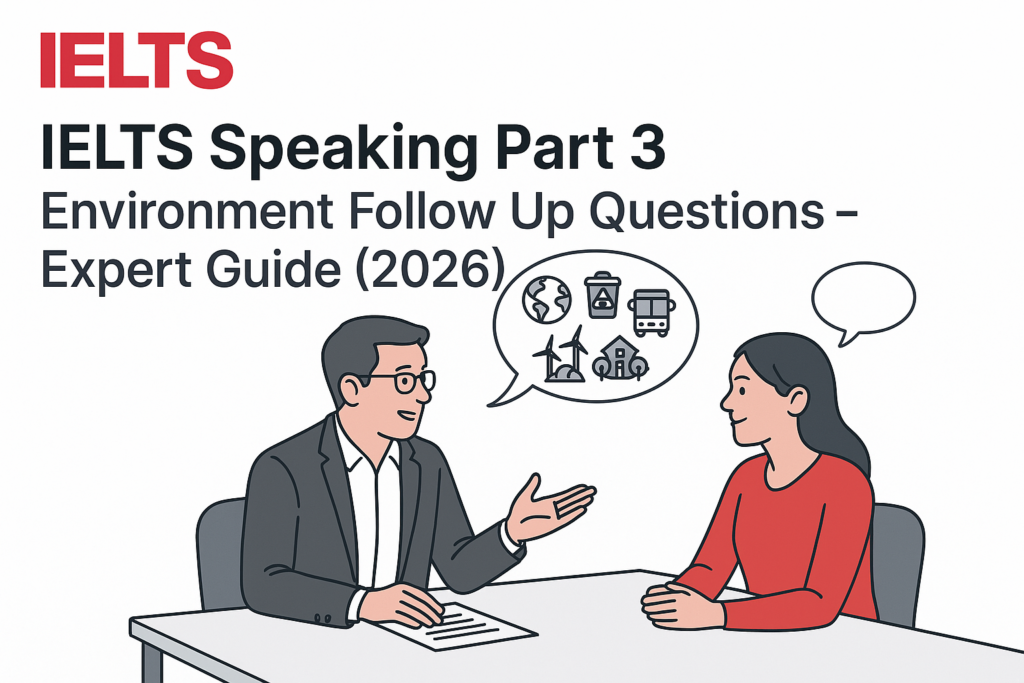
If you are preparing for IELTS Speaking Part 3 Environment follow up questions, expect the examiner to move beyond recycling at home or whether you like parks. Part 3 usually asks you to discuss pollution, climate change, public transport, government rules, business responsibility, consumer habits, education, technology, and the way environmental choices affect everyday life. Before you practise a list of memorised answers, take the IELTS Express Pre-Test to check your current band level and see which speaking skills need the most attention.
The environment is a common IELTS Speaking topic because it connects personal behaviour with wider social decisions. The danger is that many candidates answer too generally. They say, “People should protect nature,” and then stop. A stronger Part 3 answer explains why environmental problems happen, who should respond, what trade-offs are involved, and which solutions are realistic. You do not need to be a climate scientist. You need clear ideas, natural examples, and enough language to discuss causes, effects, responsibility, and future change.
What Environment Questions In Part 3 Are Testing
Part 3 tests whether you can discuss general ideas, not only your own habits. If Part 2 asks you to describe a beautiful natural place, Part 3 may ask whether governments should limit car use, whether companies should pay for pollution, or why some people ignore environmental advice. The topic becomes broader, so your answer needs development.
A useful response usually has four parts: a direct answer, a reason, an example, and a result. If the examiner asks whether individuals can solve environmental problems, you can say individuals can help, but they cannot solve everything alone. Then explain that people can recycle, save energy, and use public transport, but large problems also need infrastructure and regulation. Finish by saying that personal habits matter most when they are supported by better systems.
- Answer the exact question first.
- Move from your personal view to a wider social point.
- Use examples that are realistic and easy to explain.
- Finish with a consequence, comparison, or judgement.
For the full speaking test structure, read the IELTS Speaking Test complete guide while you practise this topic.
How To Build A Band 7 Environment Answer
A Band 7 answer is usually clear, balanced, and specific. You do not need dramatic vocabulary or extreme opinions. You need to show that you can explain an environmental issue from more than one angle. The safest pattern is answer, explain, example, extend.
For example, if the question is “Should governments do more to protect the environment?”, you might say yes, because many environmental problems are too large for individuals to manage alone. Explain that transport systems, industrial pollution, energy policy, and waste management require public investment and rules. Add an example such as better train networks or stricter standards for factories. Then extend the answer by saying that government action works best when it makes environmentally friendly choices affordable and convenient.
If you want to test this answer shape under exam pressure, use unlimited IELTS mock tests and record several Part 3 environment answers in one session. You will quickly hear whether your ideas stay organised when the examiner changes the question.
Common IELTS Speaking Part 3 Environment Follow Up Questions
Use these questions to practise flexible thinking. Do not memorise full scripts. Prepare useful ideas for each theme so you can adapt naturally on test day.
- What are the biggest environmental problems in cities?
- Should governments punish companies that pollute?
- Can individuals make a real difference to the environment?
- Why do some people ignore environmental problems?
- Is public transport important for protecting the environment?
- Should children learn about the environment at school?
- How can businesses become more environmentally responsible?
- Do you think technology can solve environmental problems?
- Should people pay more for eco-friendly products?
- Will environmental problems become worse in the future?
Sample Answer: Can Individuals Make A Real Difference?
Individuals can make a difference, but I do not think they can solve environmental problems by themselves. Personal choices such as recycling, reducing food waste, saving electricity, and using public transport can reduce pressure on the environment. However, many problems come from large systems, such as energy production, manufacturing, and urban planning. For example, a person may want to take the train, but if the train system is slow or expensive, driving becomes the easier option. So individual action is useful, but it needs support from governments and businesses.
This answer works because it avoids a simple yes or no. It gives credit to personal responsibility but also explains the limits. That balanced position gives the examiner more language to assess.
Sample Answer: Should Companies Be Responsible For Pollution?
Yes, companies should be responsible for pollution because they often have more power and resources than ordinary consumers. If a factory produces waste or a business uses excessive packaging, the cost should not be passed entirely to the public. For example, companies could be required to treat wastewater properly, reduce plastic packaging, or pay penalties if they damage local areas. At the same time, the rules should be clear and realistic so businesses can adapt. The aim should be cleaner production, not simply punishment.
Notice the careful tone. The answer supports business responsibility, but it also mentions realistic rules. That kind of qualification is useful in Part 3 because environmental questions often involve money, jobs, convenience, and fairness.
Sample Answer: Is Public Transport Good For The Environment?
Public transport can be very good for the environment if it is reliable and widely used. Buses, trains, and trams can reduce the number of private cars on the road, which means less traffic congestion and lower emissions per passenger. For example, if commuters can reach work quickly by train, many of them may not need to drive every day. However, public transport has to be frequent, safe, clean, and affordable. If it is inconvenient, people will choose cars even if they care about the environment.
This answer gives both a benefit and a condition. That makes it stronger than simply saying public transport is good. It explains when the solution works and why people may or may not use it.
Vocabulary For Environment Discussion
Useful vocabulary for this topic should help you explain problems, responsibility, solutions, and consequences. Avoid technical words unless you can use them naturally. Clear everyday language is better than complicated language used awkwardly.
- air pollution: harmful substances in the air, often from traffic, factories, or burning fuel.
- carbon emissions: gases released by transport, industry, or energy use that contribute to climate change.
- sustainable habits: daily choices that can continue without damaging the environment heavily.
- waste management: the way rubbish is collected, sorted, recycled, or disposed of.
- renewable energy: energy from sources such as solar, wind, or hydro power.
- environmental awareness: understanding how human actions affect nature and resources.
- single-use plastic: plastic designed to be used once and then thrown away.
Use these phrases inside complete answers. Instead of only saying “carbon emissions”, say: “Better public transport can reduce carbon emissions because fewer people need to drive private cars every day.” That sentence is simple, but it shows control.
How To Extend Short Environment Answers
If your answer is too short, add one useful layer. You can explain a cause, give a result, compare individuals and governments, mention cost, or connect the issue to transport, housing, schools, businesses, or technology. Environment questions are easy to extend because they involve both personal choices and public systems.
For example, if you say people should recycle, explain why recycling alone is not enough. It reduces waste, but reducing unnecessary packaging may be even better. If you say governments should act, explain what kind of action matters: better public transport, cleaner energy, tree planting, recycling facilities, or rules for companies. If you say eco-friendly products are useful, mention the cost problem because many people cannot choose expensive products every week.
- Compare individual action and government policy.
- Compare short-term convenience and long-term environmental cost.
- Mention transport, packaging, energy, food waste, pollution, or education.
- Explain how environmental choices affect health, money, jobs, cities, or future generations.
If your answers are organised but still sound basic, the IELTS Speaking Part 3 tips and strategies guide can help you build stronger discussion habits.
Common Mistakes With Environment Follow Up Questions
The first mistake is giving slogans instead of answers. If the examiner asks why people do not protect the environment, do not simply say, “Everyone should care more.” Explain the barriers, such as cost, habits, limited public transport, weak rules, lack of time, or the feeling that one person cannot change much.
The second mistake is using extreme claims. Saying technology will solve everything is too simple. Renewable energy, electric vehicles, recycling systems, and cleaner manufacturing can help, but they still require money, planning, and behaviour change. A balanced answer gives you more room to show language.
The third mistake is blaming only individuals. People make daily choices, but those choices are shaped by price, infrastructure, work schedules, advertising, and government policy. If you mention both personal responsibility and larger systems, your answer sounds more mature.
- Do not turn every answer into a moral lecture.
- Do not ignore cost, convenience, or public infrastructure.
- Do not use extreme opinions without support.
- Do not memorise long answers that ignore the exact question.
Environment Answer Frames You Can Reuse
Reusable frames help you start clearly without sounding robotic. For causes, try: “One reason this problem continues is that the environmentally friendly option is not always the easiest or cheapest option.” Then add transport, packaging, energy, or food waste. For benefits, try: “The main advantage of this solution is that it changes people’s behaviour without forcing them too harshly.” Then explain the example.
For balance, try: “Individuals have a role, but the bigger change usually has to come from governments and businesses.” This is useful because many environment questions ask about responsibility. For future questions, try: “The problem may become worse if cities grow without better planning, but it could improve if clean technology becomes cheaper and more common.” This gives you a natural way to discuss prediction without sounding dramatic.
These frames are not scripts. They are starting points. Practise them with different questions until you can change the examples naturally.
Practice Plan For This Topic
Start with six questions and answer each one for 45 to 60 seconds. Record yourself. Then listen for three things: whether you answered directly, whether you gave a clear example, and whether your final sentence finished the idea. If your answer stops too early, repeat it with one extra cause or result.
On the second round, change the angle. Move from “Should governments protect the environment?” to “Should local governments protect the environment?” Then try “Should governments make people pay more for pollution?” This trains flexibility, which is exactly what Part 3 requires. You can also compare your responses with the IELTS Speaking Part 3 sample answers to see how developed answers are shaped.
If your test is close and you need a structured plan, see our IELTS preparation plans so you can choose the right level of speaking support instead of guessing what to practise next.
How To Sound Natural When Discussing The Environment
Natural answers usually sound specific, not emotional. Instead of saying, “The environment is the most serious problem in the world,” say, “Environmental problems affect people’s health, transport costs, city planning, and the quality of life for future generations.” That sentence is more useful because it gives the examiner clear content.
Use moderate language when the issue is complex. Phrases like “in many cases”, “for some people”, “one possible solution”, and “it depends on the cost” can help you avoid overgeneralising. This matters in environment questions because people’s choices are affected by income, local facilities, culture, jobs, government rules, and the availability of cleaner alternatives.
Also remember that health can be part of many environment answers. If the question is about traffic, you can mention air quality and stress. If the question is about green spaces, you can discuss exercise and mental wellbeing. This gives your response more depth without sounding forced.
Ready to find out your IELTS band score?
Take the IELTS Express Pre-Test for just $4.99 and get your personalised band prediction with a 14-day improvement plan.
FAQ: IELTS Speaking Part 3 Environment Follow Up Questions
How long should my Part 3 environment answers be?
Most strong answers are around 35 to 60 seconds. Answer directly, explain one clear idea, give a realistic example, and add a result or comparison. Very short answers usually do not show enough language.
Do I need scientific vocabulary for IELTS Speaking?
No. You need accurate everyday language more than specialist scientific terms. Phrases such as air pollution, carbon emissions, renewable energy, waste management, and environmental awareness are useful if you can explain them naturally.
What if I do not know much about climate change?
You can still answer well. Part 3 is about communication, not expert knowledge. Discuss common issues such as traffic, plastic waste, public transport, recycling, energy use, government rules, and business responsibility.
Should I give both sides in environment answers?
Often, yes. Environmental questions usually involve trade-offs between cost, convenience, jobs, health, and long-term impact. A balanced answer can sound more mature, as long as you still give a clear view.
Can I use personal examples in Part 3 environment answers?
Yes, but keep them brief. Use a personal example to support a wider point about cities, families, companies, governments, or society. Part 3 needs broader discussion than Part 1.