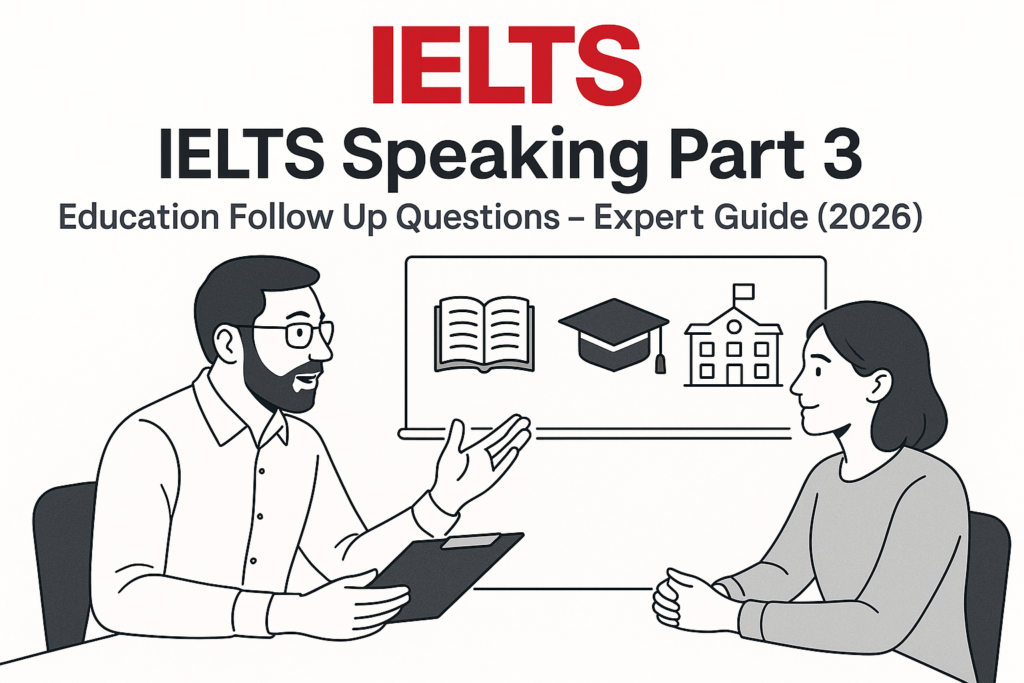
If you are preparing for IELTS Speaking Part 3 Education follow up questions, remember that the examiner is not only asking about your favourite subject or your own school. Part 3 is a wider discussion. You may need to explain the value of exams, online learning, teachers, university degrees, vocational training, homework, school discipline, creativity, technology in classrooms, or equal access to education. Before you practise random answers, take the IELTS Express Pre-Test to check your current band level and get a clearer speaking improvement plan.
Education is one of the most common IELTS Speaking topics because everyone has some experience with school, study, training, or learning new skills. The danger is that candidates often give answers that are too personal and too short. A weak answer says, “Education is important because people need knowledge.” A stronger answer explains what kind of knowledge, who benefits, and what result it creates. You do not need to sound like a policy expert. You need clear ideas, natural examples, and enough flexibility to handle follow-up questions.
What Education Questions In Part 3 Are Testing
Part 3 tests whether you can discuss ideas beyond your personal routine. If Part 2 asks you to describe a teacher or a subject you enjoyed, Part 3 may ask whether exams are fair, whether schools should teach practical skills, or whether online education can replace traditional classrooms. The topic becomes more abstract, so your answer needs more than a memory from school.
A useful response usually has four parts: a direct answer, a reason, an example, and a result. For example, if the examiner asks whether schools should teach financial skills, you can say yes because many young people leave school without knowing how to manage money. Then mention budgeting, taxes, loans, or rent. Finally, explain that this could make young adults more independent and less likely to make expensive mistakes.
- Answer the exact question first.
- Move from personal experience to a wider point.
- Use realistic examples, not memorised speeches.
- Finish with a consequence, comparison, or judgement.
For the wider test format, read the IELTS Speaking Test complete guide alongside this education topic practice.
How To Build A Band 7 Education Answer
A Band 7 style answer is usually organised rather than dramatic. It gives the examiner enough language to assess fluency, vocabulary, grammar, and coherence. The safest pattern is answer, explain, example, extend. This pattern stops you from giving one-sentence answers and helps you stay focused when the question is broad.
If the question is “Should university education be free?”, you might say that it should be more affordable, but perhaps not completely free in every case. Then explain that society benefits from well-trained nurses, teachers, engineers, and other professionals. Add an example about students from low-income families who may avoid university because of cost. Finally, say that scholarships or lower fees could improve access while still keeping universities properly funded.
If you want to test this answer shape under pressure, use unlimited IELTS mock tests and record several Part 3 education answers in one sitting. You will quickly hear whether your ideas stay organised when the examiner changes the angle.
Common IELTS Speaking Part 3 Education Follow Up Questions
Use these questions to practise flexible answers. Do not memorise complete scripts. Prepare useful ideas for each theme so you can adapt naturally in the test.
- What makes a good teacher?
- Do you think exams are a fair way to measure students?
- Should schools teach more practical life skills?
- Is online learning as effective as classroom learning?
- Should university education be free?
- Do students have too much homework?
- How has technology changed education?
- Should children start learning foreign languages early?
- Is discipline important in schools?
- What subjects will be most useful in the future?
Sample Answer: Are Exams A Fair Way To Measure Students?
Exams can be useful, but I do not think they are always a completely fair way to measure students. They are good for testing memory, time management, and the ability to work under pressure, which are useful skills in many situations. However, some students understand a subject well but perform badly in a short exam because of stress or poor exam technique. For example, a student may be excellent in class discussions or projects but still struggle with timed written tests. So I think exams should be part of assessment, but they should be balanced with coursework, presentations, and practical tasks.
This answer works because it gives a balanced view. It does not simply say exams are good or bad. It explains the benefit, gives a limitation, and ends with a realistic solution.
Sample Answer: Should Schools Teach Practical Skills?
Yes, I think schools should teach more practical skills because academic knowledge alone is not enough for adult life. Students still need subjects like maths, science, and languages, but they also need to understand money, communication, health, digital safety, and basic workplace behaviour. For example, a teenager may pass many exams but still not know how to write a professional email or manage a simple budget. Practical lessons would not replace academic subjects, but they could make education more relevant to real life. This would help students feel more confident when they leave school.
Notice the examiner-safe language. The answer does not attack traditional education. It adds a practical improvement and explains why it matters.
Sample Answer: Is Online Learning Effective?
Online learning can be effective if students are motivated and the course is well designed. It gives people flexibility, which is especially useful for adults, regional students, or people who cannot travel easily. They can watch lessons again, use digital resources, and study around work or family commitments. However, online learning can also be difficult because students may feel isolated or become distracted at home. In my view, the best system is often blended learning, where students get the convenience of online study but still have access to teachers, feedback, and real interaction.
This answer gives both sides and ends with a clear judgement. That is often stronger than a one-sided answer because many education questions involve benefits and trade-offs.
Vocabulary For Education Discussion
Good vocabulary for this topic should be flexible. You do not need rare academic words. You need phrases that help you discuss access, quality, pressure, skills, motivation, fairness, and long-term outcomes clearly.
- academic foundation: the basic knowledge students need for further study.
- practical life skills: abilities used in daily adult life, such as budgeting or communication.
- equal access: the chance for people from different backgrounds to receive education.
- critical thinking: the ability to question information and make reasonable judgements.
- student motivation: the desire to learn and keep improving.
- vocational training: education that prepares people for specific jobs or trades.
- assessment methods: ways of measuring student progress, such as exams or projects.
Use vocabulary inside complete ideas. Instead of only saying “critical thinking”, say: “Schools should develop critical thinking because students need to judge information rather than simply memorise it.” Clear sentences score better than impressive phrases used awkwardly.
How To Extend Short Education Answers
If your answer feels too short, add one useful layer. You can compare school and university, mention children and adults, explain a benefit, describe a risk, or give a simple example. Education questions are easy to extend because they connect to work, technology, money, families, government policy, migration, and the future.
For example, if you say teachers are important, extend the answer by explaining which teachers and how. A good teacher does not only explain grammar or mathematics; they also build confidence, notice weaknesses, and give feedback that helps students improve. If you say online education is useful, add a limitation such as reduced social interaction or the need for self-discipline. Then explain why this matters for children, university students, or working adults.
- Compare traditional classrooms and online learning.
- Compare academic subjects and practical skills.
- Mention access, cost, motivation, discipline, feedback, or technology.
- Explain how education affects work, confidence, family life, or social mobility.
If your answers are organised but still sound too basic, the IELTS Speaking Part 3 tips and strategies guide can help you build stronger discussion habits.
Common Mistakes With Education Follow Up Questions
The first mistake is talking only about your own school. Personal examples are useful, but Part 3 asks for wider discussion. If the examiner asks whether education should be equal for everyone, do not only describe your favourite teacher. Use that example briefly, then explain the general issue.
The second mistake is using extreme claims. Saying exams are always useless or online learning is always better is usually too simple. A stronger answer often explains that the result depends on age, subject, teacher quality, technology access, and student motivation. This gives you more room to show complex language.
The third mistake is listing many ideas without development. Saying “education helps jobs, confidence, society, and money” is not enough. Choose one or two ideas and explain them properly. Development matters more than the number of points.
- Do not answer only from personal school memories.
- Do not use extreme opinions without support.
- Do not list benefits without explaining them.
- Do not memorise long answers that do not match the question.
Education Answer Frames You Can Reuse
Reusable frames help you sound organised without sounding robotic. The goal is not to memorise a full answer. The goal is to practise flexible sentence shapes that can fit many education questions.
For benefits, try: “One major advantage is that education gives people access to…” Then add employment, confidence, social opportunities, or better decision-making. For risks, try: “The main drawback is that the system may put too much pressure on…” Then add children, families, teachers, or low-income students. For balance, try: “It depends on the student’s age and the subject. Some skills can be learned online, but younger learners often need more structure and personal feedback.”
These frames are useful because Part 3 often asks you to compare, evaluate, or predict. They help you begin clearly and then build your own example.
Practice Plan For This Topic
Start with five questions and answer each one for 45 to 60 seconds. Record yourself. Then listen for three things: whether you answered the question directly, whether you gave an example, and whether you finished with a clear result or judgement. If your answer stops too early, repeat it with one extra layer.
On the second round, change the question slightly. For example, move from “Should schools teach practical skills?” to “Should schools teach practical skills to younger children?” This trains flexibility, which is exactly what Part 3 requires. You can also compare your answers with the IELTS Speaking Part 3 sample answers to see how developed answers are usually shaped.
If you are close to your test date and need a structured plan, see our IELTS preparation plans so you can choose the right level of speaking support instead of guessing what to practise next.
Ready to find out your IELTS band score?
Take the IELTS Express Pre-Test for just $4.99 and get your personalised band prediction with a 14-day improvement plan.
FAQ: IELTS Speaking Part 3 Education Follow Up Questions
How long should my Part 3 education answers be?
Most strong answers are around 35 to 60 seconds. You should answer directly, explain one idea, give a realistic example, and add a result or comparison. Very short answers usually do not show enough language.
Do I need advanced education vocabulary for IELTS Speaking?
No. You need accurate, natural vocabulary more than academic jargon. Phrases like practical life skills, equal access, vocational training, critical thinking, and assessment methods are useful because they fit many questions.
What if I do not know much about education policy?
You can still answer safely by discussing general effects, such as cost, access, teacher quality, student motivation, exams, technology, and future work. IELTS tests communication, not specialist policy knowledge.
Should I give both sides in education answers?
Often, yes. Education topics usually involve benefits and limits. A balanced answer can sound more mature, as long as you still give a clear final opinion.
Can I use personal examples in Speaking Part 3?
Yes, but use them briefly. Part 3 needs wider discussion, so connect your example to schools, universities, families, employers, governments, or society.