If you are preparing for IELTS Speaking Part 2 for University Australia, you are probably not just chasing a better speaking score for its own sake. You need a result that supports a real application, a real deadline, and a real study plan. Part 2 can feel awkward because you have to speak alone for up to two minutes, often on a topic you did not expect. Before you assume your current level is already safe enough, take the IELTS Express Pre-Test to get a clearer sense of your band score and whether Speaking still needs work before you apply.
For university entry, a weak Part 2 answer can create a frustrating gap. Many candidates have enough ideas, but they speak too briefly, repeat themselves, or lose structure halfway through. The good news is that Part 2 responds well to practical training. You do not need to sound like a lecturer. You need to sound clear, organised, and natural under pressure.
What IELTS Speaking Part 2 means for university applicants in Australia
When Australian universities ask for IELTS, they are looking for more than grammar accuracy on paper. They want evidence that you can function in tutorials, presentations, group discussions, and one-to-one academic conversations. Part 2 matters because it shows whether you can hold the floor, organise an answer, and develop an idea without constant examiner support.
That is why this section can affect how confident your overall Speaking score looks. A short or messy Part 2 answer can drag down fluency and coherence, even if Part 1 felt comfortable. If you need broader context on scores and university pathways, the IELTS for University Australia complete guide is a useful starting point.
How IELTS Speaking Part 2 is structured on test day
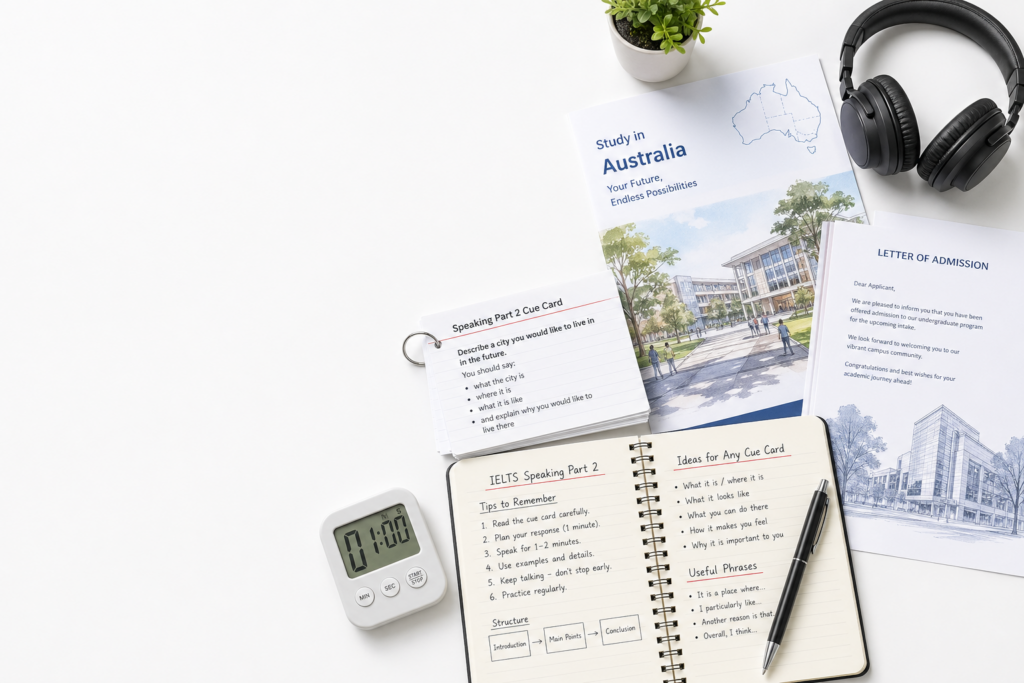
In Part 2, you receive a cue card and one minute to prepare. The card gives you a topic and a few bullet points to cover. After that, you speak for up to two minutes. The examiner usually says very little while you are speaking, so the structure has to come from you.
Most university-focused candidates do not struggle because the topic is impossible. They struggle because the one-minute planning stage disappears too fast. They write too much, panic, and then try to remember full sentences. A better approach is to prepare a simple speaking map: topic, example, detail, reason, outcome. That gives you enough shape without turning the answer into a memorised script.
- Minute 1: identify the easiest angle for the cue card
- Minute 2 speaking start: introduce the topic clearly
- Middle of the answer: add one or two specific examples
- Final part: explain why it matters to you
Why university-bound candidates often lose marks in Part 2
One common mistake is aiming for “formal” English and ending up with stiff English. Candidates who want university admission sometimes try to sound academic in every sentence. In Part 2, that often makes the answer less natural. The examiner is not looking for a mini essay. They are listening for controlled spoken English.
Another problem is over-explaining background details. If the cue card asks you to describe a teacher, a project, or a useful piece of advice, some candidates spend half the time setting the scene and never reach the main point. Others finish in under a minute because they answer the bullet points too quickly. If your wider Speaking performance still feels inconsistent, it helps to access unlimited IELTS mock tests and practise under more realistic timing pressure.
A reliable structure for IELTS Speaking Part 2 for University Australia
A simple four-part structure works well for most cue cards. First, say what or who you are describing. Second, explain the situation or relationship. Third, give one or two concrete details or examples. Fourth, finish with why the topic matters to you, especially if it connects to study, growth, or future plans.
This structure is useful because it prevents the answer from wandering. It also helps you speak long enough without sounding repetitive. For university applicants, that matters. Australian institutions are not expecting dramatic stories. They are expecting a level of spoken control that suggests you can cope in an academic environment.
Here is a safe planning model you can apply to many topics:
- Opening: name the person, event, place, object, or experience
- Context: explain when, where, or how it fits into your life
- Support: add one memory, example, or useful detail
- Meaning: say why it was important or what it taught you
Common cue card topics that suit university applicants
Part 2 topics change, but many of them can connect naturally to study or future goals. You might need to describe a teacher who influenced you, a subject you enjoy, a difficult decision, a skill you learned, a place that matters to you, or a presentation you gave. The key is not to force every answer into a university speech. The key is to choose details that sound real and easy for you to explain.
For example, if the topic is a person who helped you, you could talk about a school teacher who improved your confidence before final exams. If the topic is a goal, you could explain why studying in Australia matters to you and what you have already done to prepare. If the topic is a useful skill, you could describe note-taking, time management, or public speaking. These are natural choices for university-bound candidates because they connect to real experience.
Sample answer strategy for a university-style cue card
Imagine a cue card that says: describe a skill that will help you in the future. A weak answer might stay general and say the skill is important. A stronger answer would choose one skill, explain how it was learned, give one clear example, and then connect it to future study in Australia.
You could say that the skill is speaking in front of a group. Then explain that you developed it during a class presentation, felt nervous at first, but improved after practising with clear notes and better timing. After that, connect it to university life by saying the skill will help in seminars, group tasks, and classroom discussions. That answer works because it is specific, structured, and relevant.
The same logic applies to many other cue cards. You do not need a perfect story. You need a manageable story with enough detail to sound convincing.
How to use your one-minute preparation time properly
The one-minute preparation stage is where many candidates either save the answer or ruin it. Do not write full sentences. That almost always slows you down and makes your delivery sound read rather than spoken. Instead, write short prompts that trigger ideas.
For the skill example above, your notes might look like this: class presentation, nervous at first, weekly practice, clearer speaking, useful for seminars. That is enough. Each note can lead to one small part of the answer. Your job during the minute is not to script the answer. Your job is to prevent silence and repetition.
If your preparation still feels uneven, build your next practice sessions around the parts of Part 2 that still create hesitation, especially note planning, timing, and idea development under pressure.
Language features that help you sound clear, not memorised
Better Part 2 answers usually rely on control, not fancy vocabulary. Simple linking phrases can make a big difference because they guide the listener through the answer. Phrases such as the main reason I chose this topic is, what stands out most is, at first I found it difficult, and this mattered to me because sound natural and useful.
It also helps to mix short and slightly longer sentences. If every sentence has the same length, the answer can sound mechanical. If every sentence is long, grammar accuracy often drops. A balanced rhythm usually sounds stronger. For university candidates, the goal is calm control. You want the examiner to feel that you can express ideas clearly in an academic setting without forcing the language.
- For opening: I would like to talk about…, The topic I chose is…
- For adding detail: One thing I remember clearly is…, Another useful point is…
- For cause and effect: This helped me because…, As a result, I became more confident…
- For closing: That is why this experience still matters to me…
How to extend your answer when you finish too early
Finishing early is a very common Part 2 problem. The safest fix is to add one of three things: a specific example, a comparison, or a result. If you described a teacher, add one lesson or moment that made the person memorable. If you described a place, compare it with another place. If you described a skill, explain how it changed your behaviour or confidence.
This approach works better than repeating the same point with different words. Repetition makes the answer sound thin. New detail makes it sound developed. That is an important distinction if you are trying to protect a university-entry band score.
Ready to find out your IELTS band score?
Take the IELTS Express Pre-Test for just $4.99 and get your personalised band prediction with a 14-day improvement plan.
FAQ: IELTS Speaking Part 2 for University Australia
What band score do Australian universities usually need in IELTS Speaking?
Requirements vary by course and institution, but many universities expect an overall IELTS score around 6.0 to 7.0, sometimes with minimum section scores. You should always check the exact course requirement rather than relying on a general average.
How long should I speak in IELTS Speaking Part 2?
You should aim to speak for close to two minutes. If you stop too early, your answer may sound underdeveloped. A simple structure with one or two examples usually helps you reach the time naturally.
Should I make my Part 2 answer sound academic for university entry?
No. It should sound clear and organised, not artificially academic. Natural spoken English with good structure is usually much better than stiff language that sounds memorised.
Can I connect my cue card answer to my future university plans in Australia?
Yes, if the connection feels natural. It is often useful to mention study goals, communication skills, or personal growth when they genuinely fit the topic.
What is the fastest way to improve IELTS Speaking Part 2 for University Australia?
The fastest safe improvement usually comes from practising structure, timing, and idea development. Record short answers, review where you become vague, and train yourself to add detail without losing control.
Your next step before test day
IELTS Speaking Part 2 for University Australia does not require a perfect personality or a brilliant life story. It requires a clear structure, enough detail, and the ability to keep speaking calmly when the examiner stops helping. That is a trainable skill.
If your university timeline is approaching, focus on the parts of Part 2 that create the biggest score swings: planning quickly, developing one idea properly, and finishing with a clear reason or result. Once those habits improve, the whole section usually feels far less unpredictable.