If you are searching for an IELTS Reading General band score guide, you probably want one simple answer first: how many correct answers do you need for the band score that matters for work, study, or migration? That is the right question. Many candidates practise hard but still feel uncertain because they know their raw score changes from test to test. Before you keep guessing whether your current level is safe enough, take the IELTS Express Pre-Test to get a clearer picture of your likely band score and your biggest risk areas.
The good news is that General Training Reading is usually more predictable than it feels. Once you understand how the 40-question raw score converts into bands, you can set realistic targets, judge practice papers more honestly, and focus on the mistakes that actually change your result. This guide explains the scoring system, the usual conversion ranges, and the practical steps that help you protect marks under pressure.
How IELTS Reading General band score works
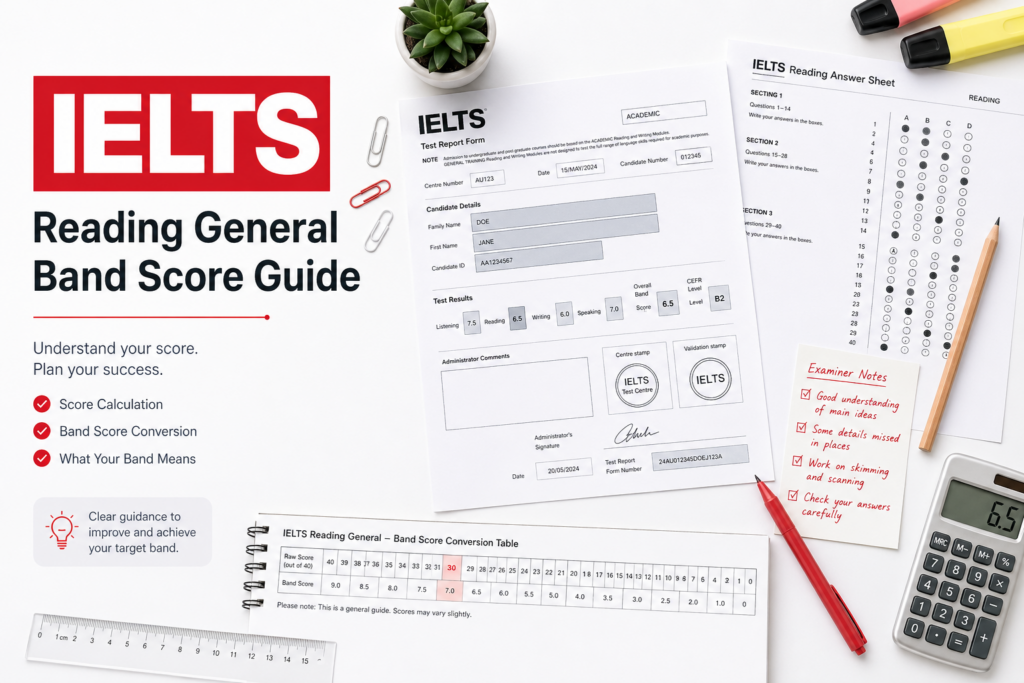
IELTS Reading General uses a raw score out of 40. Each correct answer gives you one mark. That raw score is then converted to a band score on the IELTS nine-band scale. In other words, examiners do not decide your Reading band impressionistically. They count how many answers you got right, then match that total to the score conversion table used for General Training Reading.
This matters because candidates often use vague language about doing well or badly in Reading. A much better approach is to think in marks. If you need Band 7, you should know the rough mark range that normally produces Band 7. If you need Band 8, you should know that target too. Clarity removes a lot of unnecessary anxiety.
The usual IELTS Reading General score conversion table
The exact conversion can shift slightly depending on the version of the test, but the usual General Training Reading guide looks like this:
- 39-40 correct: Band 9
- 37-38 correct: Band 8.5
- 36 correct: Band 8
- 34-35 correct: Band 7.5
- 31-33 correct: Band 7
- 27-30 correct: Band 6.5
- 23-26 correct: Band 6
- 19-22 correct: Band 5.5
- 15-18 correct: Band 5
This table is why one or two extra correct answers can matter so much. Near a band boundary, a small improvement in accuracy can lift the overall result. That is also why careless errors hurt. A missed instruction, a spelling slip, or a bad timing decision can push a candidate below the score they actually have the reading ability to reach.
Why General Reading band scores feel inconsistent in practice
Many candidates think their reading level is unstable when the real issue is performance inconsistency. On one day they score 33. On another day they drop to 28. That feels confusing, but it usually has a practical cause. Timing collapses in Section 3. Matching tasks consume too many minutes. A few answer-form mistakes turn correct ideas into lost marks.
General Training Reading often looks easier than Academic Reading at first glance, so candidates can become slightly lazy with process. They over-read easy early texts, then run out of time later. They trust familiar-looking words instead of checking exact meaning. They change answers without stronger evidence. Those are not mysterious problems. They are scoring leaks, and once you spot them, they become easier to fix.
If you want a fuller process for building speed and accuracy, the IELTS Reading practice guide is a useful next step because it connects scoring targets to daily method.
What score do you need for common IELTS goals?
Your target band depends on why you are taking IELTS. Some candidates need a safe migration score. Others need a course entry score or a work-related minimum. That is why the raw-score table matters so much. It lets you translate a broad target like Band 7 into a practical test-day goal such as 31 to 33 correct answers.
Here is a sensible way to think about it:
- If you need Band 6: aim higher than 23-26 in practice so you are not living on the edge
- If you need Band 7: try to build a stable practice range above 31, not just one lucky paper
- If you need Band 8: you need strong control, because the margin for avoidable errors becomes much smaller
Stable range matters more than one heroic result. If you score Band 7 once but usually sit at Band 6.5 level, you are not really ready yet. You want repeatable performance, not a single good afternoon.
How many marks should you aim for in practice tests?
A good rule is to aim slightly above your official requirement. If your application needs Band 7, do not build your whole plan around scraping exactly 31. Instead, try to make 33 or more your normal practice standard. That creates breathing room for nerves, harder passages, or an off day.
This is where realistic timed work helps. If your score changes too much from paper to paper, it helps to access unlimited IELTS mock tests and track not just the final mark, but where the mark changed. Did Section 1 stay strong while Section 3 dropped? Did matching headings damage your timing? Did wrong answers come from misunderstanding or from careless copying?
A practice score only becomes useful when it shows a pattern. Without that pattern, candidates often react emotionally to each result instead of improving the underlying method.
Where candidates usually lose the marks that change a band
Most Reading band drops do not come from one dramatic disaster. They come from a collection of smaller errors. A candidate might misread one instruction, spend too long on one difficult question, miss a paraphrase link, and rush the last passage. Suddenly three or four marks are gone. That can be the difference between Band 6.5 and Band 7.
The most common scoring leaks include:
- Ignoring word limits: the idea is right, but the answer form is wrong
- Over-reading early sections: easy texts quietly steal time from the harder final section
- Weak paraphrase recognition: the answer is present, but not in the exact words used in the question
- Answer changes without proof: nerves replace logic late in the paper
- Poor review habits: practice papers are completed, but mistakes are never diagnosed properly
If your wider Reading preparation still feels loose, the IELTS General Training migration guide gives useful context for how Reading fits into the full test plan.
How to move from one band to the next
Moving from Band 5.5 to Band 6 usually means reducing basic errors and finishing more of the paper cleanly. Moving from Band 6 to Band 7 usually demands better timing, stronger paraphrase awareness, and more disciplined question control. Moving from Band 7 to Band 8 is often about precision. At that level, you can already read reasonably well, but you cannot afford many careless losses.
That is why the improvement strategy should match the score gap. A Band 5 candidate does not need the same fix as a Band 7.5 candidate. One may need broader control of question types. The other may need sharper section timing and calmer decision-making under pressure. Generic advice often fails because it treats every candidate as though the same problem is holding them back.
A practical section-by-section target for stronger scores
General Training Reading usually becomes more demanding as the paper goes on, so your timing should reflect that. A sensible starting split is around 15 minutes for Section 1, 20 minutes for Section 2, and 25 minutes for Section 3. The point is not to follow those numbers like a robot. The point is to stop the early easy texts from eating time you need later.
Within that timing plan, think section by section:
- Section 1: collect straightforward marks efficiently
- Section 2: stay alert to paraphrase and practical workplace details
- Section 3: protect enough time for the longest and most demanding passage
Once candidates start managing the paper this way, their band scores often become much more stable. They stop relying on speed alone and begin using a repeatable system.
How to review your score properly after each practice test
After every test, do more than check the band. Go back through each wrong answer and label the cause. Was it timing, vocabulary, paraphrase, instruction error, or question-type confusion? Then find the proof line in the text. This is not glamorous work, but it is where real score gains usually begin.
It also helps to record your practice results over time. If you can see that you score 28, 29, 31, and 32 across four recent papers, that tells a more honest story than one isolated result. Patterns beat guesswork. If you want structured support rather than patching each weakness randomly, you can see our IELTS preparation plans and follow a clearer route to your target band.
Ready to find out your IELTS band score?
Take the IELTS Express Pre-Test for just $4.99 and get your personalised band prediction with a 14-day improvement plan.
FAQ: IELTS Reading General band score guide
How many correct answers do I need for Band 7 in IELTS Reading General?
In the usual General Training conversion range, Band 7 is normally around 31 to 33 correct answers out of 40. The exact conversion can vary slightly, but that is the standard target most candidates use.
Is IELTS Reading General easier to score highly in than Academic Reading?
General Training Reading often requires more correct answers for the same band than Academic Reading. That means it may feel more accessible in topic, but you still need strong accuracy to reach higher bands.
Why does my General Reading score keep changing?
Score changes usually come from timing, answer-form mistakes, and inconsistent control of question types rather than from a completely different reading level each day. Review patterns matter more than one-off results.
Can one or two mistakes really change my band?
Yes. Near a band boundary, one or two marks can make the difference between, for example, Band 6.5 and Band 7. That is why careless losses matter so much in Reading.
What is the best way to improve my IELTS Reading General band score?
The safest improvement usually comes from doing timed practice, reviewing every wrong answer honestly, and fixing recurring problems such as instruction errors, weak paraphrase recognition, and poor section timing.
Your next step if you want a safer Reading score
An IELTS Reading General band score guide is most useful when it changes how you practise. Know the score range you need, aim slightly above it, and track your marks honestly across several recent tests. That gives you a much clearer picture than hope, panic, or random extra papers.
Once you start treating Reading as a marks game rather than a mystery, the path usually gets simpler. You still need work, of course, but it becomes the right kind of work: targeted, measurable, and much easier to trust on test day.