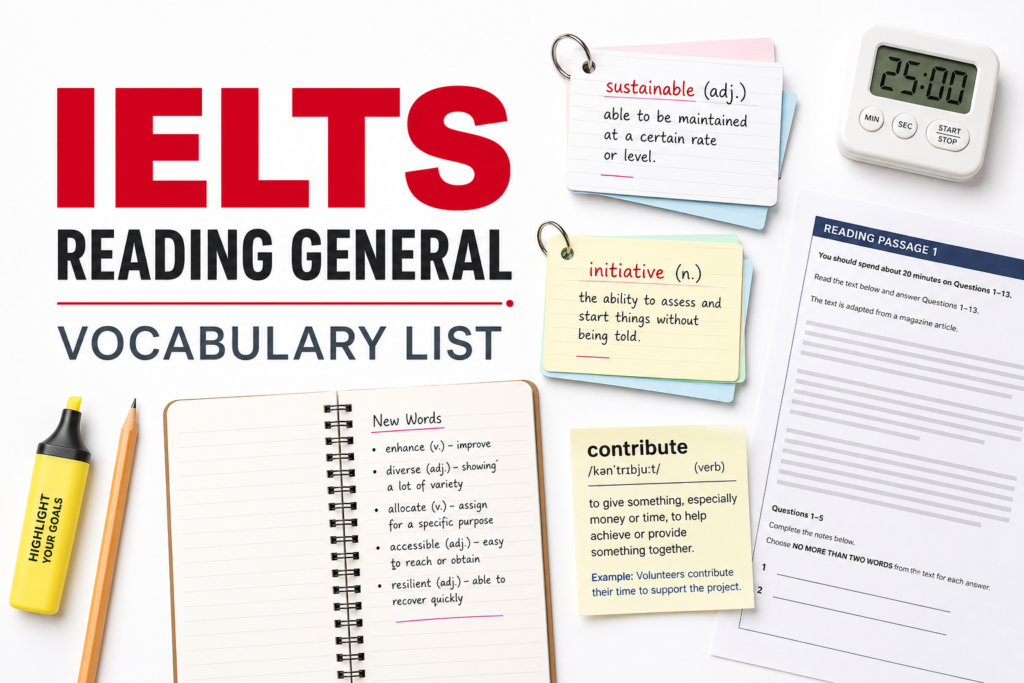
If you are building an IELTS Reading General vocabulary list, the goal is not memorising hundreds of random words and hoping the exam becomes easier. General Training Reading rewards practical language control. You need vocabulary that helps you understand notices, work instructions, advertisements, community information, and longer factual texts without freezing when the wording changes. Before you assume Reading is already safe, take the IELTS Express Pre-Test to check your current band score and see whether vocabulary is still quietly costing you marks.
A smarter vocabulary list focuses on the language that appears again and again in real IELTS General passages. That includes everyday verbs, workplace terms, service information, time expressions, warning language, and common paraphrases. Once you learn those patterns, the paper starts to feel less random and much easier to manage under time pressure.
Why vocabulary matters so much in General Training Reading
IELTS General Training Reading is not testing whether you know the most advanced English in the room. It is testing whether you can understand useful, functional English quickly and accurately. Many candidates lose marks not because the passage is impossible, but because one key word changes the meaning of a sentence and they miss it.
For example, a notice may use required, while the question uses must provide. A workplace text may say postponed, while the answer depends on understanding that something was delayed. These are not huge literary tricks. They are ordinary vocabulary shifts, but they matter a lot in a timed exam.
The types of words you should include in your vocabulary notebook
A useful IELTS Reading General vocabulary list should be organised by function, not just alphabet. That helps you remember how words behave in real texts. If you only collect isolated words, revision becomes slower and less practical. If you group them by meaning and task, you begin to notice patterns.
Good categories include:
- Instructions: complete, attach, submit, confirm, replace, collect
- Time and scheduling: prior to, by, within, postpone, permanent, temporary
- Money and services: fee, refund, discount, deposit, charges, payment due
- Workplace language: supervisor, duties, shift, applicant, vacancy, induction
- Rules and warnings: prohibited, restricted, permitted, compulsory, caution
This kind of grouping makes revision cleaner because you are learning small language systems rather than disconnected pieces.
Core everyday verbs that appear again and again
Verbs do a lot of heavy lifting in General Training Reading. A candidate may understand the topic but still miss the answer because the action word changes. That is why your vocabulary list should give special attention to practical verbs used in forms, notices, job adverts, and public information.
Some of the most useful verbs include:
- apply – to request formally for a job, service, or place
- book – to reserve a seat, class, room, or appointment
- cancel – to stop a booking or arrangement
- collect – to pick something up from a place
- deliver – to bring something to a destination
- enrol – to join a course or programme
- issue – to provide officially, such as a permit or document
- notify – to tell someone formally
- provide – to give what is needed
- replace – to put something new in place of something old
When you revise these verbs, learn common partners too. For instance, apply for a position, provide identification, issue a refund, and notify staff in advance. Collocations like these are often more useful than single-word memorisation.
Important nouns for notices, forms, and public information
General Training passages often include information-heavy nouns. These words appear in community notices, transport updates, service rules, workplace policies, and customer guidance. If they are unfamiliar, even simple texts can feel slower than they should.
Strong nouns to learn include application, appointment, deadline, evidence, identification, membership, permission, requirement, schedule, and vacancy. You should also learn the small differences between similar words. A deadline is the final time for action. A schedule is a planned timetable. A vacancy is an available job or room. Those details matter when two answer choices look similar.
If you want a broader strategy for handling the section itself, this guide to IELTS Reading General tips and strategies is a good companion because it connects vocabulary work with timing and question control.
Useful adjective pairs and opposites that change meaning fast
One underrated part of an IELTS Reading General vocabulary list is adjective control. Small adjective changes often decide whether a statement is correct, incorrect, or not given. They also appear in service conditions and workplace instructions where precision matters.
Useful pairs include:
- available / unavailable
- full-time / part-time
- temporary / permanent
- local / international
- mandatory / optional
- public / private
- suitable / unsuitable
These words look simple, but they create major meaning differences. If a text says a service is temporary and you remember it as permanent, the answer falls apart. If a job is part-time and the question assumes full-time work, that difference is the whole task.
Paraphrases you should train, not just memorise
Vocabulary study becomes much more powerful when you learn paraphrase pairs. IELTS rarely repeats the exact same wording from question to passage. Instead, it rewards candidates who can recognise the same idea in different language. That is why your notebook should include small equivalence groups.
- buy = purchase
- help = assist
- job = position = role
- needed = required = necessary
- free = no charge = complimentary
- delayed = postponed = put back
- closed = not in operation = unavailable
This is where many candidates save time on test day. Instead of reading a sentence three times, they recognise the paraphrase quickly and move on. If your timing still becomes messy under pressure, it helps to access unlimited IELTS mock tests and track which vocabulary shifts are slowing you down most.
Topic-based vocabulary that appears in General Training texts
General Training Reading often uses familiar real-life topics rather than purely academic ones. That means your vocabulary revision should include common text settings. You do not need to master every industry in detail, but you should be comfortable with the language that appears regularly.
Useful topic areas include:
- Employment: applicant, reference, interview, duties, roster, probation
- Housing: tenant, lease, deposit, inspection, maintenance, utilities
- Transport: route, platform, fare, departure, transfer, valid ticket
- Courses and training: enrolment, module, attendance, assessment, certificate
- Community services: registration, eligibility, support officer, opening hours
When you study by topic, collect one short example sentence for each word. That makes recall faster and helps you understand how the term functions inside a realistic text.
How to learn vocabulary without wasting study time
Many candidates build long word lists and barely remember any of them a week later. The problem is not effort. The problem is method. A better system is to collect fewer words, revise them repeatedly, and test them in context.
Here is a practical approach:
- Keep a small notebook or digital list divided by category
- Add the word, a plain English meaning, and one example sentence
- Include common paraphrases beside the word
- Review older words before adding too many new ones
- Use the words again when checking practice test mistakes
This method is less glamorous than chasing giant vocabulary lists, but it usually works better. You are training recognition, not just decoration. That is a much better deal for Reading.
How vocabulary helps with different IELTS question types
Vocabulary does not help only with understanding the passage. It also helps you interpret the question correctly. In matching tasks, you need to see the main idea in different wording. In true false not given tasks, you need to notice exact differences between claims. In completion tasks, you need both the right meaning and the right form.
For example, if the question says employees must inform management beforehand, you need to connect that with a passage saying staff should notify their supervisor in advance. That is a vocabulary task as much as a logic task. Candidates who train this kind of language link usually become more accurate without changing anything dramatic about their English level.
If you are not sure whether your overall study system is strong enough, you can also see our IELTS preparation plans and follow a more structured path rather than guessing which weakness matters most.
How to review new words after each practice test
The best vocabulary growth often happens after a practice test, not before it. Every time you get a Reading question wrong, ask whether a vocabulary gap played a role. Did you miss a paraphrase? Did one workplace term confuse you? Did a rule word such as compulsory or restricted change the answer?
Then add only the useful words to your list. This keeps your notebook relevant to the exam instead of turning it into a dictionary project. Over time, your list becomes sharper because it is built from real mistakes, not random word hunting.
Ready to find out your IELTS band score?
Take the IELTS Express Pre-Test for just $4.99 and get your personalised band prediction with a 14-day improvement plan.
FAQ: IELTS Reading General vocabulary list
What kind of words should I learn for IELTS Reading General?
Focus on practical words used in notices, work instructions, services, transport, housing, and community information. Everyday verbs, warning language, and common paraphrases are usually more useful than rare academic vocabulary.
Do I need advanced vocabulary to get a high score in General Training Reading?
No. You need accurate understanding of common functional English more than impressive rare words. Strong results usually come from better recognition of practical language and paraphrasing.
How many words should be in an IELTS Reading General vocabulary list?
There is no perfect number. A smaller list that you review properly is usually better than a huge list you barely remember. Start with the high-frequency words that appear in real exam-style texts and expand gradually.
How can I remember vocabulary more effectively?
Group words by topic or function, write a short meaning, add one example sentence, and revise the same items repeatedly. It also helps to collect paraphrase pairs rather than single isolated words.
Can vocabulary alone improve my IELTS Reading score?
Vocabulary helps a lot, but it works best with timing control and question strategy. The strongest improvement usually comes from combining better word recognition with smarter reading habits.
Your next step for a stronger Reading score
A strong IELTS Reading General vocabulary list is not about showing off complicated English. It is about understanding the words that decide meaning in real exam texts. Learn practical verbs, common nouns, rule language, adjective contrasts, and everyday paraphrases, then review them through real mistakes and realistic practice.
That approach is usually much more effective than trying to memorise endless random terms. Keep the list practical, keep the revision regular, and your Reading accuracy should start to look far more stable.