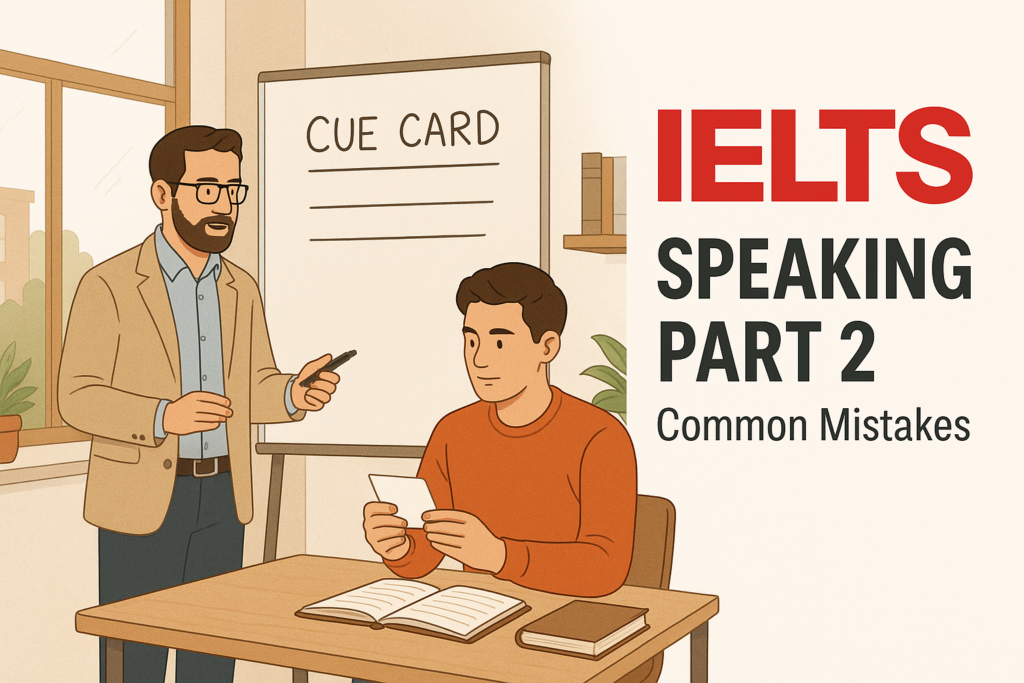
If you are searching for IELTS Speaking Part 2 common mistakes, there is a good chance you already know the problem is not always your English level. Many candidates understand the cue card, have enough ideas, and still lose marks because the answer becomes too short, too vague, too memorised, or too repetitive once the timer starts. Part 2 looks simple, but it exposes weak habits very quickly.
Before you keep guessing whether speaking is really the section lowering your score, take the IELTS Express Pre-Test to get a quick band prediction and see where your result is most at risk.
Why IELTS Speaking Part 2 common mistakes matter so much
In IELTS Speaking Part 2, you get one minute to prepare and up to two minutes to speak. That sounds manageable, but the task tests several things at once. The examiner is listening for fluency and coherence, vocabulary, grammar control, and pronunciation. If your answer breaks down in the first minute, every one of those scoring areas can suffer.
This is why small mistakes become expensive. A candidate may know the topic well, but poor planning can lead to long pauses. Another candidate may have strong vocabulary, but memorised phrases make the answer sound unnatural. A third candidate may speak confidently at first, then repeat the same point because there is no real structure underneath. None of these problems are unusual, but they can keep a score stuck below the target.
The good news is that most IELTS Speaking Part 2 common mistakes are fixable. They are usually habit problems, not intelligence problems. Once you can spot them clearly, you can train a better response.
Mistake 1, answering for less than one minute
This is one of the most common Part 2 problems. A candidate gives the basic answer, covers the bullet points quickly, and then stops after 40 or 50 seconds. That creates an obvious fluency problem because the response never really develops. It also limits your grammar and vocabulary range because you have not stayed with the topic long enough to show much variety.
Short answers usually happen for one of three reasons. First, the candidate chooses an example that is too small. Second, they treat the cue card like a checklist instead of a speaking task. Third, they have no clear plan for how to extend an idea once the first few sentences are finished.
A safer method is to build every answer in four parts:
- Topic: say clearly what person, place, object, or event you chose.
- Background: explain when, where, or how it happened.
- Development: add specific details, examples, or actions.
- Reflection: explain why it mattered or what you learned.
That simple shape gives you room to speak for close to two minutes without sounding forced. If you want to test whether your answers are really long enough under pressure, access unlimited IELTS mock tests and record several cue-card attempts back to back.
Mistake 2, memorising full answers
Many candidates think memorisation is the safest way to prepare. It feels efficient because you can rehearse polished lines and repeat them until they sound smooth. The trouble is that IELTS examiners hear memorised speech all the time. When an answer sounds too fixed, too formal, or only partly connected to the cue card, it can hurt rather than help.
Memorised answers also create pressure. If you forget one line, the next line often disappears too. Then the speaker panics, restarts, or forces a prepared phrase into the wrong topic. That is not fluent speaking. It is script recovery.
A better approach is to prepare flexible building blocks instead of full scripts. You can practise:
- natural opening lines
- simple linking phrases
- ways to give an example
- ways to explain why something mattered
That gives you support without trapping you. In a real test, flexibility is worth more than polished memorisation.
Mistake 3, wasting the one-minute preparation time
The one-minute planning stage is where many answers quietly go wrong. Weak candidates spend too long deciding what story to choose. Others try to write full sentences. By the time the examiner tells them to start speaking, they have notes, but no useful route through the answer.
You do not need a script in that minute. You need a map. Write a few fast prompts only:
- Main choice: what you will talk about
- Context: when or where it happened
- Two details: one or two things that stand out
- Why it matters: one clear feeling, lesson, or result
This works because short prompts keep your answer organised while still letting you sound natural. It also reduces the chance of freezing halfway through. Good planning is not about writing more. It is about deciding faster.
If you are not sure what the whole speaking test expects around this section, the IELTS Speaking Test complete guide is useful because it shows how Part 2 fits into the wider scoring picture.
Mistake 4, staying too general
Another major problem is vague language. Candidates say a place was beautiful, a person was kind, or an experience was interesting, but they do not show what that actually means. The examiner hears opinion, but not enough content. That makes the answer feel thin.
Specific detail is what gives a Part 2 answer life. If you describe a helpful teacher, mention one moment when that teacher helped you. If you talk about a memorable place, describe something you saw, heard, or did there. If you speak about a useful skill, explain when you learned it and where you still use it now.
A good self-check is simple. After every main point, ask yourself one follow-up question:
- What happened exactly?
- Why did that matter?
- What changed because of it?
- How did I feel at the time?
These questions help you move from general statements to real development. That usually makes fluency easier as well, because concrete ideas are easier to speak about than abstract ones.
Mistake 5, repeating the same idea in different words
Some candidates do manage to keep speaking for two minutes, but the answer still feels weak because it keeps circling around the same point. This often happens when the speaker notices time is still left and tries to fill the gap by rephrasing earlier sentences.
Repetition usually signals that the answer has run out of direction. The fix is not to talk faster. The fix is to extend each idea in a different way. One useful pattern is to move through description, example, reason, and result. For example, if you are describing an important event, you can explain what happened, give one specific moment, say why it mattered, and then describe what happened afterwards. That is real development, not repetition.
Try thinking of extension as forward movement. Each new sentence should add something. It can add a detail, a comparison, a feeling, or a consequence. If it adds nothing new, cut it.
Mistake 6, chasing difficult vocabulary instead of clarity
This mistake catches many serious candidates. They want a high band score, so they try to sound advanced in every sentence. The result is often hesitation, awkward word choice, or grammar that collapses under pressure. In speaking, ambitious language is useful only when you can control it naturally.
Simple language is not the enemy of a good score. Clear language is usually safer than forced language. A candidate who says, “I felt nervous because I had never spoken in front of so many people before,” will often sound better than a candidate who tries to force in a rare expression and then stops mid-sentence.
Useful vocabulary growth in Part 2 comes from precision, not performance. Replace weak words like good, nice, or bad with more exact choices such as stressful, relaxed, crowded, supportive, or practical. That is enough to improve range without damaging fluency.
If you need structured support rather than random internet tips, see our IELTS preparation plans and choose the level of guidance that matches your timeline.
Mistake 7, sounding too formal or unnatural
Part 2 is still a speaking task. It should sound organised, but it should not sound like a written report. Some candidates use openings and transitions that feel stiff because they learned them from model essays or old coaching notes. That can make the answer less believable.
Natural spoken English is usually lighter. Expressions like “I want to talk about…”, “what I remember most is…”, and “the reason this stayed with me is…” are simple, but effective. They give structure without sounding robotic.
A practical test is to read your answer aloud. If a sentence feels unnatural in your mouth, it will probably sound unnatural to the examiner as well. Keep what sounds clear and human. Remove what sounds performed.
How to fix these mistakes before test day
The fastest improvement usually comes from short review loops, not endless new advice. Record yourself answering three cue cards. Listen back once for timing, once for repetition, and once for vague language. Then answer the same cards again with cleaner planning and better detail.
A simple practice routine looks like this:
- Day 1: record three Part 2 answers without stopping.
- Day 2: mark where you paused too long, repeated yourself, or became too general.
- Day 3: redo the same cards using a four-part structure.
- Day 4: focus only on stronger examples and clearer detail.
- Day 5: do one full speaking test so Part 2 connects naturally to Parts 1 and 3.
- Day 6: practise two unfamiliar cue cards to test flexibility.
- Day 7: review your latest recording and compare it honestly with the first one.
This kind of practice is not glamorous, but it works. It turns invisible habits into visible ones. Once you can hear the problem, you can usually fix it much faster.
Ready to find out your IELTS band score?
Take the IELTS Express Pre-Test for just $4.99 and get your personalised band prediction with a 14-day improvement plan.
Frequently Asked Questions
What is the most common mistake in IELTS Speaking Part 2?
The most common problem is finishing too early. Many candidates answer the cue card points, but do not develop the ideas enough to keep speaking for close to two minutes.
Are memorised answers bad for IELTS Speaking Part 2?
They are risky. Examiners can usually hear when an answer sounds learned rather than natural. It is safer to prepare a structure, useful phrases, and flexible examples instead of full scripts.
How can I stop repeating myself in Part 2?
Use a development pattern such as description, example, reason, and result. That helps each sentence add something new instead of circling around the same point.
How should I use the one-minute planning time?
Write only short prompts, not full sentences. Choose the topic, note the context, add two useful details, and decide why the topic matters to you.
Can simple vocabulary still get a good speaking score?
Yes. Clear, controlled language is better than difficult vocabulary that causes hesitation or awkward grammar. Precision matters more than showing off.