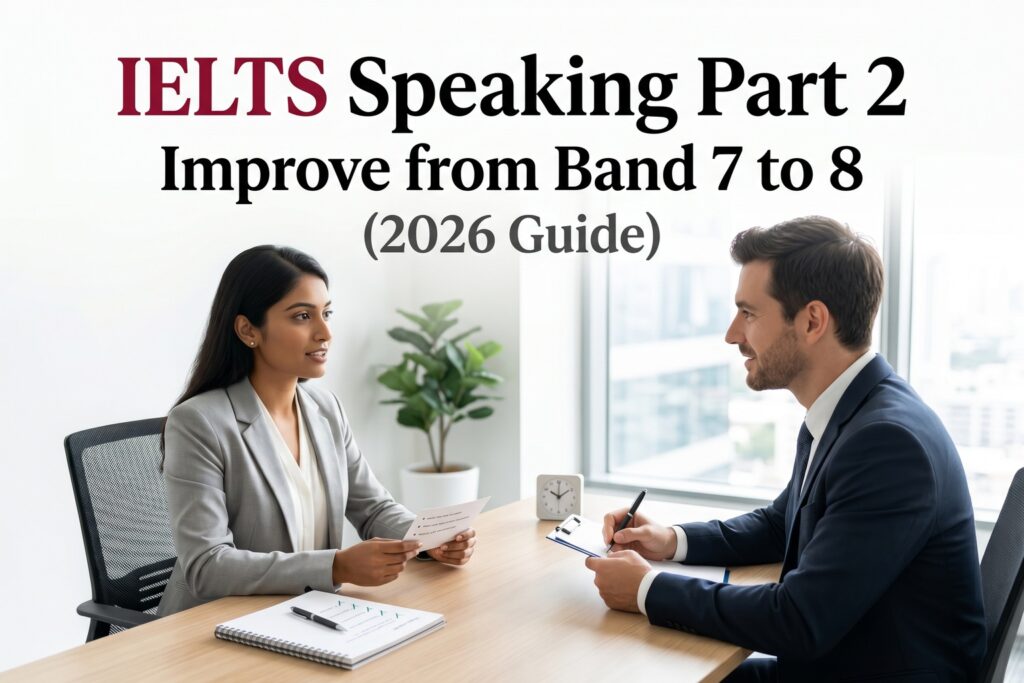
If you are searching for how to improve IELTS Speaking Part 2 from band 7 to 8, you are probably already doing many things reasonably well. You can usually speak for two minutes, your ideas are mostly relevant, and your grammar is often accurate enough to avoid serious damage. The problem is that band 8 needs more than being good enough. It needs stronger control, better precision, and a more natural speaking rhythm under pressure.
Before you keep guessing whether Speaking is really the section stopping your overall result, take the IELTS Express Pre-Test to get a quick band prediction and see how close you are to your target.
What changes between band 7 and band 8 in Part 2
The jump from band 7 to band 8 in IELTS Speaking Part 2 is usually not about learning a huge amount of new vocabulary. It is more about tightening what you already do. At band 7, many candidates can organise an answer clearly and speak at a reasonable length, but small issues still appear. There may be occasional hesitation, some repetition, slightly awkward phrasing, or a few moments where the answer sounds prepared rather than genuinely spoken.
At band 8, the long turn usually feels easier to listen to. The speaker develops ideas without forcing them. Linking is smoother. Vocabulary sounds accurate rather than decorative. Grammar remains flexible even when the speaker changes direction. Most importantly, the answer feels like real communication, not a memorised performance.
If you want the wider scoring context, it helps to compare your long-turn answers against the public band descriptors and listen for patterns in your own recordings rather than judging yourself only by instinct.
Why strong band 7 candidates often stay stuck
Many candidates plateau at band 7 because they keep polishing the wrong things. They memorise more topic vocabulary, collect more model answers, and try to sound more advanced. That often creates the opposite effect. The answer becomes heavier, less flexible, and slightly unnatural.
Another common reason is that the candidate has one stable answer pattern and uses it for every cue card. That pattern may be good enough to protect a band 7, but it can also make the delivery feel predictable. The examiner starts hearing the same language blocks again and again. A band 8 answer usually sounds more responsive to the exact cue card in front of you.
There is also an accuracy problem that many strong candidates underestimate. Their grammar is generally good, but under time pressure they still make small slips with articles, tense control, prepositions, or word choice. One or two slips are fine. A repeated pattern of small slips keeps the score from moving higher.
How IELTS Speaking Part 2 improve from band 7 to 8 starts with better planning
If your goal is IELTS Speaking Part 2 improve from band 7 to 8, the first place to look is your one-minute preparation stage. Band 7 candidates often use that minute to list content. Band 8 candidates usually use it to create shape. That difference matters.
A strong plan for Part 2 should give you four things:
- a clear topic choice that you can talk about naturally
- a simple timeline so the answer moves forward
- two specific details that make the story feel real
- a reason the topic matters so the ending has depth
For example, if the cue card asks you to describe a person who gave you useful advice, weak notes might look like a rough sentence list. Stronger notes would look more like this: person, situation, advice, result, why remember. That kind of plan helps you sound organised without trapping you in memorised language.
If your speaking practice still feels too random, access unlimited IELTS mock tests so you can test your planning method across several cue cards in one sitting rather than judging yourself from a single answer.
Fluency at band 8 means controlled movement, not faster speech
One of the biggest misunderstandings in speaking preparation is the idea that higher bands sound faster. They usually do not. In fact, candidates pushing for band 8 often hurt themselves by rushing. Fast delivery can hide thought for a few seconds, but it usually creates more repetition, weaker pronunciation, and poorer grammar control.
Band 8 fluency in Part 2 usually sounds calm and well-paced. The speaker can pause briefly, then continue without sounding lost. Sentences vary naturally in length. Ideas connect without overusing simple linkers like and, so, and because. The answer keeps moving, but it does not run.
If this is your weak point, practise slowing the answer slightly and adding clearer follow-up detail. Instead of saying a place was interesting, explain what made it interesting. Instead of saying a person helped you, explain what they did and what changed afterwards. That extra precision often improves fluency because it gives the answer somewhere real to go.
Vocabulary improvement from band 7 to 8 is about precision and flexibility
Many band 7 candidates already know plenty of vocabulary. The issue is not quantity. The issue is fit. They sometimes choose words that are technically correct but slightly stiff, too formal, or not quite natural for spoken English. Band 8 vocabulary usually feels more accurate to the moment.
That means you should focus on three practical upgrades:
- choose exact words instead of broad words like nice, good, bad, interesting
- use topic language naturally without forcing rare expressions
- paraphrase smoothly when you need to repeat an idea
For example, instead of saying an experience was good, you might say it was reassuring, demanding, eye-opening, or unexpectedly useful. Instead of repeating that a person was kind, you could say they were patient, supportive, or thoughtful, depending on the story. Those changes sound small, but they make the response feel more mature.
You do not need to sound academic in Part 2. You need to sound natural, flexible, and accurate. Examiners usually notice that much more quickly than they notice one unusual word.
Grammar at band 8 needs range that still sounds natural
To improve IELTS Speaking Part 2 from band 7 to 8, grammar needs to stay stable while your answer develops. At band 7, many candidates can use a mix of structures, but the range becomes narrower when they feel nervous. They fall back on simple past tense, short sentence patterns, and repeated clause shapes.
Band 8 answers usually show a wider mix without sounding forced. You might hear:
- past narration when the event happened
- present explanation for why it still matters now
- relative clauses to add detail naturally
- conditionals or comparisons when reflecting on the experience
The goal is not to show off grammar. The goal is to let your answer breathe. If every sentence starts the same way, the answer feels flatter. If you can move between structures with control, the answer sounds more capable.
A useful practice habit is to review recordings and check whether your sentence openings are too repetitive. If five sentences start with I plus a basic verb, your grammar may be accurate but limited in effect. Small changes in structure can lift the answer noticeably.
How to add depth without sounding memorised
This is where many band 7 candidates either improve sharply or get stuck. They know they need more development, so they add extra sentences. Unfortunately, those extra sentences often sound generic. You hear lines like, “It was a very memorable experience in my life” or “I learned many valuable lessons from it”. Those lines are not wrong, but they are vague and interchangeable.
Band 8 development usually feels more specific. Instead of saying an event was memorable, explain the one moment that stayed with you. Instead of saying a person influenced you, explain how your behaviour changed after that conversation. Specificity makes the answer more convincing and more natural at the same time.
A simple way to deepen any Part 2 answer is to add one of these:
- a concrete example from the event or situation
- a contrast between before and after
- a personal reaction that explains why the topic mattered
- a result that shows the longer effect
This helps you avoid the trap of memorised “high-band” language. Real detail is usually stronger than impressive-sounding filler.
Common habits that stop band 8 in Speaking Part 2
Some problems appear again and again among strong candidates. The first is over-rehearsal. If you have practised one answer too many times, the rhythm starts to sound fixed. The examiner can hear that you are delivering language blocks rather than building an answer in real time.
The second is over-linking. Candidates chasing a higher score often stuff the answer with connectors like moreover, furthermore, and on the other hand. In spoken English, that can sound unnatural very quickly. You only need linking that fits naturally.
The third is perfection pressure. Because band 7 candidates are already relatively strong, they often become too aware of mistakes. One small slip happens, then attention shifts away from the message and onto self-monitoring. That usually harms fluency more than the original slip.
The fourth is weak endings. The answer starts well but fades out. A band 8 long turn often ends with a clear reflective point, not a flat final sentence. You want the answer to land, not just stop.
A practical practice routine to move from band 7 to 8
You do not need endless speaking hours to improve. You need focused repetition with feedback. A practical weekly cycle looks like this:
- choose three cue cards from different topic families
- give yourself one minute to plan and record the full two-minute answer
- listen back once for fluency and mark hesitation, repetition, and rushed sections
- listen back again for language and mark awkward vocabulary or grammar patterns
- redo the same cue card with better shape, not a memorised script
This works because it builds control, not just familiarity. If you are serious about the jump, your practice must include review. Repeating new cue cards every day without analysing anything often keeps you at the same level.
If you want more guided support with scoring and feedback, see our IELTS preparation plans and choose the level that matches your timeline and target band.
What a band 8 mindset sounds like on test day
On test day, the strongest candidates are not usually the ones trying hardest to sound advanced. They are the ones who trust a simple method. They choose an answer they can genuinely develop. They use the planning minute to create structure. They speak with calm control, recover naturally from small pauses, and keep adding relevant detail.
If you are already around band 7, you do not need a completely new personality in the exam room. You need a cleaner version of your current speaking. More precision. Better flexibility. Less filler. Less panic. More confidence in letting the answer unfold naturally.
That is why the move from band 7 to 8 is realistic. It is demanding, but it is not mysterious. In most cases, it comes from fixing repeated small habits rather than discovering one magic strategy.
Ready to find out your IELTS band score?
Take the IELTS Express Pre-Test for just $4.99 and get your personalised band prediction with a 14-day improvement plan.
Frequently Asked Questions
How hard is it to improve IELTS Speaking Part 2 from band 7 to 8?
It is challenging, but it is usually more about control than major new knowledge. Most candidates at band 7 already have enough English to improve. The real work is reducing hesitation, improving precision, and developing answers more naturally.
Do I need very advanced vocabulary to reach band 8 in Part 2?
No. You need vocabulary that is accurate, natural, and flexible. Precise spoken English is much more useful than rare words that sound forced or unnatural.
Should I memorise high-band model answers?
No. Memorising full answers often makes your delivery sound fixed. It is much safer to memorise a planning structure and a few flexible phrases that help you develop ideas in real time.
What is the biggest difference between band 7 and band 8 fluency?
Band 8 fluency usually sounds more controlled and natural. The speaker can pause briefly, continue smoothly, and develop ideas without too much repetition or rushed delivery.
How can I practise IELTS Speaking Part 2 improve from band 7 to 8 at home?
Use timed recordings, review them carefully, and repeat the same cue cards with better structure. Home practice works well when you focus on clear weaknesses such as weak endings, repetition, or awkward vocabulary choices.
Your next step for a band 8 Part 2 answer
If you want to improve IELTS Speaking Part 2 from band 7 to 8, start by tightening your method rather than chasing flashy language. Build better one-minute plans, speak at a steadier pace, and replace vague ideas with specific detail. Those are the upgrades that usually move strong candidates higher.
The smartest next step is to measure where you are now, then practise with cold honesty. If you can hear your real patterns, you can fix them. If you want that clearer starting point, begin with the pre-test and use the result to target the exact habits that are still holding your speaking score back.