If you are searching for an IELTS Speaking Part 2 Work And Career cue card sample, you probably want more than one model answer to memorise. You need to see how a strong response is built, how it stays natural for two minutes, and how to adapt the same method to similar speaking topics on test day. Work and career cue cards appear often because they are broad enough for almost every candidate, but they still expose weak structure very quickly.
Before you spend more time guessing whether speaking is the skill lowering your result, take the IELTS Express Pre-Test to get a quick band prediction and see where your score is really under pressure.
What this cue card is usually asking you to do
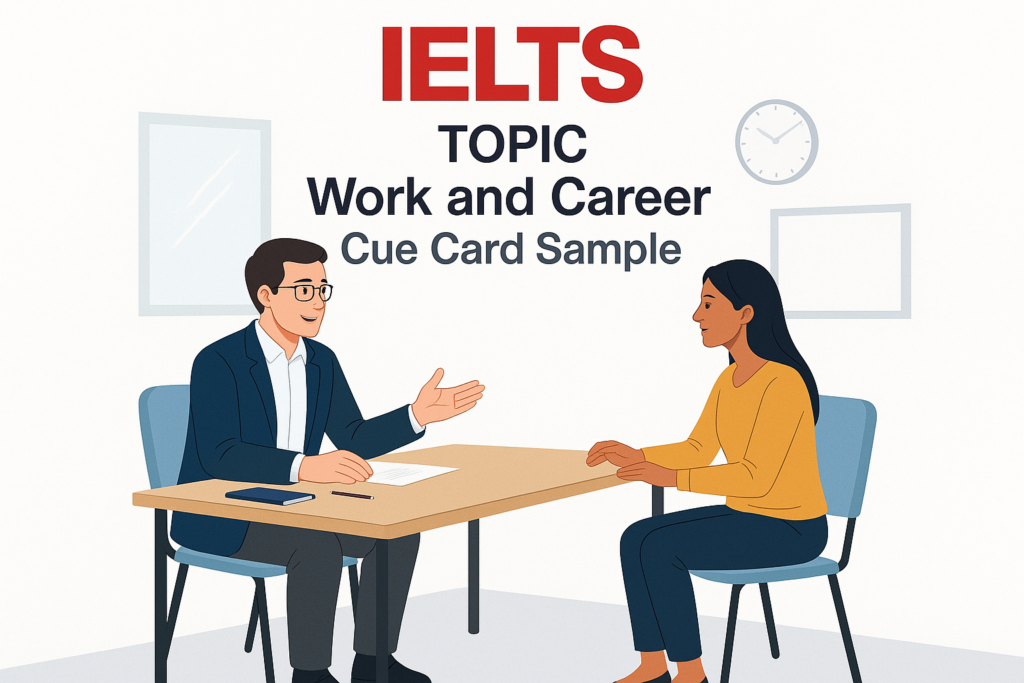
In IELTS Speaking Part 2, you receive a topic card, one minute to prepare, and up to two minutes to speak. A work and career topic may ask you to describe a job you would like to do, a person with an interesting career, a time you worked hard, or a career choice you admire. The wording changes, but the skill is the same. You need to choose one clear example, organise it fast, and develop it naturally.
This is where many candidates struggle. They know the general topic, but they choose an example that is too wide. Then the answer becomes vague. Instead of telling one small, clear story, they start talking about their whole career history, every job they have ever considered, or broad opinions about working life. That usually hurts fluency and coherence.
A safer approach is simple. Choose one person, one job, one experience, or one career goal. Build the answer around that single example. Depth is more useful than breadth in Part 2.
IELTS Speaking Part 2 Work And Career cue card sample question
Here is a realistic version of the task:
- Describe a job or career you would like to have in the future.
- You should say:
- what the job is
- how you became interested in it
- what skills or qualities are needed for this career
- and explain why you would like to do this job
This kind of question works well because it gives you a clear topic and four prompts, but it still leaves space for personal detail. The prompts are guides, not separate short answers. Your real goal is to turn them into one connected response.
How to plan your one-minute notes
Do not use the preparation minute to write full sentences. That almost always wastes time. Instead, write short prompts that give your answer a route to follow. For this topic, a quick note plan could look like this:
- Job: project manager in a technology company
- Interest: watched cousin manage digital projects
- Skills: organisation, communication, problem solving
- Why: variety, teamwork, growth, useful role
Those notes are enough. They help you remember the order of your answer without pushing you into memorised language. If you want to practise this under timed pressure, access unlimited IELTS mock tests and record several cue-card responses back to back.
A strong sample answer you can learn from
I would like to talk about a career I would genuinely like to have in the future, and that is becoming a project manager in a technology company. I am interested in this kind of work because it combines organisation, communication, and problem solving, which are all skills I enjoy using.
I first became interested in this career because one of my cousins works in a digital company and manages several projects at the same time. A few years ago, I spoke to her about what her daily routine looked like, and I was surprised that the job was not only about giving instructions. She explained that a large part of her role was making sure everyone understood the goal of the project, deadlines were realistic, and problems were solved before they became serious. That sounded challenging, but also very meaningful.
As far as I can see, this career requires a mix of technical awareness and people skills. A project manager needs to stay organised, communicate clearly, and remain calm when unexpected issues come up. I also think patience is important because not every team member works in the same way, so you need to keep people moving in the same direction without creating unnecessary pressure.
The main reason I would like to do this job is that it seems varied and practical. I do not think I would enjoy a role where I repeat exactly the same task every day. In contrast, project management looks more dynamic because you have to plan, coordinate, and adapt constantly. I also like the idea of doing work that helps a team produce something useful rather than only focusing on one small individual task. Overall, it is a career that feels demanding in a good way, and I think it would suit my personality quite well.
This sample works because it stays specific. It gives one career choice, one reason for the interest, several useful skills, and a clear explanation of why the job is attractive. It also sounds like real spoken English, not a memorised script.
Why this sample answer scores better than a generic one
Many weak answers to work and career topics sound too general. A candidate says they want to be successful, earn good money, and have a stable future. Those ideas are not wrong, but they are too broad on their own. The examiner needs clearer development than that.
The sample above is stronger for four reasons:
- it chooses one realistic job instead of talking about many careers
- it explains how the interest started through a real person and situation
- it gives specific skills such as organisation and communication
- it ends with reflection, not only description
That structure helps fluency because each sentence has somewhere to go. If you want a wider picture of how the long turn is assessed, the IELTS Speaking Part 2 and Part 3 framework is helpful because it shows how good development supports the examiner’s overall impression.
Useful language for work and career topics
You do not need very advanced vocabulary to answer this cue card well. In fact, simple and controlled language is usually better than ambitious language that causes hesitation. What matters is choosing words that sound clear and relevant.
- for interest: I became interested in it when…, what attracted me was…, I started thinking about it after…
- for skills: it requires strong communication skills, you need to stay organised, it involves solving problems quickly
- for reasons: it suits my personality, it offers variety, it seems rewarding, it gives me a sense of purpose
- for reflection: what I like most is…, the main reason is…, overall, I think it would be a good fit for me
These phrases help you sound natural because they are flexible. You can use them in many different work-related cue cards without sounding rehearsed. If your wider speaking foundation still feels shaky, see our IELTS preparation plans and choose the level of support that matches your deadline.
Common mistakes in a work and career cue card
The first common mistake is choosing an example that is too big. If you say you want a successful international career in business, that may sound ambitious, but it is difficult to explain clearly in two minutes. It is much easier to describe one role, such as accountant, nurse, architect, or project manager, and then explain why it interests you.
The second mistake is turning the answer into a list of job benefits. Candidates often say the job is respected, well paid, and interesting, but they do not explain anything in depth. The third mistake is using memorised expressions that sound formal or unnatural, especially at the start of the answer. A natural opening is usually stronger than a polished but stiff one.
Another problem is forgetting the personal element. Part 2 answers usually become stronger when you connect the topic to a real experience, person, memory, or future goal. The examiner is listening for a clear, developed response, not a textbook definition of career success.
How to adapt this sample to similar cue cards
One good Part 2 sample should not stay locked to one exact question. You should learn how to adapt the same method to related topics. For example, this same structure can work if the card asks you to describe:
- a person with an interesting job
- a career you admired when you were younger
- a job that is useful to society
- a time when you thought seriously about your future career
The structure stays almost the same. Start with the topic, explain the background, develop one or two useful details, and finish with why it matters. That is much safer than memorising one answer word for word. For a broader overview of speaking test expectations, you can also read the IELTS Speaking Test complete guide after you finish practising this cue-card type.
A simple practice method before test day
If you want this sample to actually help your band score, do not just read it once and move on. Use it as a model for practice. First, speak through the sample in your own words. Then change the job and keep the structure. Finally, try a new work-related topic with only one minute of planning.
A practical routine could look like this:
- Round 1: read the sample and underline the parts that introduce, develop, and reflect
- Round 2: record yourself answering the same cue card with a different job
- Round 3: listen again and check for pauses, repetition, or vague language
- Round 4: answer a related cue card without looking at your previous notes
This is the kind of practice that builds flexibility. On test day, flexibility matters more than memorisation because the cue card may be familiar in theme but different in wording.
Ready to find out your IELTS band score?
Take the IELTS Express Pre-Test for just $4.99 and get your personalised band prediction with a 14-day improvement plan.
Frequently Asked Questions
How long should my answer be for a work and career cue card?
You should aim to keep speaking until the examiner stops you, which is usually close to two minutes. The easiest way to do that is to choose one clear example and develop it with background, skills, and personal reasons.
Do I need advanced vocabulary for an IELTS Speaking Part 2 Work And Career cue card sample?
No. Clear and natural language is more important than difficult vocabulary. Specific detail and steady fluency usually help more than impressive words that you cannot control well.
Can I use a future dream job if I do not have work experience?
Yes. You do not need real work experience to answer this topic well. You can talk about a future career goal, explain how you became interested in it, and describe why it suits your strengths and interests.
What is the biggest mistake in work and career cue cards?
The biggest mistake is being too general. If you talk about success, money, and your future in a vague way, the answer becomes thin. Choose one job and build the answer around one believable example.
Should I memorise this sample answer?
No. Learn the structure, not the exact wording. A memorised answer can sound unnatural. A flexible structure helps you respond to the real cue card with more confidence.
Your next step with this cue card type
A good IELTS Speaking Part 2 Work And Career cue card sample should make the task feel clearer, not more complicated. Keep your example narrow, use simple notes, and make sure each part of the answer moves forward. That is what turns a familiar topic into a stronger score opportunity.
If you want a realistic picture of your current level before test day, start with the pre-test, then practise three work-related cue cards using the same structure. That will tell you much more than reading ten more sample answers without speaking.