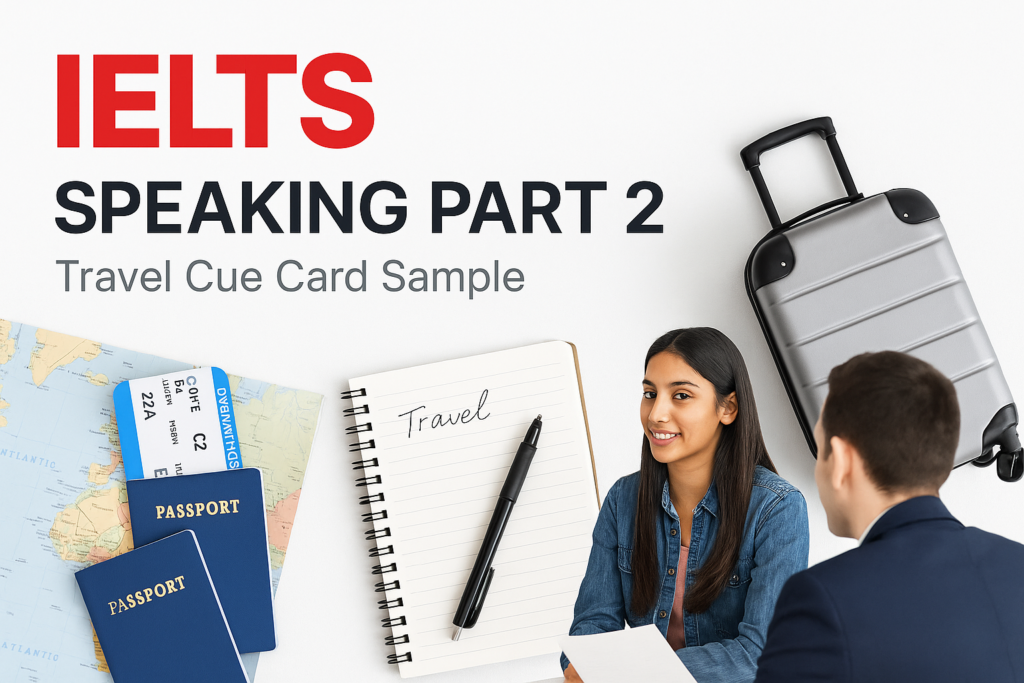
If you are searching for an IELTS Speaking Part 2 Travel cue card sample, you probably want more than one memorised answer. You want to know what a strong two-minute response actually sounds like, how much detail is enough, and how to keep going without drifting halfway through. Travel topics are common in IELTS because they let the examiner hear description, sequence, feeling, and reflection all in one answer. The problem is that many candidates make the same mistake, they tell a flat story and run out of substance too early.
Before you keep guessing whether Speaking is really the section holding down your score, take the IELTS Express Pre-Test to get a quick band prediction and see where your current speaking level becomes unstable.
What this cue card topic is really testing
A travel cue card may look simple, but it tests several skills at once. You need to organise a short story, choose relevant detail, use past tense accurately, and explain why the trip mattered. It also gives the examiner a clear way to judge fluency. If your answer jumps around, repeats itself, or stays too general, that weakness becomes obvious quite quickly.
Most travel cue cards ask you to describe a trip, a place you visited, a journey you enjoyed, or a travel experience you remember well. The exact wording changes, but the logic stays similar. You need one clear example, enough detail to make it real, and a final reflection that shows why the story is worth telling.
Why travel cue cards cause trouble
Travel feels like an easy topic because almost everyone has taken some kind of trip. But that is exactly why answers often become dull. Candidates say where they went, who they went with, and that the trip was “very enjoyable” or “very memorable”, then they start repeating the same idea in different words. The answer sounds smooth for thirty seconds and then falls apart.
The second problem is scale. Some candidates choose a huge topic such as a month-long overseas holiday, then try to describe every part of it. That creates a messy answer with no centre. A much better move is to focus on one clear travel experience, such as a weekend trip, one day of a longer holiday, or the most memorable moment of the journey.
If you want the wider structure behind high-scoring long turns, the IELTS Speaking Part 2 tips and strategies guide is a useful companion because it explains how to plan and extend answers under pressure.
IELTS Speaking Part 2 Travel cue card sample question
A common prompt could look like this:
- Describe a trip you enjoyed.
- You should say:
- where you went
- who you went with
- what you did there
- and explain why you enjoyed the trip
This is a typical IELTS Speaking Part 2 Travel cue card sample because it gives a clear personal topic but still requires enough structure to fill two minutes naturally. The bullet points are there to guide you, not trap you. You do not need to answer them one by one in a robotic way. They are just the spine of the response.
A band-friendly sample answer
I would like to talk about a short trip I took to the Blue Mountains with two close friends about a year ago. We had all been working long hours at the time, so we decided to leave Sydney early on a Saturday morning and spend the weekend somewhere quieter. It was not a very expensive trip or a grand holiday, but I still remember it clearly because it gave me a real break from routine.
When we arrived, the first thing I noticed was how different the atmosphere felt compared with the city. The air was cooler, the streets were calmer, and everything seemed to move at a slower pace. On the first day, we visited a few lookout points, walked along one of the easier hiking tracks, and spent a lot of time just taking photos and talking. I am not usually the kind of person who enjoys long walks, but that day I actually liked having no pressure and no fixed schedule.
One part of the trip that stayed with me was a late afternoon stop at a small cafe near the mountains. We sat outside, had coffee, and watched the light change over the valley. It sounds quite ordinary now, but at the time it felt like exactly what I needed. I had been feeling tired and mentally crowded by work, and that quiet moment made me realise how rarely I stopped properly.
I enjoyed the trip mainly because it was simple. We did not try to do too much, and there was no complicated plan. I could relax, talk to people I trust, and enjoy the scenery without thinking about deadlines. In a way, the trip reminded me that travel does not always have to be international or luxurious to be meaningful. Sometimes a short journey close to home can help you reset much more than a bigger holiday.
Why this sample works
This answer works because it does a few basic things well. First, it chooses one specific trip instead of trying to summarise years of travel. Second, it moves in a clear order, background, activities, one memorable moment, and final reflection. Third, it includes enough concrete detail to sound real without drowning the listener in unnecessary facts.
Notice that the language is not especially difficult. That is fine. IELTS does not reward fancy vocabulary by itself. It rewards clear communication with enough range and control. A natural answer with specific detail usually scores better than a dramatic answer filled with memorised phrases.
If you want to hear how your own long turns hold up in realistic conditions rather than in your head, access unlimited IELTS mock tests and record several Part 2 answers back to back. That usually shows your real habits very quickly.
How to build your own answer instead of memorising one
The safest way to use an IELTS Speaking Part 2 Travel cue card sample is to copy the structure, not the wording. If you memorise a full script, your answer will often sound stiff and fragile. The moment the question changes slightly, the prepared version stops fitting and you start forcing it.
A simple planning pattern works much better:
- Place: where did you go?
- People: who were you with?
- Main activities: what happened there?
- Best moment: what part stands out most?
- Meaning: why did you enjoy it?
Those five prompts are enough for most travel topics. During the one-minute preparation stage, write only short note fragments. For example: Blue Mountains, two friends, hike and lookout, cafe at sunset, felt relaxed. That is enough to guide a full answer without turning your notes into a script.
Useful language for travel cue cards
You do not need unusual travel vocabulary to sound strong in this topic. You need practical language that helps you describe sequence, setting, and feeling clearly. Useful phrases include:
- To set the scene: We left early in the morning, It was only a short trip, We stayed there for two days
- To describe activities: We spent most of the day, We ended up visiting, One thing I really enjoyed was
- To explain feeling: I felt much more relaxed, It gave me a break from routine, The atmosphere was much calmer
- To reflect: What I liked most was, Looking back, I think the trip mattered because
That kind of language sounds natural in conversation. It gives movement to the answer. If you need more examples of strong long-turn phrasing and topic control, the IELTS Speaking Part 2 sample answers page is worth reviewing alongside this guide.
Common mistakes and how to fix them
One common mistake is choosing a trip with too many moving parts. A candidate starts talking about flights, hotels, food, activities, weather, family arguments, and shopping, all in two minutes. The answer becomes rushed and shallow. The fix is simple, narrow the story. Pick one trip and one main thread through it.
Another mistake is staying too general. Sentences like “it was beautiful” or “we had a great time” are not wrong, but they do not carry much weight on their own. Add one detail. What was beautiful about it? Why was the time great? The colour of the sky, the quiet road, the conversation with friends, those details make the answer more believable.
A third mistake is forgetting the final reflection. Many candidates answer the bullet points but never really explain why the trip mattered. That last part is important because it gives the answer shape. It helps you move from description to meaning.
A simple 2-minute answer structure for travel topics
If time management is your main issue, think in blocks instead of one long speech.
- First 20 to 30 seconds: introduce the trip, where it was, and who you went with
- Next 40 to 50 seconds: describe what you did and what the place felt like
- Next 20 to 30 seconds: focus on one memorable moment
- Final 20 to 30 seconds: explain why you enjoyed it and what stayed with you
This structure helps because it prevents two familiar problems, spending too long on background and ending too suddenly. It also keeps your answer flexible. Even if the question changes to a journey, a place, or a holiday, the same structure still works.
If your exam is close and you want a clearer improvement plan, see our IELTS preparation plans and choose the support level that fits your timeline.
Ready to find out your IELTS band score?
Take the IELTS Express Pre-Test for just $4.99 and get your personalised band prediction with a 14-day improvement plan.
Frequently Asked Questions
How long should my IELTS Speaking Part 2 travel answer be?
You should aim to keep speaking until the examiner stops you, which is usually close to two minutes. The real goal is not filling time mechanically. It is giving a clear, developed answer with enough detail and a proper ending.
Can I use this IELTS Speaking Part 2 Travel cue card sample in the real exam?
You can use the structure and ideas behind it, but do not memorise the answer word for word. A memorised script often sounds stiff and falls apart if the cue card wording shifts.
What if I have not travelled very much?
That is fine. IELTS does not require a dramatic life story. You can talk about a short local trip, a family visit, or even a small weekend journey, as long as you describe it clearly and explain why it was memorable.
Do I need advanced travel vocabulary to score well?
No. Clear, natural English is more important than rare words. Specific details and good organisation usually matter more than difficult vocabulary used badly.
What is the best way to practise travel cue cards?
Practise with one minute of preparation, record a full two-minute answer, then listen back and check where the answer became vague, repetitive, or rushed. Repeat the same topic with a better structure.
Your next step with travel cue cards
A strong IELTS Speaking Part 2 Travel cue card sample is useful because it shows what a balanced answer sounds like. It should give you a route, not a script. Choose one real trip, keep the story narrow, add one memorable moment, and finish with a clear reason the experience mattered. That is usually enough to sound natural and well organised.
Start by recording one travel answer this week and listen back with a cold ear. If the story becomes thin after the first thirty seconds, the fix is not more memorisation. It is better structure and better detail.