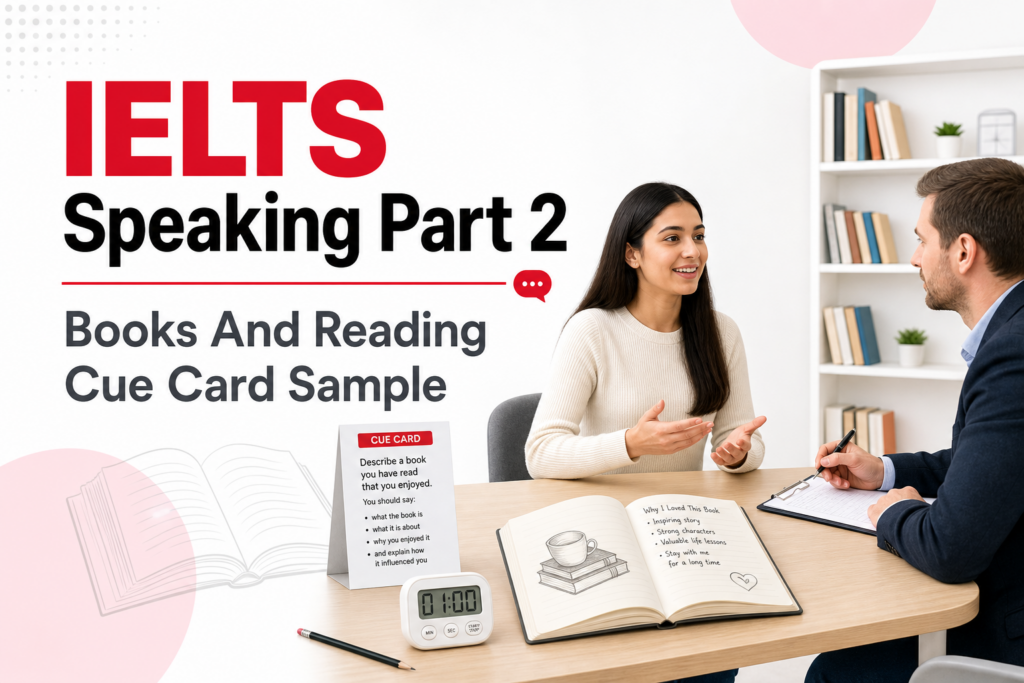
If you are looking for an IELTS Speaking Part 2 Books And Reading cue card sample, you probably do not need another vague script that sounds polished on paper but awkward out loud. You need a response model that helps you speak naturally for close to two minutes, develop one clear idea, and avoid the flat, repetitive answers that often limit Speaking scores. Before you assume your current Speaking level is already safe, take the IELTS Express Pre-Test to get a clearer picture of your band score and whether Part 2 still needs work.
Books and reading is a useful IELTS topic because most candidates can say something about it, even if they do not read every day. The challenge is not having an opinion. The challenge is turning that opinion into a well-shaped answer. A strong Part 2 response needs structure, enough detail, and a natural finish. Once you build those habits, this cue card becomes much easier to handle.
What this books and reading cue card is really testing
When the examiner gives you a topic about books or reading, they are not judging your literary knowledge. They are checking whether you can organise your ideas, speak with enough fluency, and support your points with relevant detail. In other words, the topic is only the vehicle. Your communication is the real test.
That matters because many candidates overthink the content. They worry that they need an impressive novel, a deep analysis, or a sophisticated opinion about reading culture. You do not. A simple, believable answer usually performs better than an over-ambitious one. If you want the broader scoring context, the IELTS Speaking Part 2 band score guide explains what fluency, coherence, vocabulary, and grammar look like at stronger bands.
A common IELTS Speaking Part 2 Books And Reading cue card sample prompt
You may see a prompt such as: describe a book you enjoyed reading, describe a book that influenced you, or describe a time when reading helped you learn something useful. The bullet points may ask what the book was, when you read it, what it was about, and why it was memorable.
These prompts change slightly, but the speaking job stays almost the same. You need to choose one book or reading experience, explain it clearly, add a few specific details, and close with a reason it mattered. If you try to cover too many books, your answer often becomes thin and unfocused.
How to choose the easiest book or reading experience
The safest choice is usually not the most intellectual book. It is the book you can describe most easily. That could be a novel you read at school, a self-improvement book, a biography, a children's book you still remember, or even a practical guide that genuinely helped you. IELTS does not reward you for pretending to be a full-time reader.
Pick something with three useful ingredients: a clear topic, one memorable detail, and a personal reason it stayed with you. Maybe the story taught you patience. Maybe the author's journey motivated you. Maybe reading the book improved a habit in your own life. Those hooks make the answer easier to extend without sounding forced.
- Safe options: a school novel, a biography, a motivational book, or a useful non-fiction guide
- Helpful detail types: one character, one idea, one lesson, or one moment you still remember
- Easy personal angles: enjoyment, learning, motivation, or a change in perspective
A reliable structure for this cue card
A simple four-part structure works well for most books and reading topics. First, name the book or reading experience. Second, explain when you read it and how you found it. Third, describe what it was about and give one or two specific details. Fourth, say why it mattered to you or why you would recommend it.
This structure gives you enough shape to speak for close to two minutes without memorising a speech. It also helps you avoid one of the biggest Part 2 problems: spending too long on background and then running out of useful things to say. If your Part 2 practice still feels inconsistent, it helps to access unlimited IELTS mock tests and train your timing under more realistic conditions.
IELTS Speaking Part 2 Books And Reading cue card sample answer
One book I would like to talk about is Atomic Habits by James Clear. I read it about two years ago when I was trying to become more organised with my study routine. At that time, I often felt motivated at the beginning of the week, but I found it hard to stay consistent, so I wanted something practical rather than just inspirational.
What I liked about the book was that it explained habits in a very simple and realistic way. Instead of telling readers to change everything at once, it focused on small repeated actions. One idea I still remember is that improving by a tiny amount each day can create a big result over time. That point stayed with me because it felt achievable. It did not sound like extreme advice.
After reading it, I started using a few of the suggestions in my own life. For example, I prepared my study materials the night before and set smaller daily targets instead of very ambitious weekly goals. That helped me feel less overwhelmed and more consistent. I think the book influenced me because it turned self-discipline into something practical rather than stressful.
Overall, this book was memorable for me because it changed the way I think about progress. I would recommend it to other students because it is easy to understand and genuinely useful, especially if someone wants to build better study or reading habits.
Why this sample answer works
This sample works because it is specific without becoming complicated. The speaker chooses one book, explains the context, includes one key idea from the book, and then connects that idea to a real change in daily life. That creates a natural beginning, middle, and end.
Notice that the language is clear rather than fancy. Phrases such as I was trying to become more organised, that point stayed with me, and it changed the way I think about progress sound natural in spoken English. That is what you want in Part 2. The aim is to sound controlled and believable, not theatrical. For more answer-building models, the IELTS Speaking Part 2 sample answers page is a useful next step.
Useful vocabulary for books and reading topics
You do not need advanced literary language to score well. Still, a few natural phrases can help you sound more flexible. Instead of saying a book was simply good or interesting, describe what made it worth talking about.
- To describe the book: easy to follow, thought-provoking, practical, emotional, inspiring, well-written
- To describe your experience: I picked it up during…, I could relate to it, it kept my attention, I learned a lot from it
- To explain impact: it changed my perspective, it made me think differently, it helped me improve a habit
- To recommend it: I would suggest it to…, it is a good choice for…, it is useful because…
Try to use vocabulary that matches the kind of book you choose. If it is fiction, you may mention characters, plot, or emotion. If it is non-fiction, you may talk about advice, structure, or practical lessons. Either way, clarity matters more than showing off.
Common mistakes in books and reading cue card answers
One common mistake is summarising the whole book. That usually wastes time and makes the answer sound like a school report. In Part 2, you only need enough summary to give context. The stronger part of the answer is usually your personal reaction and why the book mattered.
Another mistake is choosing a book that feels too difficult to explain. Candidates sometimes pick a famous novel because they think it sounds impressive, then struggle to describe it simply. A third mistake is giving a generic ending such as I liked it very much. That kind of finish is not wrong, but it is weak. It is better to end with a specific reason the book stayed with you.
If this pattern sounds familiar, do a few speaking recordings and listen for the moment your answer becomes vague. That is often where your score starts slipping.
How to use your one-minute preparation time
During the one-minute planning stage, do not try to write full sentences. That nearly always creates a stiff answer. Instead, note down short prompts: the book title, when you read it, one idea from it, one personal example, and your reason for recommending it.
For the sample above, your notes could look like this: Atomic Habits, study routine, small daily actions, prepared materials at night, helped me stay consistent. That is enough to keep you moving. Your notes are there to guide your answer, not to control every line of it.
- Book or topic: name it clearly
- When: school, holiday, university, exam period, last year
- Main detail: one character, one lesson, one memorable scene
- Impact: how it changed your thinking, mood, or habit
How to extend your answer if you finish too early
If you notice that you are running out of things to say, add one of three things: a specific example, a comparison, or a recommendation. For example, you can compare this book with another book you found less useful, explain one moment that stayed in your memory, or say which type of reader would benefit from it.
This works much better than repeating the same point in slightly different words. Repetition makes the answer sound thin. New detail makes it sound developed. That small difference often separates a decent Part 2 answer from a much stronger one. If you want a more structured study path, you can also see our IELTS preparation plans and focus on the exact Speaking habits that are still unstable.
Ready to find out your IELTS band score?
Take the IELTS Express Pre-Test for just $4.99 and get your personalised band prediction with a 14-day improvement plan.
FAQ: IELTS Speaking Part 2 Books And Reading cue card sample
Do I need to choose a famous book in this cue card?
No. You can choose any book that you can describe clearly. A simple book with a personal connection is usually easier to speak about than a famous book you barely remember.
Can I talk about a non-fiction book instead of a novel?
Yes. A non-fiction book can work very well, especially if it taught you something useful or changed one of your habits. The key is to explain it clearly and add a personal reason it mattered.
What if I do not read books very often?
That is fine. You can still talk about one book you read in school, one useful guide, or even one reading experience that stayed with you. IELTS is testing your English, not your lifestyle.
How long should my IELTS Speaking Part 2 answer be?
You should aim to speak for close to two minutes. A clear structure with one or two useful details usually helps you reach the time naturally.
What is the best way to practise this type of cue card?
Choose one book, make five short planning notes, record yourself for two minutes, and then listen for vague or repetitive parts. After that, rebuild the answer with clearer detail and a stronger ending.
Your next step for a stronger Part 2 response
An IELTS Speaking Part 2 Books And Reading cue card sample is most useful when you treat it as a model rather than a script. Learn the structure, borrow the speaking logic, and then adapt it to a book you can describe comfortably.
That is usually the safest way to sound natural on test day. Keep the answer focused, add one or two specific details, and finish with a clear reason the book mattered to you. Once that habit becomes normal, books and reading topics stop feeling awkward.