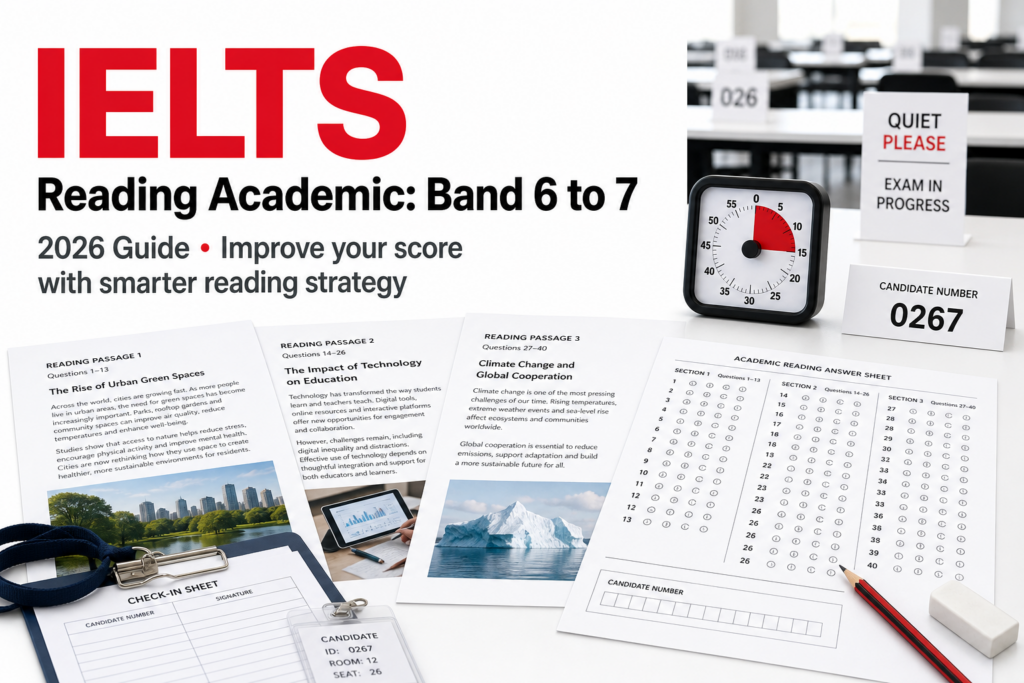
If you want to improve IELTS Reading Academic from band 6 to 7, you do not usually need a completely different level of English overnight. In many cases, you need better control of timing, clearer question-handling habits, and a more disciplined review system after each practice paper. Before you keep guessing whether your current Reading level is close enough, take the IELTS Express Pre-Test to see whether Reading is still the section stopping you from reaching your target.
Band 6 readers often understand a fair amount of the passage, but they still lose marks through slow location skills, weak paraphrase recognition, overthinking difficult items, and avoidable answer-form mistakes. Band 7 usually comes when your reading becomes more selective, more evidence-based, and less emotional under pressure. The goal is not to read every line perfectly. The goal is to make better decisions across the full sixty minutes.
What usually separates band 6 from band 7 in Academic Reading
The jump from band 6 to band 7 is often smaller than candidates imagine, but it is also less random than they hope. Band 6 readers commonly have partial control. They can handle easier question sets, understand the general topic, and find some direct answers. However, they lose consistency when the passage becomes denser, when wording changes through paraphrase, or when two options look almost correct.
Band 7 readers are not perfect readers. They are usually better at staying organised. They read for structure before detail, recognise likely answer zones faster, and avoid spending too long proving one answer while the rest of the paper quietly gets away from them. If you want a broader baseline for how the section works, the IELTS Reading Academic tips and strategies guide is a useful companion.
Why strong English alone does not guarantee band 7
Many candidates sitting at band 6 believe the main issue must be vocabulary size or general comprehension. Sometimes that is true, but not always. Academic Reading is also a decision-making test. It rewards efficient scanning, controlled close reading, and accurate matching between question meaning and passage meaning. A candidate may understand most of a paragraph and still choose the wrong answer because they chased one familiar word instead of the real idea.
This is why intelligent candidates can stay stuck for longer than expected. They are not failing because they are careless in a simple sense. They are often too willing to read broadly when the task needs precision, or too eager to confirm an answer before enough evidence is actually there. Band 7 comes more easily once you stop treating Reading as a memory test and start treating it as guided evidence collection.
How to read passages more selectively
One of the biggest upgrades from band 6 to band 7 is selective reading. At band 6, many candidates either read too much too early or scan too fast without building any structure. Both habits cause trouble. A better approach is to get a light sense of passage direction first. Notice the topic, the paragraph flow, and where examples, opinions, or process stages seem to sit. Then let the questions guide your deeper reading.
Selective reading matters because Academic passages are built to waste your time if you insist on full understanding before you answer anything. You do not need to admire the passage. You need to work with it. Read enough to know where ideas live, then slow down only when the question points you to a likely answer area. This usually improves both pace and accuracy because your concentration stops leaking across irrelevant lines.
- First pass: identify topic, structure, and paragraph movement
- Question stage: focus on the key idea rather than one isolated keyword
- Answer stage: read the likely area carefully and confirm with evidence
- Exit rule: once the answer is supported, move on instead of rereading for comfort
How to handle paraphrasing more accurately
Paraphrasing is where many band 6 candidates quietly bleed marks. The question may use one wording, while the passage expresses the same idea through different vocabulary, grammar, or sentence order. If you rely too heavily on word matching, you can miss a correct answer that is actually sitting in front of you. You can also choose a wrong answer simply because one familiar term appears nearby.
To fix this, train yourself to ask what the question really means before you hunt in the passage. If the question says a theory was criticised for being too narrow, you should be ready for passage language such as limited, incomplete, lacking range, or failing to consider broader factors. This is why targeted review matters so much. After practice, do not only record that an answer was wrong. Record which paraphrase relationship you failed to recognise.
If you need more repetition across realistic papers while tracking those patterns, it can help to access unlimited IELTS mock tests and compare the kinds of paraphrasing that keep slowing you down.
Question types that usually hold band 6 candidates back
Most candidates have at least one Academic Reading question type that repeatedly damages the score. True False Not Given and Yes No Not Given often cause trouble because they test precision, not broad agreement. Matching headings can be difficult because candidates focus on one memorable detail instead of the main paragraph purpose. Multiple-choice is another common problem because distractors often sound sensible before the final evidence is clear.
The solution is not to fear these tasks. It is to isolate them. If one question type causes repeated losses, train that format separately for a while. Learn what evidence the task actually rewards. For example, Not Given does not mean the statement feels unlikely. It means the passage does not clearly confirm or contradict it. That small distinction can save a surprising number of marks.
- True False Not Given: check whether the exact claim is confirmed, contradicted, or absent
- Matching headings: look for paragraph purpose, not decorative detail
- Multiple-choice: eliminate options only when the passage gives a clear reason
- Sentence completion: follow word limits and grammar fit carefully
How to manage time without rushing the whole paper
Candidates trying to move from band 6 to band 7 often make one of two timing mistakes. They either work too slowly in the early passages and panic later, or they try to become faster by rushing everything equally. Neither approach works well. Better timing comes from protecting minutes, not from turning yourself into a speed machine.
A practical rule is to notice time traps early. If one answer is becoming sticky, mark it, make your best controlled move, and continue. The paper contains forty marks, so your timing strategy should protect access to as many of them as possible. You can return later if time allows. This is especially important in Academic Reading, where later passages often become denser and need a calmer head.
Many candidates also improve when they stop rereading whole paragraphs after already locating the likely answer area. The second or third reread often feels responsible, but it is frequently just hesitation in disguise. If your pacing regularly falls apart across full papers, the IELTS Reading Academic time management guide can help you build a steadier section-by-section routine.
How to review practice tests in a band 7 way
One of the clearest differences between stuck candidates and improving candidates is what happens after a practice test. Band 6 candidates often check the score, feel disappointed or relieved, and then move straight to the next paper. Band 7 improvement usually begins when review becomes more forensic. You need to know why marks were lost, not just where they were lost.
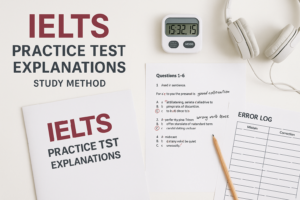
A useful review method is to label each wrong answer by cause. Was it a paraphrase miss, a timing error, a careless word-limit issue, a mistaken inference, or a failure to understand the paragraph structure? Once you group mistakes like that, your study plan becomes much smarter. Instead of vaguely “doing more Reading”, you are fixing a repeatable problem. That is how the score begins to move with more reliability.
Keep a short error log after each paper. Over time, you may notice that only two or three habits are doing most of the damage. That is good news, because narrow problems are usually easier to repair than a general feeling of being bad at Reading.
A weekly study plan to move from band 6 to 7
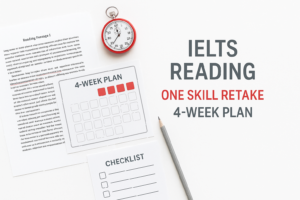
You do not need endless full tests every week. You need a balanced routine that combines measurement with repair. One good pattern is to do one full Academic Reading paper under timed conditions, then spend the next session reviewing every wrong answer and tracing the evidence. After that, complete one targeted drill on your weakest question type and one shorter session on paraphrases or passage mapping.
This kind of routine works because it keeps the full exam in view while still making room for technical improvement. A second full paper later in the week can help you test whether the adjustment is actually holding under pressure. If your overall preparation still feels too scattered, you can also see our IELTS preparation plans and follow a more structured path instead of trying to fix everything by instinct.
- Session 1: full timed Academic Reading paper
- Session 2: detailed error review with evidence notes
- Session 3: targeted drill on weakest question type
- Session 4: paraphrase training and passage-structure practice
- Session 5: second timed paper or one difficult passage with strict pacing
What to do in the final two weeks before the exam
In the final stretch, your aim is not to experiment wildly. It is to make your best habits repeatable. Keep practising with realistic timing, but avoid the trap of judging progress only by raw score swings from one paper to the next. Look at process as well. Are you locating answer zones faster? Are you spending less time on stubborn items? Are you making fewer instruction mistakes? Those are often the real signs that band 7 is getting closer.
This is also the stage to simplify your method. On test day, you do not need ten strategies in your head. You need a clear approach: question meaning first, selective scanning second, careful confirmation third, then move. Clean habits under pressure beat complicated plans almost every time.
Ready to find out your IELTS band score?
Take the IELTS Express Pre-Test for just $4.99 and get your personalised band prediction with a 14-day improvement plan.
FAQ: IELTS Reading Academic improve from band 6 to 7
How long does it usually take to improve IELTS Reading Academic from band 6 to 7?
It depends on why you are stuck. If the problem is mainly timing, paraphrasing, or question control, improvement can happen quite quickly with focused practice. If the problem includes major vocabulary or comprehension gaps, it may take longer. The key is to identify the real cause instead of doing random extra papers.
What is the biggest mistake band 6 candidates make in Academic Reading?
One of the biggest mistakes is reading too broadly without enough purpose. Many candidates understand parts of the text but still lose marks because they do not track question meaning carefully enough or spend too long proving one difficult answer.
Should I read the whole passage first in IELTS Academic Reading?
Usually, no. A light sense of structure is useful, but full detailed reading before the questions often wastes time. A more effective approach is to understand the passage direction, then let the questions guide where you read closely.
Can practice tests alone move me from band 6 to band 7?
Not reliably. Practice tests are useful for measurement, but the score usually improves faster when you review errors carefully, isolate weak question types, and train paraphrasing and timing with intention.
Is band 7 mostly about vocabulary?
Vocabulary matters, but band 7 is not only a vocabulary issue. It also depends on how well you recognise paraphrases, manage time, locate evidence, and avoid avoidable answer-form errors under exam pressure.
Your next step towards a safer band 7
To improve IELTS Reading Academic from band 6 to 7, you usually need fewer random papers and more disciplined practice. Read more selectively, train paraphrasing more actively, review mistakes by pattern, and protect your time for the questions that matter most. Those changes are not flashy, but they are often exactly what lifts a stuck score.
Band 7 becomes more realistic when your process stops breaking down halfway through the paper. Build a calmer system, trust evidence more than instinct, and keep correcting the same few habits until they stop costing you marks.