If you are searching for an IELTS Speaking Part 2 band score guide, you probably want a straight answer to one question: what does the examiner actually hear in a strong two-minute response? Many candidates leave the test feeling that they spoke for long enough, used decent vocabulary, and still got a lower band than expected. Usually, the problem is not one dramatic mistake. It is a cluster of small weaknesses in structure, development, control, and natural delivery.
Before you keep guessing whether Speaking Part 2 is really the section dragging your overall result down, take the IELTS Express Pre-Test to get a quick band prediction and see where your score is actually under pressure.
What IELTS Speaking Part 2 is and why it affects your band
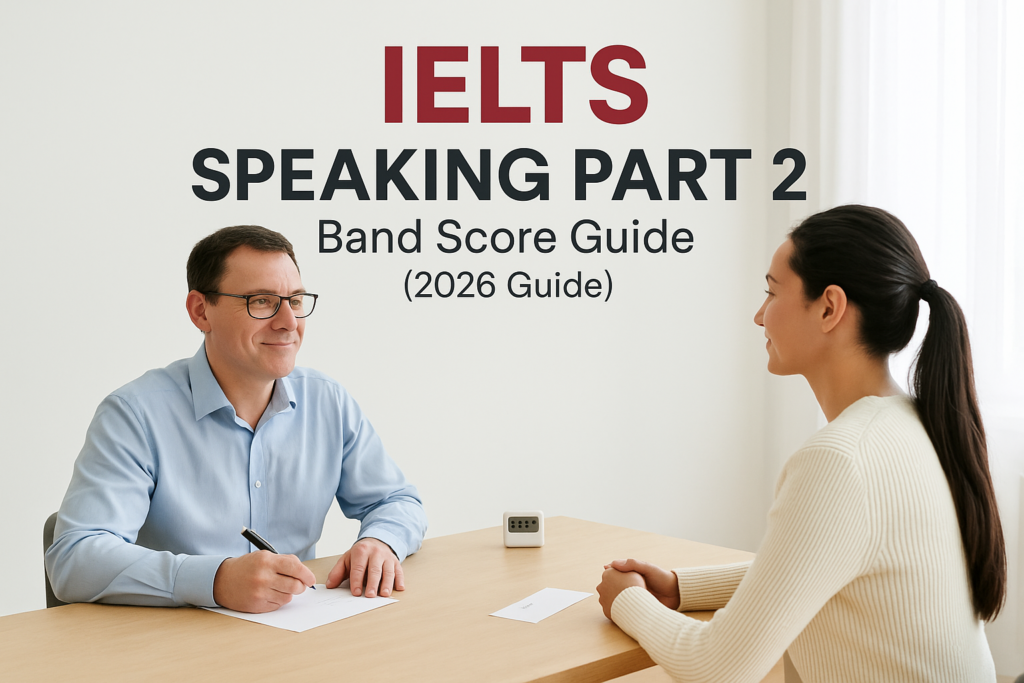
IELTS Speaking Part 2 is the long-turn section of the test. You receive a cue card, one minute to prepare, and up to two minutes to speak. The topic may ask you to describe a person, place, event, object, skill, or experience. On paper, that sounds simple. In practice, this part exposes weak speaking habits very quickly.
The examiner is not scoring Part 2 as a separate mini test with its own independent band. Instead, Part 2 contributes to your overall Speaking score through the same four criteria used across the speaking interview: fluency and coherence, lexical resource, grammatical range and accuracy, and pronunciation. That means a messy long turn can hurt the examiner’s impression across multiple scoring areas at once.
This is why candidates who “know the topic” still lose marks. Familiarity is not enough. If your answer is too short, too general, too memorised, or too repetitive, the band drops even when your basic English is good enough for a higher score.
How the examiner really scores your long turn
A useful IELTS Speaking Part 2 band score guide needs to start with the scoring logic, not random tips. Examiners are trained to listen for four things at the same time.
- Fluency and coherence: can you keep speaking with a clear direction, without long breakdowns or confusing jumps?
- Lexical resource: do you use vocabulary that fits the topic naturally, with enough range and precision?
- Grammatical range and accuracy: can you control sentence forms well enough to explain ideas clearly?
- Pronunciation: are you easy to understand, with stress, rhythm, and sounds that support communication?
What matters here is how these areas work together. A candidate may have enough vocabulary, but if the answer keeps stalling, the overall impression weakens. Another candidate may sound confident, but if the ideas are thin and poorly linked, coherence becomes a problem. Part 2 is one of the fastest places for those weaknesses to become obvious.
If you want to practise this under pressure rather than only reading about it, access unlimited IELTS mock tests and record several long-turn answers in one session. That shows you much more than silent reading ever will.
What band 5, band 6, band 7, and band 8 answers usually sound like
Candidates often ask for a perfect checklist, but band scores in speaking are based on overall performance, not one rigid formula. Still, there are clear patterns.
Band 5 answers usually communicate the basic idea, but they often stop early, repeat points, or become hard to follow. The speaker may rely on simple language and hesitate when trying to extend the answer. There is usually some real communication, but it feels limited.
Band 6 answers are more reliable. They may still contain grammar mistakes or awkward phrasing, but the answer usually has a shape. The candidate can describe a topic, add some supporting detail, and stay understandable through most of the turn. This band often comes from better organisation rather than fancy language.
Band 7 answers tend to sound more natural and better developed. The speaker can extend ideas with less strain, move between points more smoothly, and use vocabulary with more flexibility. Errors may still happen, but they usually do not damage the flow very much.
Band 8 answers usually feel controlled and easy to follow. The speaker develops ideas fully, uses language with confidence, and sounds natural rather than mechanical. Even when small mistakes appear, they rarely interrupt communication.
The gap between these levels is not magic. In many cases, the jump from band 5 to 6 or 6 to 7 comes from clearer planning, stronger development, and fewer self-inflicted fluency breaks.
Fluency and coherence, the score driver most candidates underestimate
Many candidates think vocabulary is the main reason they lose marks. Often, fluency and coherence do more damage. In Part 2, fluency is not about speaking quickly. It is about keeping the answer moving. Coherence is not about sounding academic. It is about making the answer easy to follow.
A strong answer usually does four simple things. It names the topic clearly, gives some background, develops one or two useful details, and finishes with meaning or reflection. A weak answer often does the opposite. It starts vaguely, jumps between ideas, circles back to the same point, and finishes because the speaker has run out of direction.
This is why good note-making in the one-minute preparation stage matters so much. You do not need full sentences. You need a route. If your notes give you a beginning, middle, and end, your band is already safer. For a broader view of how the long turn connects to the rest of the interview, the IELTS Speaking Part 2 and Part 3 framework is worth reading after you practise this section.
Vocabulary and grammar, what helps and what backfires
Lexical resource and grammar matter, but candidates often hurt themselves by approaching them badly. The common mistake is chasing advanced language before basic control is stable. In speaking, difficult words do not impress anyone if they create hesitation, incorrect meaning, or broken grammar around them.
A better approach is precision. Instead of vague words like good, nice, or interesting, use words that fit the idea more exactly, such as stressful, supportive, crowded, unexpected, or practical. That already improves range without making the answer heavy.
The same logic applies to grammar. In Part 2, you often move between past experience, present reflection, and future meaning. Candidates who can shift between those cleanly usually sound stronger than candidates who force long, complicated sentences that collapse halfway through.
If you are building toward a test date and want structured support instead of patchy internet advice, see our IELTS preparation plans and choose the level of help that fits your timeline.
How to build a higher-scoring Part 2 answer in one minute of planning
The one-minute preparation stage is where many scores quietly rise or fall. Weak candidates waste it writing full sentences or panicking about the perfect idea. Stronger candidates make fast notes that give the answer shape.
A simple planning structure works for most cue cards:
- Main choice: what person, place, event, or object you will talk about
- Context: when, where, or how it happened
- Two details: specific actions, features, or moments
- Why it matters: one feeling, lesson, result, or reason
That is enough for a strong long turn. You are not trying to write a script. You are trying to stop the answer from drifting. Once the route is clear, the answer becomes easier to extend naturally.
This planning method also protects your band because it reduces repetition. When a candidate has only one vague idea, they usually say it three times in different words. When the candidate has a route, each sentence can add something new.
Common Part 2 mistakes that lower the band fast
A solid IELTS Speaking Part 2 band score guide should be honest about what goes wrong most often. The first mistake is finishing too early. If the answer ends after 40 or 50 seconds, there is usually not enough development to support a stronger band. The second mistake is memorising full answers. Examiners hear this all the time, and it often sounds stiff or disconnected from the actual cue card.
The third mistake is staying too general. Candidates say a place was beautiful, a person was helpful, or an event was important, but they do not explain what actually happened. The fourth mistake is repeating the same idea when time is still left. The fifth is forcing advanced vocabulary that the speaker cannot control comfortably.
Most of these mistakes are habit problems, not intelligence problems. That is good news. Habits can be trained out. If you want to understand the whole speaking interview more clearly, our IELTS Speaking Test complete guide helps because many Part 2 problems start in the way candidates think about the test overall.
A simple band-lifting practice method before test day
Reading model answers is fine, but band improvement usually comes from short review loops. Record yourself answering three cue cards. Listen back once for timing, once for repetition, and once for vague language. Then answer the same cards again with cleaner notes and better development.
A practical seven-day cycle looks like this:
- Day 1: record three Part 2 answers without stopping
- Day 2: mark where you paused too long or lost direction
- Day 3: redo the same cards with a four-part plan
- Day 4: focus only on adding example, reason, and result
- Day 5: do one full speaking test so Part 2 connects naturally with Parts 1 and 3
- Day 6: practise two unfamiliar cue cards to test flexibility
- Day 7: compare your newest recording with the first one honestly
This kind of practice is not glamorous, but it works. You hear your real habits. You stop guessing. That is usually when the band starts moving.
Ready to find out your IELTS band score?
Take the IELTS Express Pre-Test for just $4.99 and get your personalised band prediction with a 14-day improvement plan.
Frequently Asked Questions
Is IELTS Speaking Part 2 scored separately?
Not as a standalone band that appears on your result sheet. Part 2 contributes to your overall Speaking score through fluency and coherence, lexical resource, grammatical range and accuracy, and pronunciation.
How long should I speak in IELTS Speaking Part 2?
You should aim to keep speaking until the examiner stops you, which is usually close to two minutes. A response that ends much earlier often lacks enough development for a stronger band.
What usually stops candidates from getting band 7 in Part 2?
The biggest barriers are usually weak development, repetition, over-memorised language, and long hesitation when ideas run out. Many candidates do not need more vocabulary first. They need a cleaner structure and better control.
Do I need advanced vocabulary for a high Part 2 band?
No. You need vocabulary that fits the topic naturally and accurately. Clear, precise language usually scores better than difficult words that cause hesitation or wrong meaning.
What is the fastest way to improve my Part 2 band score?
Use timed practice, record your answers, and review them for length, repetition, and clarity. Most candidates improve faster when they stop memorising and start building a reliable answer method.
Your next step
A useful IELTS Speaking Part 2 band score guide should leave you with something practical, not just theory. Build a simple note plan, choose one clear example, and keep extending ideas with real detail instead of padding. That is what makes the long turn sound stronger.
If you want to know whether your current speaking level is already close to your target, start with the pre-test, then practise three cue cards using the same structure. That will tell you more than another hour of guessing.