If you need IELTS Speaking Part 1 Study questions and answers, the smartest aim is not to memorise perfect lines. The aim is to sound natural, answer directly, and show enough range without turning a simple question into a speech. Before you practise for another week without knowing your level, take the IELTS Express Pre-Test to get a quick band prediction and a practical 14-day improvement plan.
The study topic is common in Part 1 because it connects to daily life, past choices, future plans, and opinions about learning. The examiner is not checking whether your school or university story is impressive. They are checking fluency, vocabulary, grammar control, pronunciation, and whether you can answer familiar questions without sounding scripted.
How IELTS Speaking Part 1 Study Questions Work
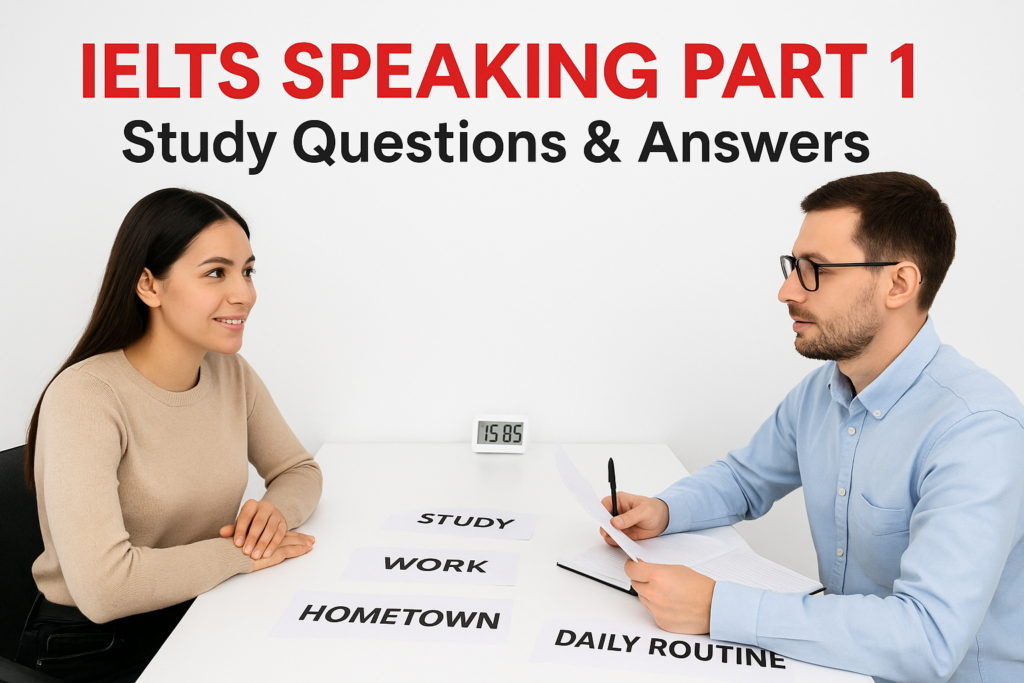
Part 1 usually lasts four to five minutes and starts with simple questions about you. The examiner may ask about your work or studies, your hometown, your home, and one or two familiar topics. If the topic is study, the questions are usually short and personal.
You might be asked what you study, why you chose it, whether you enjoy it, what subject you found difficult, or whether you prefer studying alone or with others. Strong answers are usually two or three sentences. One sentence can sound too short, but a long prepared answer can sound unnatural.
- Answer the exact question first.
- Add one reason, example, or contrast.
- Use natural spoken vocabulary.
- Avoid memorised speeches.
- Stop before the answer becomes Part 2 length.
IELTS Speaking Part 1 Study Questions And Answers
Question: What do you study?
I am studying business management at the moment. It covers areas like marketing, finance, and operations, so it is quite broad. I like that because I am still deciding which area I want to specialise in later.
Question: Why did you choose that subject?
I chose it because it feels practical. I wanted a course that could lead to different career options, not just one narrow job. Also, I have always been interested in how companies make decisions and solve problems.
Question: Do you enjoy studying?
Most of the time, yes. I enjoy learning new ideas, especially when I can connect them to real situations. The only part I find difficult is managing several deadlines at the same time.
Question: What was your favourite subject at school?
My favourite subject was English because it gave me a chance to discuss ideas, not just remember facts. I also had a teacher who made the lessons feel lively, so I became more confident about speaking in class.
What Makes These Answers Strong?
These answers work because they are direct, personal, and controlled. They do not use complicated language just to impress the examiner. Instead, they answer the question, add a reason, and include enough detail to sound natural.
Notice the use of flexible phrases such as “at the moment”, “quite broad”, “most of the time”, and “connect them to real situations”. These are normal spoken expressions. They help the answer sound fluent without becoming memorised.
If you want to test these answers under exam-style pressure, access unlimited IELTS mock tests and record whether your answers stay natural when the timer is running.
Common Study Questions In Speaking Part 1
The examiner can ask the same topic in several ways. You should prepare flexible ideas rather than one fixed script. For example, questions about your subject, your learning style, your teachers, your classmates, online study, and difficult subjects can all use similar vocabulary.
Here are useful questions to practise: What subject are you studying? Do you like your course? Why did you choose it? What subject did you dislike at school? Do you prefer studying in the morning or evening? Is it better to study alone or with friends? Do you think online learning is effective?
For broader Speaking preparation, read the IELTS Speaking Part 1 practice test guide and practise moving between topics without changing your speaking style too much.
Useful Vocabulary For The Study Topic
Good vocabulary for this topic should sound like real conversation. You can talk about a demanding course, a practical subject, a heavy workload, useful feedback, group assignments, lecture notes, independent learning, and exam pressure. These phrases are natural and easy to adapt.
For opinions, use phrases such as “I would say”, “to some extent”, “it depends on the subject”, and “I find it easier when”. For examples, use “for instance”, “a good example is”, and “in my last semester”. These help you extend answers without sounding mechanical.
- Demanding: My course is demanding because there are weekly assignments.
- Practical: I prefer practical subjects because I can apply them quickly.
- Heavy workload: The workload gets heavy near exam time.
- Independent learning: University requires more independent learning than school.
- Useful feedback: Useful feedback helps me understand what to fix next.
How Long Should Each Answer Be?
A safe Part 1 answer is usually two or three sentences. If the question is very simple, two sentences may be enough. If the question asks for a preference or reason, three sentences can work well. The key is to avoid both extremes: one-word answers and long rehearsed paragraphs.
For example, if the examiner asks whether you enjoy studying, do not only say “Yes, I do.” Add a reason and one small detail. You might say that you enjoy it when the subject feels useful, but you find exam periods stressful. That answer gives contrast and sounds more natural.
If your answers are always too short or too long, compare IELTS preparation plans and choose support that includes speaking feedback, not just question lists.
Study Topic Mistakes To Avoid
The first mistake is memorising model answers word for word. Examiners hear memorised language very quickly. A memorised answer may sound smooth at first, but it often fails when the examiner changes the question slightly.
The second mistake is using vocabulary that does not match your level. Words such as pedagogical, interdisciplinary, and intellectually stimulating may be correct in writing, but they can sound unnatural if they do not fit your normal speaking voice. Natural accuracy is usually stronger than forced complexity.
The third mistake is giving no personal detail. Part 1 questions are about familiar experience. You do not need a dramatic story, but you should make the answer yours. Mention your subject, your schedule, your learning style, or a real difficulty.
A Simple Practice Method For Study Questions
Choose ten study questions and record your answers. Do not write a full script. Instead, write three keywords for each answer: the direct answer, the reason, and one example. Then speak from those keywords. This trains flexibility, which is more useful than memorisation.
After recording, listen for three things. First, did you answer the question quickly? Second, did you add enough detail? Third, did your answer sound like normal speech? If you pause too much, practise the same question again with simpler language.
The IELTS Speaking Part 1 sample answers page can help you compare your response length and tone with natural model answers.
Band 7 Habits For Part 1 Study Answers
A Band 7-style answer is not perfect. It is fluent enough, flexible enough, and clear enough. You can make small mistakes and still do well if your meaning is easy to follow and your answer develops naturally.
Build the habit of adding a small contrast. For example, “I enjoy the course, although the workload can be heavy.” You can also add a time contrast: “At school I preferred science, but now I am more interested in business.” These simple structures show range without sounding artificial.
Pronunciation matters too. Practise common study words such as university, assignment, practical, subject, feedback, lecture, schedule, and presentation. Clear word stress can make a simple answer sound much more confident.
Final Checklist Before You Practise
Before you practise, prepare ideas, not scripts. For each study question, know your direct answer, your reason, and one example. Keep the language conversational. If you would never say a phrase in real life, be careful about using it in the test.
During practice, record yourself and listen honestly. If the answer sounds too short, add one reason. If it sounds too long, cut the background story. Part 1 rewards quick, natural communication. You are not trying to deliver a speech; you are showing the examiner that you can handle familiar questions comfortably.
Ready to find out your IELTS band score?
Take the IELTS Express Pre-Test for just $4.99 and get your personalised band prediction with a 14-day improvement plan.
FAQ: IELTS Speaking Part 1 Study Questions And Answers
How many sentences should I say for IELTS Speaking Part 1 study questions?
Most answers should be two or three sentences. Give a direct answer first, then add a reason, example, or contrast.
Can I memorise study answers for IELTS Speaking Part 1?
You should not memorise full answers. Prepare ideas and useful phrases, then speak naturally so you can adapt when the question changes.
What vocabulary is useful for the study topic?
Useful phrases include demanding course, practical subject, heavy workload, useful feedback, independent learning, group assignment, and exam pressure.
What if I am not studying now?
You can talk about what you studied in the past or explain that you are working now. Answer honestly and connect the question to your real situation.
Do study answers need advanced grammar?
No. They need clear, accurate grammar with some range. Simple contrast sentences and reason clauses are often enough for strong Part 1 answers.