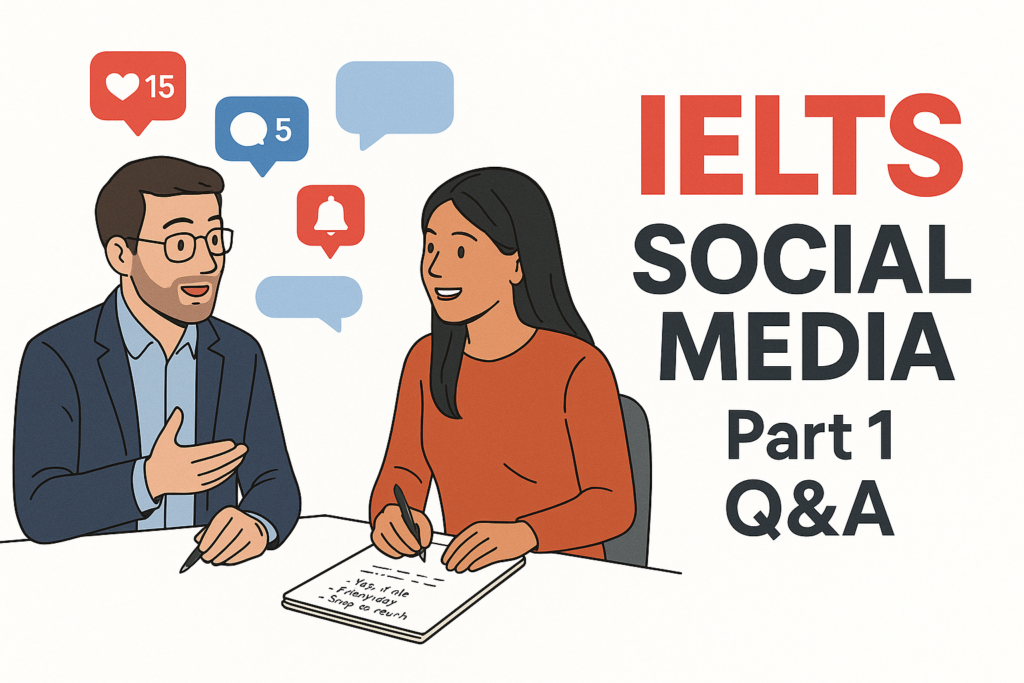
IELTS Speaking Part 1 Social Media questions and answers are common because social media is part of everyday communication for many candidates. The examiner may ask whether you use social media, what platforms you use, whether it is useful, whether it wastes time, how it affects friendships, or whether older people use it. Before you memorise social-media scripts, take the IELTS Express Pre-Test to check your current speaking band range and see whether your main issue is fluency, vocabulary, grammar, pronunciation, or answer development.
The social media topic connects with friends, news, study, entertainment, online business, photos, privacy, screen time, and communication. A strong Part 1 answer is usually two to four sentences. Answer directly, add one reason, and include one real detail from your life.
IELTS Speaking Part 1 Social Media Questions And Answers: What To Expect
In Speaking Part 1, social media questions usually focus on personal routines. The examiner may ask how often you use social media, whether you prefer posting or just looking, what kind of content you follow, or whether social media is popular in your country.
A good answer normally has three moves: answer the question, explain why, and add one small example. Instead of saying, “Yes, I use social media,” you could say, “Yes, I use it most days, mainly to message friends and follow news updates. I do not post very often, but I check a few accounts when I have a break.”
- Keep answers personal and realistic.
- Use everyday vocabulary you can pronounce clearly.
- Compare messaging, posting, scrolling, sharing, and face-to-face communication.
- Use present simple for habits and past simple for how your use has changed.
- Do not turn every answer into a long opinion about technology.
Common IELTS Speaking Part 1 Social Media Questions
Practise these questions aloud because the examiner may change the wording. Flexible ideas are safer than fixed memorised answers.
- Do you use social media a lot?
- What do you usually use social media for?
- Which social media platforms are popular in your country?
- Do you prefer posting photos or just looking at other people’s posts?
- Do you use social media to keep in touch with friends?
- Do you think social media is useful?
- Can social media waste people’s time?
- Do older people in your country use social media?
- Has your social media use changed over time?
- Would you like to use social media less in the future?
If you want more everyday topic practice, use our IELTS Speaking Part 1 sample answers guide to compare answer length, tone, and vocabulary across familiar Part 1 topics.
Sample Answers About Daily Social Media Use
Question: Do you use social media a lot?
Yes, but not constantly. I use it most days to check messages, follow news, and see updates from friends. I try not to scroll for too long because it can easily waste time.
Question: What do you usually use social media for?
I mainly use it for communication and quick information. For example, I follow a few pages related to news, study tips, and local events, but I rarely post personal updates.
Question: Which platform do you use most?
I probably use messaging-based apps the most because they are practical. I like platforms where I can contact people quickly rather than spend a lot of time browsing random content.
These answers work because they sound natural and specific. You are not listing every app you know. You are explaining your real behaviour in simple English.
Sample Answers About Posting And Sharing
Question: Do you like posting photos online?
Sometimes, but not very often. I might post a photo from a trip or a special event, but I prefer keeping most personal moments private.
Question: Do you prefer posting or just looking at other people’s posts?
I prefer looking at other people’s posts. It feels more relaxed, and I do not feel pressure to create perfect photos or write clever captions.
Question: What kind of content do you usually share?
If I share something, it is usually practical or positive, such as a useful article, a travel photo, or something connected with study or work. I avoid posting too many private details.
If you want to practise under realistic speaking pressure, access unlimited IELTS mock tests and answer social media questions without pausing to build perfect sentences first.
Sample Answers About Friends And Communication
Question: Do you use social media to keep in touch with friends?
Yes, especially with friends who live in other cities or countries. It is convenient because I can send a quick message, share photos, or reply when I have time.
Question: Has social media changed the way people communicate?
Definitely. People can stay connected more easily now, but sometimes conversations become shorter and less personal. I still think face-to-face communication is better for serious topics.
Question: Do you think online friendships are real friendships?
They can be, especially if people communicate regularly and support each other. However, I think strong friendships usually need more than likes and short comments.
Friendship questions are easy to extend because you can compare convenience and quality. A balanced answer often sounds more natural than saying social media is only good or only bad.
Sample Answers About Benefits And Problems
Question: Do you think social media is useful?
Yes, it can be very useful. It helps people find information quickly, stay in contact with others, and discover events or opportunities. The main problem is that people need to control how much time they spend on it.
Question: Can social media waste people’s time?
Yes, absolutely. It is easy to open an app for five minutes and then realise that half an hour has passed. Notifications and short videos can be especially distracting.
Question: Is social media good for learning?
It can be, if you follow useful accounts. For example, some pages share language tips, news summaries, or educational videos. But it depends on whether you choose the right content.
Benefit-and-problem questions give you a chance to show balanced language. Use phrases like on the one hand, at the same time, useful for, distracting, and depends on how people use it.
Useful Vocabulary For Social Media Answers
You only need practical vocabulary for this topic. Choose words that help you describe habits, communication, privacy, distraction, and online content.
- Scroll: move through posts or videos on a screen.
- Post: share a photo, video, or message online.
- Caption: the text written under a photo or video.
- Notification: an alert from an app.
- Distracting: taking your attention away from something important.
- Keep in touch: stay connected with someone.
- Privacy: control over personal information.
- Content: posts, videos, articles, or photos shared online.
Use vocabulary in normal sentences. For example, “Notifications can be distracting,” or “I use social media to keep in touch with friends overseas.” Simple words used accurately are stronger than advanced words used awkwardly.
Grammar Patterns That Help With Social Media Topics
Use present simple for habits: “I check social media most days,” “I rarely post photos,” or “I follow a few news accounts.” This tense is the backbone of most Part 1 social media answers.
Use past simple and present perfect for change: “I used social media more when I was younger,” or “My use has changed because I am busier now.” These patterns help when the examiner asks whether your habits have changed over time.
Use comparison language for balanced answers: “Messaging online is quicker than calling,” “Face-to-face communication feels more personal,” or “Short videos are more distracting than written posts.” Comparisons are useful for many Part 1 topics.
How To Answer If You Do Not Use Social Media Much
It is completely fine to say that you are not a heavy social media user. The key is to explain it naturally. A good answer might be: “I use social media a little, mainly for messages and news. I do not post much because I prefer to keep my private life offline.” This answer is honest and still gives enough language.
You can also mention alternatives. Maybe you prefer phone calls, face-to-face meetings, email, or messaging apps rather than public platforms. IELTS does not reward pretending to love social media. It rewards clear communication about your actual habits.
If you often struggle to extend simple Part 1 answers, see our IELTS preparation plans and choose support that includes speaking feedback on answer length, fluency, and natural vocabulary.
Common Mistakes With Social Media Answers
The first mistake is giving answers that are too short. “Yes, I use Instagram” is correct, but it does not show much range. Add why, how often, or what you use it for.
The second mistake is naming too many platforms without explanation. The examiner is not testing app knowledge. One or two examples are enough if you connect them to your habits.
The third mistake is making every answer negative. It is fine to say social media wastes time, but also mention useful sides such as communication, learning, or finding information.
The fourth mistake is giving a Part 3-style answer in Part 1. If the question is personal, keep it personal. Do not give a long lecture about society unless the examiner asks a broader question.
A Seven-Day Practice Plan For Social Media Questions
On day one, record answers to ten social media questions and keep each answer under thirty seconds. On day two, practise daily-use answers with present simple. On day three, practise posting and sharing answers with frequency phrases such as sometimes, rarely, and once in a while.
On day four, prepare vocabulary for scrolling, notifications, privacy, content, captions, and keeping in touch. On day five, practise balanced answers about benefits and problems. On day six, answer questions about friends, older people, study, news, and time wasting. On day seven, record a full Part 1 set and note three repeated problems.
This routine helps you build flexible answer habits. You are not memorising a social-media script. You are preparing ideas that can adapt when the examiner changes the wording.
Final Checklist Before Your Speaking Test
Before test day, make sure you can answer questions about how often you use social media, what you use it for, posting photos, keeping in touch, privacy, older users, useful content, wasting time, and whether your habits have changed. Practise at a normal speed and stop before your answer becomes too long.
The social media topic is easier when you keep it practical. Say what you use, explain why, and add one small personal detail. That simple structure can turn a basic Part 1 question into a confident answer.
Ready to find out your IELTS band score?
Take the IELTS Express Pre-Test for just $4.99 and get your personalised band prediction with a 14-day improvement plan.
FAQ: IELTS Speaking Part 1 Social Media Questions And Answers
What social media questions are common in IELTS Speaking Part 1?
Common questions ask whether you use social media, what you use it for, whether you post photos, whether it helps people keep in touch, and whether it wastes time.
How long should my social media answers be?
Most Part 1 answers should be two to four sentences. Give a direct answer, add one reason, and include one small real-life detail if it fits naturally.
Do I need advanced technology vocabulary for this topic?
No. Everyday words such as post, scroll, notification, caption, distracting, privacy, content, and keep in touch are usually enough if you use them accurately.
What if I do not use social media much?
You can say that honestly. Explain what you do use it for, such as messages or news, and mention that you prefer privacy, face-to-face communication, or other ways to stay connected.
Should I say social media is good or bad?
A balanced answer is usually best. Mention that social media is useful for communication and information, but it can also be distracting or time-consuming if people use it too much.