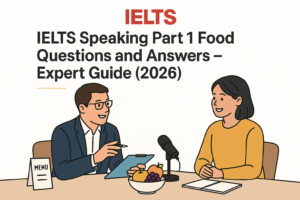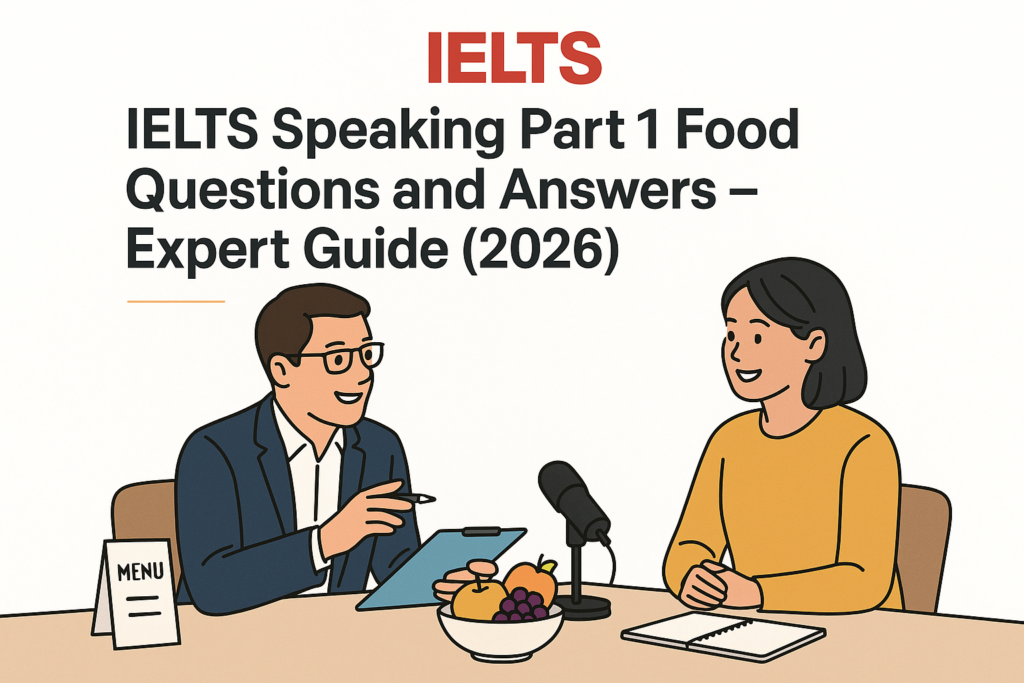
IELTS Speaking Part 1 Food questions and answers are useful because food is one of the most common everyday topics in the test. It can sound easy, but many candidates lose control because they give answers that are too short, too memorised, or too general. Before you practise another topic list, take the IELTS Express Pre-Test to check your current speaking band range and see which parts of your answers need work.
Part 1 is usually relaxed, but it still gives the examiner important evidence. Your job is to answer naturally, extend just enough, and use clear food vocabulary without sounding like you have learnt a script. This guide gives you common food questions, sample answers, vocabulary, and a simple method for building your own responses.
IELTS Speaking Part 1 Food Questions And Answers: What Examiners Listen For
In Part 1, the examiner is not testing your cooking knowledge. They are checking whether you can handle familiar personal questions in clear spoken English. Food questions often ask about likes, habits, home cooking, restaurants, snacks, healthy eating, and traditional dishes.
A strong answer usually has three parts: a direct answer, one reason, and one small detail or example. You do not need a long story. You need enough language to show fluency, vocabulary range, grammar control, and pronunciation.
- Answer the question directly in the first sentence.
- Add a reason so the answer does not stop too quickly.
- Use one specific food, place, habit, or example.
- Keep the tone natural, as if you are speaking to a polite interviewer.
- Avoid memorised answers that could fit any topic.
Why Food Is A Common IELTS Speaking Topic
Food works well in Part 1 because almost every candidate can talk about it. It connects to daily routines, family life, culture, health, work, study, travel, and personal preference. That makes it easy for the examiner to ask follow-up questions without needing specialist knowledge.
The danger is that candidates think the topic is too simple. They answer with basic words such as nice, delicious, good, bad, healthy, and favourite. Those words are not wrong, but they do not give much evidence of lexical range. Better answers use more exact language, such as home-cooked meals, spicy food, balanced diet, takeaway, fresh ingredients, comfort food, and local dishes.
If you want to practise food answers under pressure, access unlimited IELTS mock tests and record yourself answering Part 1 topics with strict timing.
Common IELTS Speaking Part 1 Food Questions
Here are common food questions you may hear. The wording can change, but the idea is usually similar. Practise the answer pattern rather than memorising exact sentences.
- What kind of food do you like?
- Do you prefer eating at home or eating out?
- Can you cook?
- What food is popular in your country?
- Do you eat healthy food?
- Did you like the same food when you were a child?
- How often do you eat with your family?
- Do you like trying new food?
- What food do people usually eat on special occasions?
- Do you prefer sweet food or savoury food?
When you practise, choose five questions and answer each one in 20 to 30 seconds. That is usually enough for Part 1. If your answer is only one sentence, add a reason. If it becomes too long, stop after one example.
Sample Answers For Food Likes And Preferences
Question: What kind of food do you like?
I usually like simple home-cooked food, especially rice dishes with vegetables and some kind of protein. I enjoy food that is fresh and not too heavy, because I still need to work or study after meals.
Question: Do you prefer sweet food or savoury food?
I prefer savoury food. I do enjoy dessert sometimes, but I cannot eat very sweet food every day. A savoury meal feels more satisfying to me, especially if it has a bit of spice.
Question: Do you like trying new food?
Yes, I do, but I am not very adventurous with extremely unusual dishes. When I travel or visit a new restaurant, I like trying local food because it helps me understand the culture a little better.
Notice that these answers are not complicated. They are clear, personal, and specific. Each answer gives the examiner more than a yes or no, but it does not turn into a Part 2 speech.
Sample Answers About Cooking And Eating At Home
Question: Can you cook?
Yes, I can cook a few basic meals. I am not an expert, but I can prepare simple dishes like fried rice, soup, and pasta. I think cooking is useful because it saves money and helps me eat healthier food.
Question: Do you prefer eating at home or eating out?
Most of the time, I prefer eating at home because it is cheaper and more comfortable. However, I like eating out on weekends because it gives me a break from cooking and cleaning.
Question: How often do you eat with your family?
When our schedules match, we try to eat dinner together. It does not happen every night, but when it does, it is a good chance to talk and relax after a busy day.
For more help with Part 1 structure, the IELTS Speaking Part 1 tips and strategies guide explains how to build answers without memorising scripts.
Sample Answers About Traditional And Popular Food
Question: What food is popular in your country?
In my country, rice-based meals are very popular because rice is part of everyday life for many families. People also enjoy noodle dishes, grilled meat, and street food because they are affordable and easy to find.
Question: What food do people eat on special occasions?
It depends on the occasion, but families often prepare larger meals with dishes they do not eat every day. The food is important, but the main point is usually spending time together.
Question: Did you like the same food when you were a child?
Not exactly. When I was younger, I preferred sweet snacks and simple food. Now I like stronger flavours and healthier meals, so my taste has changed quite a lot.
These answers use country and culture naturally, but they do not try to explain everything. In Part 1, a short cultural detail is enough unless the examiner asks another question.
Useful Food Vocabulary For Part 1
Good food vocabulary should sound natural in speech. You do not need rare words. You need words and phrases that help you give more exact answers.
- Home-cooked meal: food prepared at home, usually by family or yourself.
- Takeaway: food bought from a restaurant and eaten somewhere else.
- Balanced diet: a mix of foods that supports health.
- Comfort food: food that makes you feel relaxed or happy.
- Fresh ingredients: food items that are not old, processed, or stale.
- Local dish: food connected with a particular place or culture.
- Spicy, mild, rich, oily, light: useful adjectives for describing taste and texture.
Do not force all of these into one answer. Choose one or two that fit the question. Vocabulary only helps your score when it sounds natural and accurate.
How To Extend Food Answers Without Sounding Memorised
A safe formula is answer, reason, example. If the examiner asks whether you like cooking, answer directly, explain why, and give one example. This keeps the answer clear and prevents awkward silence.
For example: Yes, I like cooking when I have enough time. It helps me control what I eat and save money. I usually cook simple meals during the week, like rice with vegetables and chicken. That answer is short, but it gives enough development for Part 1.
You can also use contrast. Say what you usually do, then mention an exception. For example: I normally eat at home during the week, but I enjoy going to restaurants with friends on weekends. Contrast makes simple answers sound more flexible.
Common Mistakes With Food Answers
The first mistake is giving one-word answers. If you say “Yes, I do” and stop, the examiner has very little language to assess. Add a reason or example.
The second mistake is over-preparing. Some candidates memorise a perfect answer about their favourite dish, but they cannot adapt when the question changes. If the examiner asks about healthy food, restaurants, or childhood food, the memorised answer may not fit.
The third mistake is using vague adjectives too often. Delicious is useful, but if every answer says the food is delicious, your vocabulary sounds limited. Use more exact descriptions: spicy, filling, fresh, oily, light, homemade, traditional, convenient, expensive, or affordable.
If Speaking keeps feeling unpredictable, see our IELTS preparation plans and choose support that includes speaking feedback, not just topic practice.
A Seven-Day Practice Plan For Food Questions
On day one, record answers to ten food questions and listen for short answers. On day two, improve the answers by adding reasons. On day three, add specific food vocabulary. On day four, practise past and present answers, such as food you liked as a child and food you like now.
On day five, practise contrast answers about eating at home and eating out. On day six, do a mixed Part 1 session with food, hobbies, work, and study questions. On day seven, listen to your recording and write down three repeated problems.
This routine works because it trains flexibility. IELTS Speaking topics change quickly, so your practice should help you answer naturally, not recite paragraphs.
Final Tips Before You Practise Food Questions
Food questions are a good chance to sound natural and specific. Keep your answers personal, but do not make them too long. Use familiar vocabulary accurately before trying more advanced phrases.
If you are unsure what to say, think about habit, reason, and example. What do you usually eat? Why do you like or dislike it? When or where do you eat it? Those three prompts can rescue most Part 1 food questions.
The aim is controlled fluency. You want to answer smoothly, show enough vocabulary, and stay close to the question. When you can do that with an everyday topic like food, you are building the same skill you need for harder Part 1 topics.
Ready to find out your IELTS band score?
Take the IELTS Express Pre-Test for just $4.99 and get your personalised band prediction with a 14-day improvement plan.
FAQ: IELTS Speaking Part 1 Food Questions And Answers
What food questions are common in IELTS Speaking Part 1?
Common questions ask what food you like, whether you cook, if you prefer eating at home or eating out, what food is popular in your country, and whether your taste has changed since childhood.
How long should my food answers be in Part 1?
Most answers should be about two to four sentences. Give a direct answer, add a reason, and include one example or detail if needed.
Can I memorise IELTS Speaking Part 1 food answers?
You can prepare ideas and useful vocabulary, but do not memorise full answers. Memorised answers often sound unnatural and may not match the exact question.
What vocabulary should I use for food questions?
Use natural phrases such as home-cooked meals, takeaway, balanced diet, fresh ingredients, comfort food, local dishes, spicy, mild, filling, and affordable.
How can I improve my answers about food?
Record yourself answering common questions, then check whether each answer has a clear answer, a reason, and one specific detail. Replace vague words with more exact vocabulary.