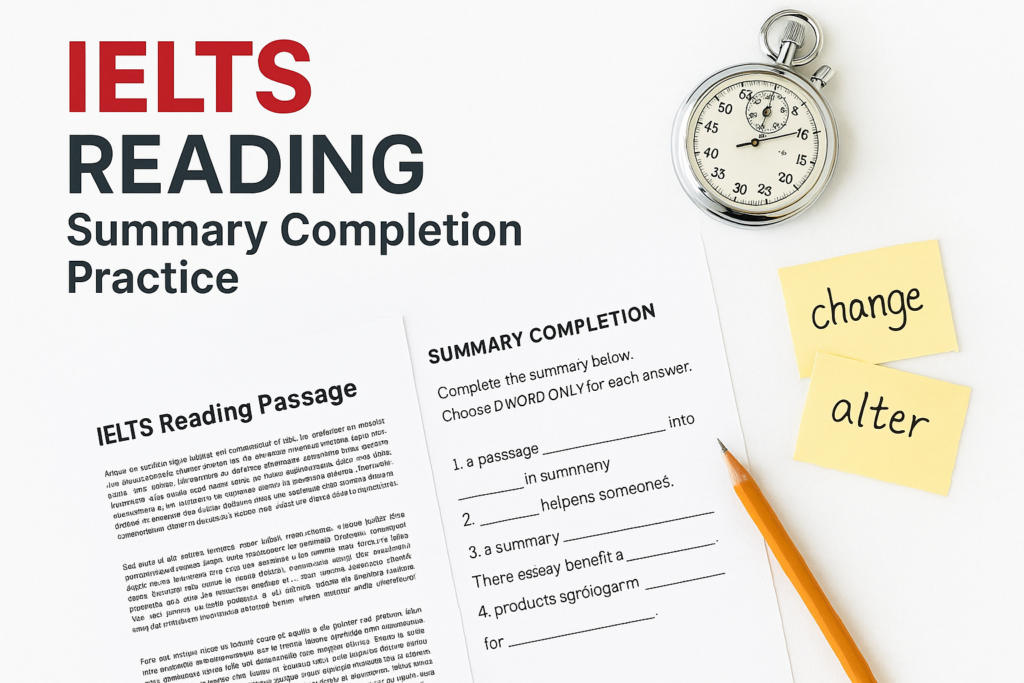
IELTS Reading Summary Completion practice guide questions test whether you can follow the main logic of a passage, locate a matching section quickly, and choose words that fit both meaning and grammar. Many candidates lose marks because they read the summary first, panic when the wording is different, and then scan randomly for the exact same phrase. Before you spend another week doing untimed reading exercises, take the IELTS Express Pre-Test to check your current band range and identify whether your real problem is vocabulary, timing, question technique, or accuracy under pressure.
Summary completion can appear in Academic or General Training Reading. Sometimes you choose words from the passage. Sometimes you choose from a box of options. In both cases, the task rewards controlled reading rather than speed alone. You need to understand the summary, predict the type of missing word, find the relevant paragraph, and avoid distractors that look close but do not complete the sentence correctly.
IELTS Reading Summary Completion Practice Guide: What The Task Tests
Summary completion gives you a shortened version of part of the passage. The summary follows the same general meaning as the text, but the language is usually paraphrased. A sentence in the passage might say that a method was “widely adopted after initial resistance”, while the summary might say it “became popular despite early opposition”. If you only search for identical words, you can miss the answer even when it is nearby.
The task usually tests three skills. First, you must locate the correct area of the passage. Second, you must match meaning across paraphrase. Third, you must check the grammar of the sentence after the missing word is inserted. A correct answer must make sense in context and fit the sentence structure.
- Read the instructions before the summary because word limits matter.
- Check whether answers come from the passage or from an answer box.
- Use grammar to predict whether the gap needs a noun, verb, adjective, or phrase.
- Scan for names, dates, technical terms, and repeated ideas.
- Return to the full sentence before choosing the final answer.
Step One: Read The Instructions Carefully
The instruction line can decide whether an answer is correct or wrong. If the task says “NO MORE THAN TWO WORDS”, a three-word answer is wrong even if the meaning is right. If it says “ONE WORD ONLY”, you cannot add an article or adjective just because the sentence sounds better to you. IELTS Reading marks are strict, so accuracy begins before you read the passage.
Also check whether the summary has a word bank. If there is a box of options, the answer may not be copied directly from the passage. You still need to locate the relevant sentence, but you choose the option that matches the idea and grammar. If there is no word bank, your answer normally comes from the passage itself, within the stated word limit.
Step Two: Understand The Summary Before Searching
Do not jump from gap to gap without understanding the summary. Read the whole summary once and ask yourself what part of the passage it probably describes. Is it explaining a process, a research finding, a historical change, a problem, or a comparison? This gives your scanning a purpose.
Next, underline clue words around each gap. These are not always the most difficult words. Often the best clues are nouns, dates, locations, names, cause-and-effect words, or contrast markers. For example, words such as “however”, “because”, “resulted in”, “before”, and “after” tell you how ideas connect.
If Reading timing is already a pressure point, practise summary completion inside full sections rather than as isolated questions. You can access unlimited IELTS mock tests to build the habit of locating answers while the clock is running.
Step Three: Predict The Word Type
Before you look for the answer, decide what kind of word the gap needs. If the gap follows an article such as “a” or “the”, it may need a noun or noun phrase. If it follows “was” or “were”, it may need an adjective, past participle, or noun phrase depending on the sentence. If it comes before a noun, it may need an adjective.
This prediction reduces guessing. Suppose the sentence says, “The experiment produced a surprising blank in behaviour.” You can predict that the answer is probably a noun. If you find a nearby adjective in the passage, it may be a clue, but it may not fit the gap. Grammar does not replace meaning, but it protects you from answers that look tempting and fail in the sentence.
Step Four: Locate The Right Paragraph
Summary completion often follows the order of the passage, but you should not rely on that blindly. Use the first gap to locate the relevant paragraph, then work forward. Look for synonyms and related ideas rather than exact words. A summary about “early research” may match a paragraph that uses “initial studies”, “first experiments”, or “preliminary evidence”.
When you find a possible area, slow down. Many wrong answers are nearby because IELTS uses distractors. A distractor may mention the same topic but belong to a different person, time period, result, or example. Read the sentence before and after the clue to confirm the relationship.
For broader Reading strategy, our IELTS Reading Practice guide explains how to balance scanning speed with answer checking.
Step Five: Match Paraphrase, Not Exact Words
Paraphrase is the heart of summary completion. The summary may replace “reduce” with “lower”, “children” with “young people”, “cause” with “lead to”, or “support” with “encourage”. It may also change the grammar. A passage sentence might use a verb, while the summary needs the noun form of the same idea.
Build a habit of thinking in meaning groups. If the summary says a system “was difficult to maintain”, search for ideas such as expensive repairs, frequent breakdowns, lack of trained staff, or complex operation. The answer may sit near these ideas even if the word “maintain” never appears.
Step Six: Check Grammar And Word Limit
After choosing an answer, put it back into the summary and read the full sentence. It should sound grammatically complete and logically accurate. Check singular and plural forms, articles, spelling, and whether the phrase exceeds the word limit. A tiny grammar problem can cost the mark.
Be especially careful with hyphenated words and numbers. IELTS instructions usually count a hyphenated compound as one word, but you should still copy exactly from the passage when answers come from the text. If the passage says “long-term”, do not change it to “long term” unless you are certain the answer rules allow it.
Common Mistakes In Summary Completion
The first mistake is scanning only for identical words. IELTS deliberately changes wording, so exact matching is unreliable. Use it when names or technical terms appear, but expect important ideas to be paraphrased.
The second mistake is ignoring the sentence grammar. Candidates sometimes copy a word that appears near the right clue but does not fit the gap. If the completed sentence is ungrammatical, the answer is probably wrong.
The third mistake is over-reading the whole passage. You do not need to understand every sentence equally. You need to locate the relevant section and read that section carefully. Efficient Reading means knowing when to skim, when to scan, and when to slow down.
The fourth mistake is leaving answers unchanged after checking. If two possible answers seem close, compare them against the full summary, not only against one sentence in the passage. If you keep losing marks to near-misses, see our IELTS preparation plans and choose support that includes guided error review.
A Timed Practice Routine For Seven Days
On day one, complete three summary completion sets without timing and write down the clue words that led to each answer. On day two, repeat the task with a strict time limit and note whether your accuracy drops. On day three, focus only on predicting word types before searching.
On day four, collect paraphrases from the passages. Make pairs such as “increase” and “rise”, “method” and “approach”, or “problem” and “difficulty”. On day five, practise checking grammar and word limits after every answer. On day six, complete a full Reading section and identify whether summary completion slowed you down. On day seven, redo the hardest set and explain each answer in one sentence.
How Summary Completion Connects To Band Improvement
Summary completion is useful because it reveals whether your Reading mistakes are random or patterned. If you can locate the right paragraph but choose the wrong word, your issue may be grammar or paraphrase. If you cannot find the paragraph, your issue may be scanning and passage mapping. If you understand the answer after checking but miss it under time pressure, your issue may be test management.
This matters for band improvement because IELTS Reading is not only about doing more passages. It is about fixing the type of mistake that repeatedly costs marks. A candidate aiming for Band 7 or Band 8 must reduce avoidable errors, especially in tasks where the answer is clearly supported by the text.
Final Checklist Before Test Day
Before test day, make sure you can read instructions accurately, predict word types, locate the relevant paragraph, recognise paraphrase, avoid distractors, and check word limits. Practise with both passage-word answers and box-option summaries because the technique changes slightly.
Summary completion becomes much easier when you stop treating it as a vocabulary hunt. Read the summary for meaning, use grammar as a filter, find the right part of the passage, and make every answer prove itself inside the sentence.
Ready to find out your IELTS band score?
Take the IELTS Express Pre-Test for just $4.99 and get your personalised band prediction with a 14-day improvement plan.
FAQ: IELTS Reading Summary Completion Practice Guide
What is summary completion in IELTS Reading?
Summary completion is a question type where you fill gaps in a shortened version of part of the passage. You may copy words from the passage or choose from a box, depending on the instructions.
Are summary completion answers in order?
They often follow the order of the relevant passage section, but you should still verify each answer. Use the first answer to locate the area, then work carefully through the nearby text.
How do I avoid distractors in summary completion?
Read the sentence around the clue and check whether the possible answer matches the same person, time, cause, result, or comparison. Distractors often share topic words but not the exact meaning.
Should I read the passage or the summary first?
Read the instructions and summary first, then scan the passage for the relevant area. This gives your reading a purpose and prevents you from spending too much time on unrelated paragraphs.
How can I practise summary completion effectively?
Practise under time limits, predict word types before searching, record the paraphrases that reveal each answer, and review whether your mistakes came from locating, vocabulary, grammar, or timing.