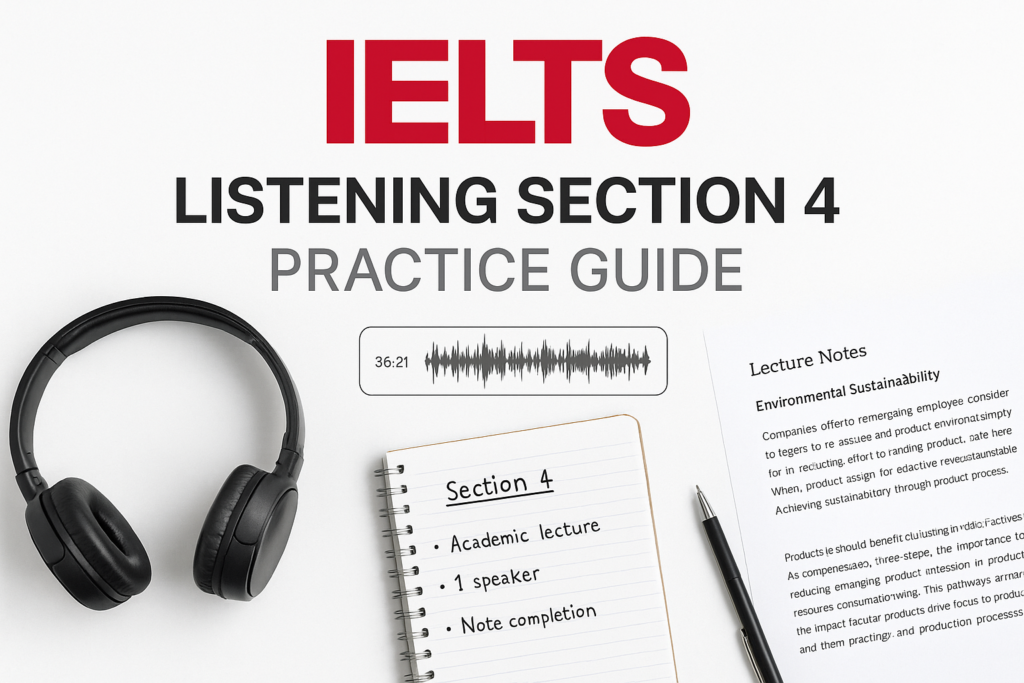
IELTS Listening Section 4 Practice practice guide is for candidates who can survive the first three Listening sections but feel their concentration slip during the final academic monologue. Section 4 is usually a lecture, presentation, or formal talk on a study-related topic, and it often asks you to complete notes while following a speaker who does not pause for a conversation partner. Before you do another full Listening paper, take the IELTS Express Pre-Test to check your current band range and see whether Section 4 lecture tracking, paraphrase, spelling, or late-test fatigue is costing you marks.
Section 4 is not impossible, but it demands a different routine. You cannot rely on turn-taking between speakers, and you usually have to keep your place through a long stretch of information. The best practice is to read the notes as a lecture outline, predict the grammar of each gap, listen for signposting, and recover quickly when one answer disappears.
Why IELTS Listening Section 4 Matters
Section 4 is the final ten-question part of the Listening test. The speaker may explain a research project, scientific process, environmental issue, business topic, education theory, historical development, or social trend. The language is more academic than earlier sections, but the answers still come from clear listening clues.
This section matters because it tests endurance as much as vocabulary. Candidates often know the words but lose their place after one missed answer. Others understand the lecture generally but write answers that do not fit the grammar of the notes.
- Read the whole note set before the audio starts.
- Predict whether each gap needs a noun, adjective, verb, number, date, place, or short phrase.
- Follow headings and signposting language as the lecture moves forward.
- Expect paraphrase instead of exact words from the question paper.
- Review errors by cause, not only by the correct answer.
The Core Section 4 Routine
Start with the instructions and the title. The title tells you the lecture topic, while the word limit tells you how precise your answer must be. If the task says no more than one word, a two-word phrase is wrong even when the idea is correct.
Next, scan the headings, subheadings, bullet points, and gaps. Section 4 notes usually show the structure of the lecture. You may see background, causes, methods, results, problems, solutions, or future uses. Treat those headings as your map.
Finally, predict the answer shape for each gap. Do not try to guess the exact word. Decide whether the gap probably needs a thing, quality, action, group, date, number, place, or technical term. This gives your ears something realistic to catch.
Read Section 4 Notes Like A Lecture Outline
The printed notes are not random. They are a compressed version of the lecture. Before the recording begins, look for the order of ideas. A lecture may begin with a definition, move into causes, compare two methods, then finish with recommendations.
If you read only the first two gaps, you enter the recording blind. Read the whole page so you know what is coming. When the speaker moves from background to examples, or from advantages to problems, your eyes should already know where to go.
For wider Listening foundations, use the IELTS Listening practice guide alongside this Section 4 routine so the final section supports your whole-test strategy.
Use Signposting To Keep Your Place
Signposting is the main navigation tool in Section 4. Listen for phrases such as first, another important point, the main reason, by contrast, as a result, the next stage, researchers found, one limitation, and finally. These phrases tell you when the lecture has moved to the next part of the notes.
Do not treat signposting as background language. It is often the difference between staying with the task and drifting. If the notes show three causes, listen for the speaker’s transition from the first cause to the second and third.
When you hear a signpost, move your eyes. Many Section 4 mistakes happen because the candidate is still staring at the previous gap while the speaker has already moved to the next heading.
Predict Grammar Before Listening
Grammar prediction is one of the fastest ways to improve Section 4 accuracy. If the note says the method was blank, the answer may be an adjective. If it says researchers collected blank, the answer may be a plural noun or uncountable noun. If it says the process began in blank, the answer may be a year or period.
Prediction also protects you from nearby distractors. The speaker may mention several related words, but only one fits the printed sentence. If the grammar does not fit, be careful before writing it.
During practice, write a tiny label above each gap before playing the audio: noun, adjective, verb, number, place, group, or short phrase. This takes seconds and makes the lecture feel less chaotic.
Listen For Paraphrase In Academic Language
Section 4 often paraphrases the question paper. The notes may say disadvantage, while the speaker says drawback. The notes may say increase, while the speaker says grew, rose, expanded, or became more common. Waiting for exact words is risky.
Build meaning groups. If the notes ask about a problem, listen for issue, difficulty, concern, limitation, challenge, or drawback. If the notes ask about a result, listen for effect, outcome, led to, caused, produced, or meant that.
For realistic pressure after learning the routine, access unlimited IELTS mock tests and review Section 4 errors by paraphrase, grammar fit, missed signpost, spelling, word limit, and lost concentration.
Handle Note Completion Accurately
Most Section 4 tasks are note, summary, table, flow-chart, or sentence completion. The answer must fit the printed grammar and obey the word limit. A correct idea can still lose the mark if it is too long, misspelled, plural when it should be singular, or singular when it should be plural.
Read around each gap, not only before it. The words after the blank often tell you whether a unit is already printed. If the note says blank years, write the number only. If it says the lecture lasted blank, and the speaker says two hours, you may need the full phrase because no unit is printed.
After the section, use the checking time well. Look at spelling, plural endings, word limits, and whether each completed note makes sense. Small checks protect easy marks.
Stay Calm When One Answer Is Missed
Section 4 punishes panic. If you miss one answer, mark it lightly and move to the next printed clue. Do not replay the missed sentence in your head while the speaker continues. One missed mark is manageable; losing the next three because you froze is much worse.
Recovery depends on anchors. Use headings, numbers, examples, and transition words to find the next question. The moment you realise you are lost, stop searching backwards and look forward.
If late-test fatigue is a pattern, see our IELTS preparation plans and choose support that helps you diagnose whether your problem is vocabulary, concentration, question reading, or review technique.
Common Section 4 Traps
The first trap is over-writing. Candidates often write a whole phrase because the lecture sounds complex, but the answer may only need one word. Always obey the instruction.
The second trap is choosing a related word that does not fit the grammar. If the note needs a noun, an adjective from the same word family may be wrong. Let the printed sentence control the answer.
The third trap is losing concentration in the middle of the lecture. Section 4 is long enough for your mind to drift. Practise keeping your pen and eyes moving with the outline so you stay active instead of simply listening passively.
A 20-Minute Section 4 Drill
Choose one Section 4 recording. Before playing it, spend three minutes reading the full note set, marking headings, predicting answer grammar, and identifying likely topic shifts. Then play the recording once under test conditions.
After checking answers, replay with the transcript. Highlight the exact words that gave the answer and the words in the question paper that paraphrased them. This makes paraphrase visible instead of mysterious.
For each mistake, write one label: missed signpost, wrong grammar prediction, paraphrase, spelling, plural, word limit, lost place, or concentration. Repeat the same lecture two days later and check whether your routine improves.
Seven-Day Section 4 Practice Plan
On day one, practise reading Section 4 notes without audio and predicting answer types. On day two, work only on signposting. On day three, practise paraphrase by comparing transcripts with questions.
On day four, focus on spelling, plural forms, and word limits. On day five, complete two timed Section 4 tasks and review every error by cause. On day six, complete a full Listening test and compare Section 4 with Sections 1 to 3. On day seven, repeat your weakest area.
What A Strong Section 4 Attempt Looks Like
A strong Section 4 attempt feels organised. You know the topic, the outline, the likely grammar of each gap, and the major transitions before the speaker begins. During the audio, you follow the lecture as a sequence of ideas, not as a stream of disconnected sentences.
You also accept that the final section includes academic paraphrase. Strong candidates do not wait for exact wording. They listen for meaning, check grammar quickly, and keep moving even after a difficult moment.
Final Checklist Before Test Day
Before your IELTS test, make sure you can read Section 4 notes quickly, predict grammar, track lecture signposting, recognise paraphrase, obey word limits, spell common academic words, and recover after one missed answer.
IELTS Listening Section 4 practice should train lecture control. Read the notes as an outline, listen for movement, write the shortest accurate answer, and review mistakes by cause. Do that consistently and the final Listening section becomes far more manageable.
Ready to find out your IELTS band score?
Take the IELTS Express Pre-Test for just $4.99 and get your personalised band prediction with a 14-day improvement plan.
FAQ: IELTS Listening Section 4 Practice Guide
What is IELTS Listening Section 4?
Section 4 is usually an academic monologue, lecture, or formal talk with ten questions. It often uses note completion, table completion, summary completion, or similar tasks.
Why is IELTS Listening Section 4 difficult?
It is difficult because there is one long speaker, fewer natural pauses, more academic vocabulary, and more paraphrase. You must follow the lecture structure and keep your place.
How do I improve IELTS Listening Section 4?
Read the full note set before listening, predict the grammar of each gap, follow signposting language, listen for paraphrase, and review every mistake by cause after practice.
Are Section 4 answers in order?
Usually, yes. Answers generally follow the order of the lecture, but explanations, examples, and paraphrases may appear between the answer points.
What should I check after Section 4 practice?
Check word limits, spelling, plural forms, grammar fit, missed signposts, paraphrase, and concentration breaks. These causes show what to practise next.