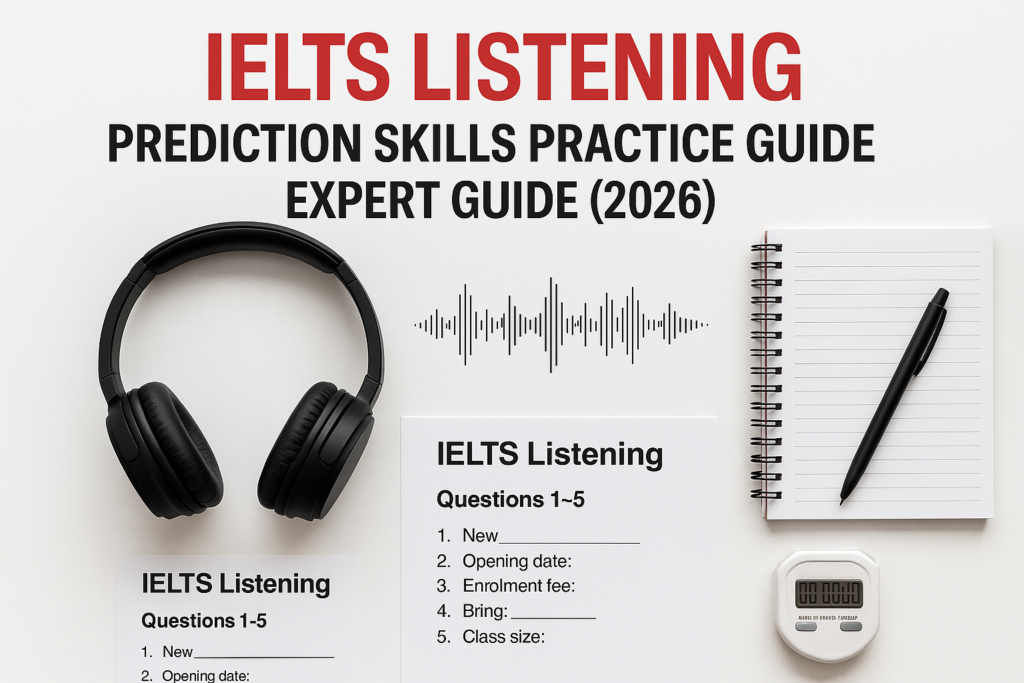
IELTS Listening Prediction Skills practice guide is for candidates who start the audio too passively. In IELTS Listening, prediction means using the question paper before the recording starts so you know what kind of information you are waiting for. It is not guessing the answer. It is preparing your ears for names, numbers, dates, opinions, reasons, locations, and short phrases before they arrive. Before you do another full Listening paper, take the IELTS Express Pre-Test to check your current band range and see whether prediction, spelling, distractors, or lost-place errors are costing you marks.
Good prediction makes the recording feel slower. You still hear the same audio, but your attention is narrower and more useful. Instead of trying to understand every word, you listen for the answer shape, the grammar around the gap, and the signpost that tells you the speaker is moving towards the next question.
What IELTS Listening Prediction Skills Actually Mean
Prediction skills are the habits you use before and during the recording to prepare for likely answer types. You read the instructions, scan the question set, identify the task type, and decide what each gap or option is asking for. That preparation helps you listen with a target.
Prediction does not mean writing answers before the audio proves them. That is risky. IELTS often uses distractors, corrections, and paraphrase. Prediction simply gives you a short list of possibilities: a noun, a number, a place, a reason, an opinion, or a final choice.
- Read the word limit first.
- Identify the topic and setting.
- Predict the grammar of each gap.
- Mark important names, dates, places, and option differences.
- Listen for confirmation before writing the final answer.
Why Prediction Improves IELTS Listening Accuracy
IELTS Listening is fast because you must read, listen, write, and move forward at the same time. Prediction reduces that load. If you already know a gap needs a price, you do not waste attention on adjectives or explanations. If a multiple choice question asks for a reason, you listen for cause language rather than every detail.
Prediction also helps with recovery. When you miss one answer, the next predicted answer type pulls you back to the task. Without that structure, many candidates keep thinking about the missed word while the recording has already moved on.
For a broader foundation, use the IELTS Listening practice guide alongside this prediction routine so your general Listening practice stays organised.
The Core IELTS Listening Prediction Skills Practice Guide Routine
Start with the instruction line. If it says no more than one word and/or a number, your prediction must respect that limit. A correct idea with too many words can still be wrong. Next, read the title, headings, and question stems. These show the topic and the order of information.
Then predict the answer type for each item. Use simple labels: name, number, date, time, place, object, adjective, reason, problem, solution, person, or opinion. Do not overthink this step. The goal is not a perfect forecast. The goal is a useful listening target.
Finally, listen for the exact moment when the audio confirms or rejects your prediction. If the speaker changes a time, corrects a spelling, rejects an option, or contrasts two ideas, follow the final meaning rather than your first guess.
Predict Answer Types Before The Audio Starts
Completion questions give you strong clues. The words before and after the blank usually show the grammar of the answer. If the line says the course is blank, the answer may be an adjective. If it says the blank was repaired, the answer is probably a noun. If the note says because of blank, you may need a noun phrase.
For forms and notes, labels are even clearer. Address, postcode, phone number, date, cost, booking reference, and appointment time all tell you exactly what kind of answer to expect. In Section 1, this kind of prediction can protect easy marks.
For maps, predict direction language and location words. You may hear next to, opposite, between, at the end of, on the left, past the entrance, or beside the cafe. The more prepared you are for that language, the easier it is to keep your place.
Use Grammar To Narrow The Possible Answer
Grammar is one of the safest prediction tools because it comes from the printed question, not from your imagination. A gap after an article such as a or an normally needs a singular countable noun. A gap after many may need a plural noun. A gap after very usually needs an adjective.
This matters because IELTS often places distracting words near the answer. You may hear a related noun, then the real adjective later. If you have predicted the grammar, you are less likely to copy the first related word you hear.
After the section, check whether your answer completes the sentence naturally. If the note sounds grammatically broken, review the audio or transcript. Many lost Listening marks are not hearing problems. They are fit problems.
Predict Paraphrase, Not Exact Words
The wording on the question paper often changes in the recording. The question may say cost, while the speaker says fee, charge, price, discount, or payment. It may say location, while the speaker says site, venue, room, entrance, or area.
Before listening, think of one or two simple paraphrases for important words. Do this quickly. If the question asks why a student chose a course, listen for because, the reason was, what attracted me, I decided on it since, or it suited my timetable.
For realistic pressure after learning this routine, access unlimited IELTS mock tests and review whether your wrong answers came from weak prediction, missed paraphrase, or distractors.
Prediction For Multiple Choice Questions
Multiple choice prediction is different from gap prediction. You cannot usually predict the exact answer, but you can predict what the question wants. Read the stem first. Is it asking for the main reason, the final decision, a problem, an advantage, a recommendation, or the speaker’s opinion?
Then compare the options. Do not read them as three separate sentences. Identify the difference between them. One option may focus on cost, one on convenience, and one on quality. During the audio, listen for evaluation language that confirms or rejects each idea.
Be patient. IELTS may mention all options. A familiar word is not enough. Wait until the speaker accepts, rejects, changes, or ranks the options.
Prediction For Section 3 Discussions
Section 3 often has two or more speakers discussing study plans, assignments, research, presentations, or feedback. Prediction here should include speaker ownership. If the question asks what Sarah thinks, do not choose Tom’s opinion just because he speaks first.
Before the audio, underline names and roles. Notice whether the question asks for agreement, disagreement, a recommendation, a problem, or a change in plan. During the discussion, listen for phrases such as I agree, I am not sure, the tutor suggested, we decided, or that would not work.
If Section 3 is one of your weaker areas, see our IELTS preparation plans and choose support that helps you diagnose whether the issue is prediction, vocabulary, speaker tracking, or answer timing.
Prediction For Section 4 Lectures
Section 4 is usually an academic monologue, so prediction is mainly about structure. Read the headings and subheadings as a lecture outline. The notes may move from background to causes, then methods, results, problems, and future uses.
Predict the answer type for every gap before the recording begins. Because the speaker does not pause for another person, you need your eyes to move with the lecture structure. Signposting phrases such as first, another factor, by contrast, the main problem, researchers found, and finally are your navigation points.
Do not try to understand every technical word. Use prediction to identify the words that complete the notes. The answer is usually a clear word or short phrase, even when the topic sounds academic.
A 20-Minute Prediction Drill
Choose one Listening section and do not play the audio immediately. Spend three minutes reading the questions and writing tiny labels beside each item: noun, number, place, reason, opinion, or final choice. For multiple choice, write one word for what each option is mainly about.
Now play the audio once under test conditions. After checking answers, replay the recording with the transcript. For every correct answer, find the clue that matched your prediction. For every wrong answer, write one cause: wrong answer type, missed paraphrase, distractor, correction, grammar fit, spelling, or lost place.
Repeat this drill three times in a week. The improvement comes from training the pre-listening routine, not from memorising one recording.
Seven-Day Prediction Practice Plan
On day one, practise predicting answer types from Section 1 forms without audio. On day two, practise names, numbers, dates, and spelling. On day three, practise paraphrase prediction in note completion. On day four, focus on multiple choice stems and option differences.
On day five, practise Section 3 speaker ownership. On day six, practise Section 4 lecture outlines and signposting. On day seven, complete a full Listening test and review every mistake by prediction cause.
Keep the review simple. If you label errors clearly, you will see patterns quickly. Some students need more grammar prediction. Others need better option comparison. Others need to wait longer before accepting an answer.
Common Prediction Mistakes To Avoid
The first mistake is guessing too strongly. If you decide the answer must be one specific word before the audio, you may ignore the real answer. Prediction should stay flexible.
The second mistake is predicting only vocabulary and forgetting grammar. A related word is not enough if it does not fit the sentence. The third mistake is stopping after the first possible answer. Corrections and contrast language can change the answer quickly.
The final mistake is skipping prediction because the topic feels familiar. Familiar topics still contain traps. A booking conversation can include changed dates, corrected spellings, and rejected options. Prediction is most useful when the task looks easy.
Final Checklist Before Test Day
Before your IELTS test, make sure you can read instructions quickly, predict answer types, use grammar around gaps, compare multiple choice options, listen for paraphrase, track speaker opinions, follow Section 4 signposting, and recover after a missed item.
IELTS Listening prediction skills are practical. They do not require advanced English. They require a calm routine before the audio starts and disciplined listening while the recording plays. Read, predict, listen for confirmation, write only what fits, and review mistakes by cause.
Ready to find out your IELTS band score?
Take the IELTS Express Pre-Test for just $4.99 and get your personalised band prediction with a 14-day improvement plan.
FAQ: IELTS Listening Prediction Skills Practice Guide
What are prediction skills in IELTS Listening?
Prediction skills are the habits you use before listening to identify likely answer types, grammar, topic clues, option differences, and signposting. They help you listen with a clear target.
Is prediction the same as guessing in IELTS Listening?
No. Guessing means choosing an answer without evidence. Prediction means preparing for the type of answer you may hear, then waiting for the recording to confirm it.
How can I predict answers in Listening completion tasks?
Read the words around each blank and decide whether the answer should be a noun, adjective, number, date, place, name, reason, or short phrase. Then check that the answer fits the sentence.
How does prediction help with multiple choice?
Prediction helps you understand what the question is asking and how the options differ. This stops you from choosing an option only because you heard a familiar keyword.
Can prediction improve my IELTS Listening band score?
Yes, especially if your mistakes come from lost place, distractors, weak paraphrase recognition, or grammar fit. Prediction makes practice more focused and easier to review.