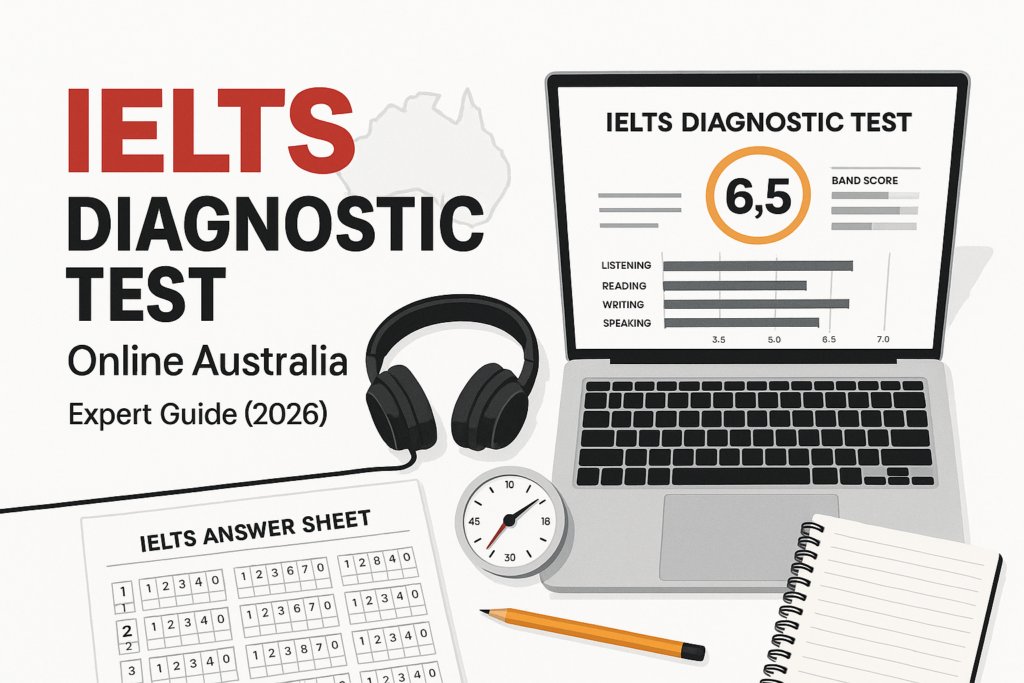
If you are searching for an IELTS diagnostic test online Australia, you probably want a clear answer before you spend more money on classes, books, or an official test booking. A diagnostic test should show your current band range, your weakest section, and the preparation priorities that matter most. For a fast starting point, take the IELTS Express Pre-Test and use the result to plan your next 14 days of study.
Many IELTS candidates in Australia study hard without first checking what is actually holding the score down. That usually leads to random practice: one day a listening video, the next day a writing sample, then a speaking tip from social media. A diagnostic test gives your preparation a map. It helps you stop guessing and start working on the score gap that is most likely to affect your result.
What Is An IELTS Diagnostic Test Online Australia?
An IELTS diagnostic test online is a short assessment designed to estimate your current IELTS level and identify your main weaknesses. It is not the same as the official IELTS exam. It is a preparation tool that helps you understand where you are before you choose a study plan, course, mock test schedule, or official test date.
In Australia, a diagnostic test is especially useful for candidates preparing for migration, university entry, professional registration, nursing, engineering, teaching, or partner visa requirements. The required score may be different for each pathway, so the diagnostic should be interpreted against your target, not against a generic idea of a good score.
- It estimates your current band range.
- It highlights weak skills across Listening, Reading, Writing, and Speaking.
- It shows whether timing is affecting your accuracy.
- It helps you choose the right preparation level.
- It reduces the risk of booking the official test too early.
Why You Should Start With Diagnosis Before More Practice
More practice is not always better practice. If you keep repeating full IELTS tests without reviewing the pattern of errors, you may simply become faster at making the same mistakes. A diagnostic test interrupts that cycle. It gives you a baseline and makes your study decisions more precise.
For example, one candidate may be stuck because Writing Task 2 lacks clear paragraph development. Another may lose Reading marks because of True, False, Not Given questions. A third may understand Listening recordings but lose marks through spelling, plurals, and answer transfer. These candidates need different study plans.
If you want to compare your diagnostic result with timed exam-style practice, access unlimited IELTS mock tests and check whether your score holds under full test pressure.
What A Good IELTS Diagnostic Test Should Measure
A useful diagnostic test should measure more than whether you know English. IELTS is a test of English under exam conditions. That means the diagnostic should look at language level, task knowledge, timing, accuracy, and response quality.
For Listening and Reading, it should show whether wrong answers come from vocabulary, paraphrase, distractors, spelling, grammar, question type, or time management. For Writing, it should look at task response, coherence, vocabulary, grammar, and whether the answer matches the task. For Speaking, it should consider fluency, pronunciation, vocabulary range, grammar control, and answer development.
A weak diagnostic only gives you a number. A better diagnostic gives you a number and tells you what to do next. The action plan is where the value is.
How Accurate Is An Online IELTS Diagnostic Test?
An online IELTS diagnostic test can be useful, but you should understand its limits. It can estimate your level and identify likely weaknesses. It cannot guarantee your official IELTS band because the official result depends on full test conditions, examiner marking, test version, nerves, and how consistently you perform on the day.
The accuracy depends on the quality of the questions and the feedback. Multiple-choice Listening and Reading diagnostics can be scored quickly, but Writing and Speaking need more careful review. If a diagnostic claims to give a precise Writing or Speaking band without enough evidence, treat it cautiously.
Use the result as a planning tool, not a promise. If your diagnostic suggests Band 6.0 and your target is Band 7.0, you should assume there is serious work to do. If it suggests you are already near target, confirm that with a full timed mock test before booking the official exam.
Online Diagnostic Test Versus Full IELTS Mock Test
A diagnostic test and a mock test are related, but they are not the same. A diagnostic test is usually shorter and focused on finding your current level and weaknesses. A mock test is closer to the official exam and is useful for checking stamina, timing, and score readiness.
Early in preparation, a diagnostic test is often better because it stops you wasting time. Later in preparation, mock tests become more important because you need to prove that your skills work under pressure. The best plan uses both at the right time.
Think of the diagnostic as the first scan and the mock test as the rehearsal. The diagnostic tells you what to fix. The mock test tells you whether the fix is working.
Who Needs An IELTS Diagnostic Test In Australia?
Almost any serious IELTS candidate can benefit from diagnosis, but it is most important when the score matters for a deadline. Migration applicants, university applicants, nurses, engineers, teachers, and candidates with section minimums should not rely on guesswork.
If you have already taken IELTS and missed your target, a diagnostic can help explain why. Your official score tells you the outcome, but it may not explain the cause. A diagnostic review can show whether the issue is task knowledge, grammar, timing, vocabulary, fluency, or exam strategy.
If you are preparing from outside Australia for an Australian pathway, the same principle applies. Your study plan should begin with your current level and your required score, not with a random course length.
How To Read Your Diagnostic Result
Start by comparing the diagnostic band range with your target. Do not ask whether the score is good in general. Ask whether it is enough for your purpose. A Band 6.5 may be strong for one goal and too low for another.
Next, check the section gap. If Listening and Reading are close to target but Writing is one band lower, your study plan should be built around Writing. If all four skills are below target, you may need broader language development before intensive test strategy.
Finally, look for the highest-risk section. For many candidates, the section minimum matters more than the overall band. A strong overall score may still be useless if one required section is too low.
Common Diagnostic Patterns
One common pattern is strong Reading and Listening but weaker Writing. This often happens because candidates understand English well but struggle to produce organised, accurate written responses under time pressure. The solution is not more passive reading; it is targeted writing feedback.
Another pattern is confident Speaking with limited development. The candidate can communicate socially, but IELTS answers are too short, repetitive, or underdeveloped. In this case, the diagnostic should lead to answer extension, Part 2 practice, and Part 3 reasoning work.
A third pattern is uneven Listening performance. The candidate understands the recording but loses marks on spelling, plural forms, distractors, and missed transitions. That calls for detailed error review, not just more listening exposure.
Building A 14-Day Plan From Your Diagnostic
Use the first two days to complete the diagnostic and review the result. Write down your target score, your current estimated band, and the gap for each section. Be honest about which skill controls your timeline.
Use Days 3 to 7 for the weakest section. If Writing is the blocker, work on planning, paragraphing, task response, grammar correction, and feedback. If Reading is the blocker, drill question types and paraphrase. If Speaking is the blocker, record answers and review fluency, development, and pronunciation.
Use Days 8 to 11 for mixed practice. Combine your weakest skill with one stronger skill so your preparation stays balanced. Use Days 12 to 14 for a timed mock test, review, and booking decision. If the mock score is still below your target, delay the official test if your deadline allows.
Choosing Between Self Study And Support
Your diagnostic result should help you decide whether self study is enough. If the gap is small and the problem is clear, a focused self-study plan may work. If the gap is large, the deadline is close, or Writing and Speaking are weak, feedback becomes much more important.
Self study is useful for vocabulary, question type familiarity, Reading timing, Listening spelling, and regular practice. Support is useful when you cannot see why your Writing or Speaking score is not improving. Those sections often need someone to identify the pattern you are missing.
If you want structured help after your diagnostic, compare IELTS preparation plans and choose the option that matches your deadline, target band, and weakest section.
Diagnostic Test Mistakes To Avoid
The first mistake is treating the diagnostic as the official result. It is a guide, not a certificate. Use it to make decisions, but confirm readiness with a full mock test before booking the official exam.
The second mistake is ignoring the weakest section because it feels uncomfortable. Many candidates keep practising the sections they enjoy. That feels productive, but it does not solve the score problem.
The third mistake is taking too many diagnostics and doing too little repair work. Diagnosis is useful only if it leads to action. Once you know the pattern, spend most of your time fixing it.
How Diagnostic Testing Helps Migration And Study Pathways
For migration and study pathways, IELTS is often tied to dates, documents, and application planning. A diagnostic test helps you decide whether your timeline is realistic. It can also show whether you need a higher target for points, professional registration, or university admission.
If you are preparing for migration, read the IELTS General Training migration guide to understand how English testing fits into a broader application plan. If you are preparing for study, check whether IELTS Academic is required and whether each section has a minimum score.
The practical benefit is confidence. You know whether to book, delay, change strategy, or get help. That is much better than finding out after an official test that one section was not ready.
Final Checklist Before You Book IELTS
Before booking the official test, make sure your diagnostic result is close to your target, your weakest section has improved, and you have completed at least one full timed mock test. Also check that you are preparing for the correct IELTS module: Academic or General Training.
Review your section minimums carefully. If your target requires Band 7 in every section, a high overall score is not enough. Your plan should protect the lowest section first.
A good IELTS diagnostic test online in Australia should give you clarity, not just motivation. Use the result to make a realistic plan, practise the right skills, and book the official test only when the evidence says you are ready.
Ready to find out your IELTS band score?
Take the IELTS Express Pre-Test for just $4.99 and get your personalised band prediction with a 14-day improvement plan.
FAQ: IELTS Diagnostic Test Online Australia
What is an IELTS diagnostic test?
An IELTS diagnostic test is a short assessment that estimates your current IELTS level and identifies the skills or question types most likely to limit your score.
Is an online IELTS diagnostic test the same as the official IELTS exam?
No. It is a preparation tool, not an official result. Use it to plan study, then confirm readiness with full mock tests and the official IELTS booking process.
Should I take a diagnostic test before booking IELTS?
Yes, especially if you need a specific score for migration, study, or professional registration. It can reduce the risk of booking before your weakest section is ready.
Can a diagnostic test predict my exact IELTS band?
It can estimate your likely range, but it cannot guarantee the official band. Writing, Speaking, nerves, timing, and test-day performance can all affect the final result.
What should I do after an IELTS diagnostic test?
Compare the result with your target, identify the weakest section, build a focused study plan, and then use mock tests to check whether your score is improving.