
An IELTS crash course online can give your preparation structure when the test date is close. It cannot turn a large language gap into a guaranteed score in a few days. The useful question is not how many lessons you can finish, but which practice decisions will make your remaining time count. A focused plan combines a realistic starting point, short training blocks, feedback and timed checks.
Start by writing down your required overall score, any minimum skill scores and the hours you can genuinely protect each day. Then use this guide to plan intensive practice without filling every spare minute with another mock test. You can explore the broader preparation options at Career Wise English, but choose your next activity from evidence about your own performance.
Decide whether intensive preparation fits your starting point
A short course is most useful when you already understand English reasonably well but lose marks through unfamiliar tasks, weak organisation or inconsistent timing. If you regularly misunderstand the main ideas in practice materials, you may need a longer period of language development alongside exam preparation. Recognising that early is more helpful than buying the busiest timetable available.
Take a representative practice task in each skill before building your schedule. Use the version you intend to sit: Academic and General Training share some features, but Reading and Writing tasks differ. Work without dictionaries, answer hints or extra time for this baseline. Record what happened, including unfinished questions, uncertainty and any technical difficulty. A result without notes tells you less about what to change.
Separate language problems from performance problems. Not knowing a word is different from knowing it but misspelling it. Having no clear argument is different from having one but failing to explain it. Your plan should target the actual cause. If several weaknesses appear together, choose the two most frequent or most damaging ones first rather than attempting a complete rebuild in a week.
Choose an online crash course by practice quality
Compare what you will actually do each day, not just the number of videos in the library. A useful intensive course should make it easy to find relevant tasks, check answers and understand why an approach works. Look for clear explanations, realistic practice conditions and a manageable route through the material. A long catalogue is valuable only if you can select from it efficiently.
Writing and Speaking need particular attention. An answer key cannot fully explain why an essay is underdeveloped or why a spoken response is difficult to follow. Check whether feedback is included, who provides it, how quickly it arrives and whether there are limits. Do not assume a course includes individual marking, live lessons or unlimited support unless those features are explicitly described.
Before committing, compare the current IELTS course packages with your available time and preferred study style. Confirm access duration, payment terms and the resources included. Avoid choosing purely on a promised band increase. Your starting level, the quality of your practice and the time available all affect what is realistic.
For additional practice options, review the unlimited IELTS mock tests page and confirm the current access terms. For test-style practice, review the IELTS mock tests offering and check that the tasks suit your test version. Treat practice results as guidance rather than an official score prediction. The best purchase is the resource you can use, review and revisit before your exam, not the one with the largest headline quantity.
Build a repeatable daily practice cycle
Use a simple cycle: attempt, analyse, train and retry. Begin with a task that exposes a specific weakness. Check the result carefully, identify the reason for errors, then practise a smaller component before trying a fresh task. This keeps review connected to an observable change. Watching explanations for an hour without attempting anything can feel productive while leaving performance unchanged.
For a two-hour study day, try a short planning block, a focused timed task, a substantial review block and a brief retry. For example, spend ten minutes selecting a target, thirty minutes attempting suitable practice, forty minutes reviewing, thirty minutes on a targeted exercise and ten minutes recording your next step. Adjust the timings to the task rather than treating this example as a compulsory formula.
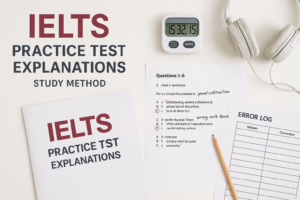
Protect review time when the schedule becomes crowded. If you only have forty-five minutes, one carefully reviewed task is usually more informative than several hurried attempts. Keep an error log with four columns: task, error, cause and next action. Write a concrete action such as “check singular and plural endings before moving on” instead of “be more careful”.
Finish each session by deciding what evidence would show improvement tomorrow. That might be fewer unsupported answers, a completed essay plan within your chosen practice limit or a clearer spoken explanation. Use fresh material for the check where possible. Remembering yesterday’s answer is not the same as being able to apply the skill independently.
Use a seven-day intensive practice plan
On day one, establish your baseline and organise materials. On day two, prioritise the weakest recurring issue in Listening or Reading. On day three, focus on Writing, with time reserved for planning, drafting and reviewing. On day four, work on Speaking and return to one receptive-skill weakness. This rotation gives every skill attention while leaving room for your individual priorities.
On day five, combine tasks under more realistic conditions and check whether your earlier changes survive time pressure. On day six, complete a suitable longer simulation if you have the energy and enough time to analyse it. On day seven, review your error log, complete a small amount of familiar practice and organise practical details. Avoid turning the final evening into a frantic search for new strategies.
If your exam is not seven days away, keep the sequence but spread or repeat the middle days. A learner with three hours per day should not copy the workload of someone studying full time. The one-week preparation plan with practice tests offers a related framework; adapt either plan to your own baseline rather than trying to complete both as separate checklists.
Leave a buffer for work, family commitments and feedback delays. A timetable that requires perfect concentration every evening is fragile. Choose a minimum session you can still complete on a difficult day: one short task, one meaningful review and one recorded next step. Consistency matters more than maintaining an impressive-looking study calendar.
Make each skill block specific enough to improve
In Listening, review the point where you lost track, not only the final answer. Was it an unfamiliar expression, a correction by the speaker, a distractor or difficulty moving between questions? After checking the answer, listen again to the relevant section and explain what evidence supports it. Keep answer limits and spelling in view when they affect the task.
In Reading, require yourself to locate supporting evidence. Underline or note the relevant passage section and explain the link between the question and the text. If timing is the issue, practise deciding when to move on instead of spending the entire session on one difficult question. Do not confuse faster guessing with improved reading.
In Writing, work on one clear target per attempt: answering every part of the prompt, developing a main idea, organising paragraphs or improving sentence accuracy. Review your work against the relevant assessment criteria and use qualified feedback where available. Memorised essays and decorative vocabulary do not replace a relevant, well-developed response.
In Speaking, record a response and listen for whether your ideas are understandable and developed. Notice repeated hesitation, unclear references and places where an example would help. Re-answer the question using a simple outline rather than memorising the recording. Practise explaining ordinary experiences clearly; you do not need an impressive personal story for every topic.
If you are preparing on a computer, include navigation and typing in your practice. The recent computer Listening interface tips can help you identify practical habits to rehearse. Use the interface guidance supplied for your booked test, and do not let technical familiarity replace work on comprehension.
Check progress without exhausting your practice materials
Use short checkpoints between full practice tests. Compare similar tasks and conditions, and look for patterns across several attempts rather than celebrating or worrying about one result. Record accuracy, completion, error types and confidence separately. You may become more consistent before a score estimate changes, and that consistency is useful evidence.
For Writing and Speaking, progress can mean clearer organisation, fewer recurring errors or more complete answers. It does not automatically mean a particular official band. If your required score remains well beyond what you can demonstrate, reconsider the preparation period where your circumstances allow. More mock tests alone will not solve every language gap.
Keep sleep and breaks in the plan. Intensive preparation should increase the focus of your practice, not remove recovery time. Stop a session when you are merely clicking through answers and no longer reviewing meaningfully. Before the test, check your booking instructions, identification requirements and travel arrangements through your test provider rather than relying on a study-course checklist.
Frequently asked questions about online IELTS crash courses
Can an online IELTS crash course guarantee my target band?
No course can establish your individual result in advance. A short programme may improve familiarity, organisation and practice habits, but progress depends on your starting skills and how effectively you use feedback. Set practical learning targets alongside the score you need.
How many hours should I study each day?
Choose an amount you can sustain while staying attentive. Two focused hours with careful review can be more useful than a much longer distracted session. Increase the workload only when you can still explain your errors and complete the next day’s practice effectively.
Should I take a full mock test every day?
Not necessarily. Full tests are useful checkpoints, but they require substantial review and can leave little time to fix weaknesses. Mix timed sections, targeted exercises and occasional longer simulations. Let the error log determine your next task.
What should I do on the last day before IELTS?
Review familiar strategies and recurring mistakes, complete a small amount of comfortable practice and check practical arrangements. Avoid changing your whole approach or staying up late to finish a course. The aim is to arrive ready to use what you have practised.